


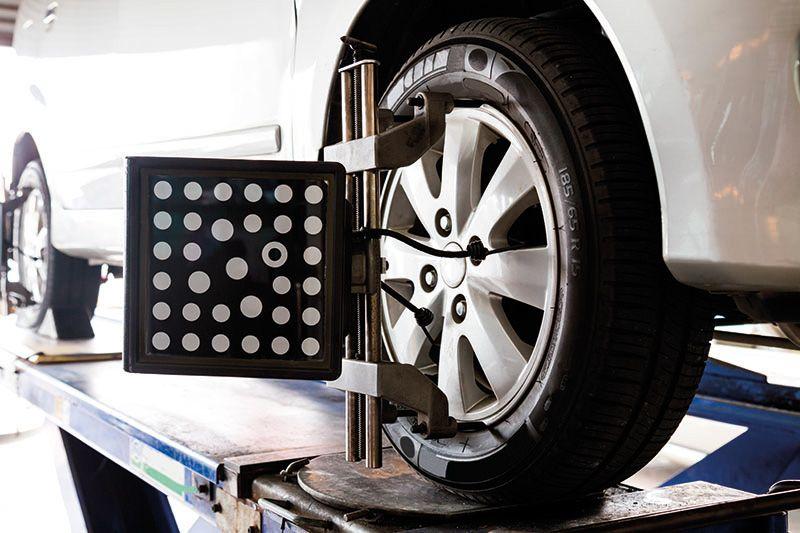
Driving through the bustling streets of Thane, from the scenic views near Gaimukh to the commercial hubs of Kasarvadavli, requires a vehicle that is not just powerful, but precise. While many drivers focus on engine oil or brake pads, there is a silent hero beneath your chassis that dictates the comfort and safety of every kilometer: Wheel Balancing.
If you’ve ever felt a rhythmic shudder in your steering wheel while cruising down Ghodbunder Road, you’ve experienced the physical manifestation of physics gone wrong. For those seeking expert maintenance, finding a reliable center for wheel balancing in Kasarvadavli is the first step toward restoring your car’s harmony.
What is Wheel Balancing?
At its core, wheel balancing is the process of ensuring that the weight of the tire and wheel assembly is distributed perfectly around the axle. It might seem like a simple concept, but in the world of high-speed rotation, even a minute weight discrepancy—as small as 5 to 10 grams—can create significant centrifugal force.
When a tire is manufactured, it is impossible to make it 100% perfectly symmetrical in terms of weight. There will always be a "heavy spot" where the rubber is slightly thicker or where the valve stem adds a fraction of an ounce. Wheel balancing uses specialized computer machinery to identify these spots and counteract them by adding small zinc or lead weights to the rim.
Static vs. Dynamic Balancing
Professional shops in Kasarvadavli typically use two methods:
-
Static Balancing: This addresses balance on a single plane (up and down). It’s the more traditional method where a wheel is placed on a vertical spindle. If one side is heavier, it will tip.
-
Dynamic Balancing: This is the modern standard. It measures the wheel on three planes (lateral, radial, and axial) while it spins at high speeds. It detects "wobble" or side-to-side movement that static balancing might miss.
The Telltale Signs: When Your Car is Crying for Help
How do you know if your wheels are out of balance? Your car is remarkably communicative if you know what to listen for.
-
The "Magic Speed" Vibration: The most classic symptom is a vibration that starts at a specific speed—usually between 60 km/h and 90 km/h. If the steering wheel shakes in your hands but smooths out when you slow down or speed up, your front wheels are likely imbalanced.
-
The "Seat Shudder": If you feel the vibration in your seat or the floorboards rather than the steering wheel, the issue usually lies with the rear wheels.
-
Uneven Tire Wear: Look at your tire treads. Do you see "cupping" or "scalloping"—dips in the rubber that look like they were carved out with a spoon? This is a sign that the tire is "bouncing" on the road rather than rolling smoothly.
-
Strange Noises: A humming or thumping sound that increases in frequency with your speed often points to a weight distribution issue.
Why Balancing Matters: Beyond Just Comfort
Many drivers ignore a slight vibration, thinking it’s just a quirk of the car. However, neglecting wheel balancing is a recipe for expensive repairs down the line.
1. Protecting Your Suspension
Your car’s suspension system—shocks, struts, and ball joints—is designed to absorb the bumps of the road. It is not designed to handle the constant, high-frequency "hammering" effect of an imbalanced wheel. Over time, this vibration can rattle your suspension components loose, leading to a repair bill that far exceeds the cost of a simple balance.
2. Fuel Efficiency
An imbalanced wheel creates more rolling resistance. Think of it like trying to roll a slightly egg-shaped ball; it takes more energy to keep it moving than a perfectly round one. By ensuring your wheels spin true, you reduce the strain on your engine and save money at the petrol pump.
3. Tire Longevity
Tires are expensive. An imbalanced wheel causes localized heat buildup and uneven friction. This can shorten the life of a tire by thousands of kilometers. Regular balancing ensures that the entire tread surface shares the load equally.
The Professional Process at Diwan Auto Care
If you are looking for wheel balancing in Kasarvadavli, CEAT Shoppe, Diwan Auto CareClick to open side panel for more information offers a high-tech approach. Here is what you can expect during a professional session:
-
Mounting: The wheel and tire are removed from the car and placed on a sophisticated balancing machine spindle.
-
The Spin Test: The machine spins the assembly at high speeds to simulate road conditions. Sensors measure the vibration and pinpoint exactly where the weight distribution is off.
-
Weight Application: The computer tells the technician exactly how many grams of weight are needed and the precise location (inner or outer rim).
-
Verification: The wheel is spun again to ensure the reading is "zeroed out," signifying perfect balance.
Wheel Balancing vs. Wheel Alignment: Know the Difference
It is common for drivers to confuse these two services, but they are distinct:
-
Balancing is about weight distribution within the wheel.
-
Alignment is about the angle at which the wheels meet the road (Camber, Caster, and Toe). If your car pulls to the left or right, you need an alignment. If it vibrates, you need balancing.
Ideally, both should be checked during your routine service or every 5,000 to 10,000 kilometers.
Conclusion: A Small Step for a Safer Journey
Maintaining your vehicle in a high-traffic area like Kasarvadavli is about more than just aesthetics; it's about precision and safety. Proper wheel balancing ensures that your tires last longer, your fuel goes further, and your driving experience remains as smooth as the day you bought your car.

 Arabic
 French
 Spanish
 Portuguese
 Deutsch
 Turkish
 Dutch
Dutch
 Italiano
 Russian
 Romaian
 Portuguese (Brazil)
 Greek
Greek