


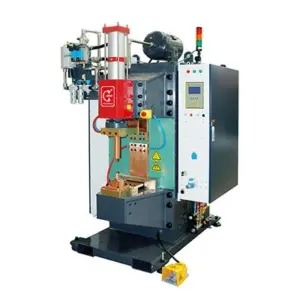
In today’s competitive manufacturing landscape, efficiency, precision, and reliability are non-negotiable. One technology that continues to drive high-quality metal joining across industries is the spot resistance welder. From automotive production lines to appliance manufacturing, these machines are essential for joining sheet metal quickly, accurately, and with minimal material distortion.
At Heron Welder , we specialize in advanced resistance welding systems, providing robust spot welding solutions tailored for modern industrial requirements. In this guide, we explore the principles, applications, advantages, and best practices of spot resistance welding, helping engineers and factory managers make informed equipment decisions.
What is a Spot Resistance Welder?
A spot resistance welder is a machine that joins two or more metal sheets by applying pressure and passing an electric current through the contact point. The high current generates heat due to the metal’s electrical resistance, melting the metal locally and forming a strong weld nugget upon cooling.
Unlike other welding methods, spot resistance welding does not require filler material, shielding gas, or extensive post-processing. This makes it highly suitable for high-volume production environments where speed and consistency are critical.
Key Components of a Spot Resistance Welder:
-
Electrodes: Copper tips that conduct electricity and apply pressure to the workpiece.
-
Transformer/Power Supply: Provides high-current, low-voltage output for welding.
-
Control System: Regulates current, time, and force for precise welds.
-
Cooling System: Maintains electrode temperature to prevent overheating and deformation.
Heron Welder offers a broad range of MFDC, capacitor discharge, and automated spot resistance welders designed to meet varying production demands, from compact machines for light assembly to heavy-duty industrial lines.
How Spot Resistance Welding Works
Spot resistance welding relies on the controlled combination of heat, pressure, and time:
-
Preparation: Metal sheets are positioned between electrodes. Surface cleanliness is crucial to minimize contact resistance fluctuations.
-
Current Application: A high-amperage current flows through the electrodes, generating heat at the contact points due to the metal’s electrical resistance.
-
Weld Formation: The heat melts the metal locally, forming a small, solid weld nugget when the current is stopped and pressure maintained.
-
Cooling: The metal solidifies under electrode pressure, ensuring a strong, uniform bond.
Modern Heron spot welders integrate precise digital controls, enabling repeatable welds with minimal operator intervention. Automated monitoring and feedback systems ensure consistent quality across thousands of cycles.
Applications of Spot Resistance Welders
Spot resistance welding is widely used across industries where metal joining is a high-volume, high-precision requirement:
-
Automotive Manufacturing: Joining car body panels, chassis components, and brackets.
-
Appliance Production: Fabricating refrigerators, washing machines, and ovens.
-
Electronics & Electrical: Battery tabs, electrical enclosures, and metallic housings.
-
Aerospace & Transportation: Sheet metal assemblies where strong, localized welds are required.
-
Industrial Fabrication: Structural components, metal furniture, and HVAC ducts.
By choosing a Heron spot resistance welder, manufacturers can streamline production, improve joint strength, and reduce labor costs, while maintaining compliance with industrial welding standards.
Advantages of Spot Resistance Welding
-
High Production Speed: Weld cycles often last just a fraction of a second, ideal for automated assembly lines.
-
Material Efficiency: No filler metal or flux is needed, minimizing costs and reducing waste.
-
Consistency: Digital controls ensure uniform weld quality across large production volumes.
-
Minimal Distortion: Localized heat reduces warping and maintains component integrity.
-
Automation Compatibility: Spot welders integrate seamlessly into robotic cells and production lines for scalable manufacturing.
Choosing the Right Spot Resistance Welder
Selecting a spot resistance welder depends on production volume, material thickness, and automation requirements:
-
Manual Spot Welders: Suitable for prototyping, small workshops, or repair applications.
-
Pneumatic/Servo Spot Welders: Offer precise control over electrode force and welding time for medium to high-volume production.
-
Automated Robotic Systems: Ideal for automotive OEMs and high-volume industrial manufacturers, providing programmable welding sequences and in-line quality monitoring.
Heron Welder offers customizable solutions for all these categories, ensuring OEMs and factory integrators achieve optimal productivity and quality.
Best Practices for Spot Resistance Welding
-
Maintain Electrode Condition: Regular cleaning and dressing prevent inconsistent welds.
-
Control Welding Parameters: Optimize current, time, and force based on material type and thickness.
-
Ensure Proper Sheet Alignment: Misaligned sheets can reduce weld quality or cause electrode damage.
-
Implement Cooling Systems: Proper electrode cooling enhances weld repeatability and prolongs electrode life.
-
Monitor Weld Quality: Use destructive and non-destructive testing methods to verify weld integrity.
By following these best practices, manufacturers can maximize uptime, reduce scrap, and achieve high-quality metal joining consistently.
Spot Resistance Welding vs. Other Welding Methods
| Feature | Spot Resistance Welding | MIG Welding | TIG Welding |
|---|---|---|---|
| Speed | Very High | Medium | Low |
| Automation Suitability | Excellent | Moderate | Low |
| Material Distortion | Minimal | Moderate | Minimal |
| Filler Material Required | No | Yes | Yes |
| Skill Requirement | Low to Moderate | Moderate | High |
Spot welding stands out in high-volume, repetitive processes, particularly where thin sheet metals need precise and consistent joining.
FAQs about Spot Resistance Welders
Q1: Can spot welders join different metals?
A1: Yes, but joint quality depends on material conductivity and thickness. Heron welders can be customized for aluminum, steel, and coated metals.
Q2: How thick can the metal sheets be?
A2: Most industrial spot welders handle 0.5–6 mm for mild steel; heavy-duty machines can weld thicker sheets.
Q3: Are spot welders compatible with robotic automation?
A3: Absolutely. Heron offers robotic integration with precise digital controls for high-volume production lines.
Q4: How often should electrodes be maintained?
A4: Electrode condition should be checked daily in high-volume production; regular dressing improves weld consistency.
Q5: What industries benefit most from spot resistance welding?
A5: Automotive, appliance, electronics, aerospace, and industrial sheet metal fabrication are the primary users.
Why Choose Heron for Spot Resistance Welding
As a global leader in industrial welding technology, Heron Welder provides:
-
Advanced MFDC and capacitor discharge spot welders.
-
Fully automated welding lines for high-volume manufacturing.
-
Technical support for installation, integration, and process optimization.
-
Customized solutions for unique production requirements.
Request a Quote or Consultation
Investing in the right spot resistance welder can significantly boost your production efficiency and product quality. Contact Heron Welder today to discuss your manufacturing needs and explore customized welding solutions designed to meet your exact requirements. Our team of experts is ready to provide a quote and guide you through the optimal setup for your facility.

 Arabic
 French
 Spanish
 Portuguese
 Deutsch
 Turkish
 Dutch
Dutch
 Italiano
 Russian
 Romaian
 Portuguese (Brazil)
 Greek
Greek