


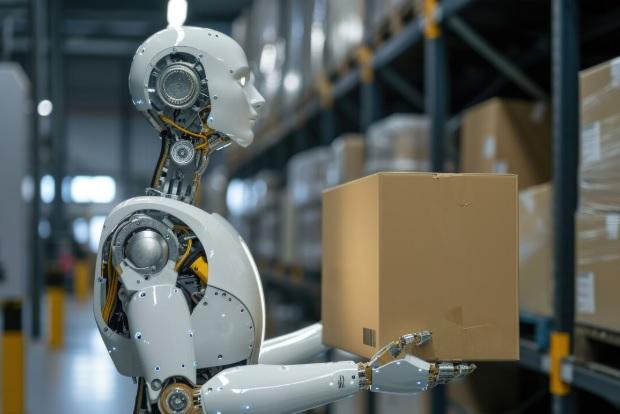
Over the years, the warehouse workers relied on physical effort to maximise product flow. They would walk through rows of shelves, look for products, and move boxes around for every working hour. However, these movements started becoming slow, and delays started to occur as the number of orders received continued to grow.
When companies shift from manual warehousing to robotic warehousing, the transformation is felt almost instantly. Robots are deployed to oversee those tasks in the warehouse that require travelling, thereby helping the team focus more on the overseeing part, the checking, and the decision-making. Daily activities are more manageable, and there is a better view of things happening on the warehouse floor.
Increased Speed and Efficiency with Robotic Warehousing
One of the most evident shifts comes from a quicker pace of operations created by robotic warehousing. Robots transport products around the facility, bring inventory to workstations, and keep orders moving through each step. Tasks that used to require long walks now occur in short, continuous cycles.
With the machines doing routine movements, congestion just fades away, and work can flow with fewer stops. Supervisors can also plan labour more precisely, while teams waste less time waiting for products to arrive. Even at peak times, the floor feels much calmer, and higher volumes can be handled without sudden staffing surges.
Improved Accuracy and Fewer Errors
Once automation is in place, accuracy can dramatically improve. In entirely manual settings, wrong picks and misplaced stock are difficult to avoid. Robotic warehousing relies on guided motion, along with real-time data, to ensure that items are in their correct place and orders are on track.
Inventory levels are updated instantly, increasing the confidence within the teams about what is available and where they are. Problems arise early, not after the shipments have left the dock. Over time, returns diminish, rework disappears, and customer loyalty improves due to timely delivery.
Safer and More Organised Work Environment
Robotic warehousing also impacts the perceived day-to-day floor safety. Robots take on heavy lifting and long transport routes, which reduces the physical stress on employees. Fewer manual moves reduce injury and long-term fatigue risks.
Layouts are modified to accommodate automated traffic. Well-marked lanes, designated storage zones, and clean staging areas become the norm. Workers move around the site more comfortably with less hurrying and fewer lifts, and daily work remains stable and predictable.
Features That Transform Warehouse Operations
Automation introduces several technologies that reshape workflows within robotic warehousing, including:
-
Real-time tracking: Robotics provide constant visibility of inventory along with order progress so that the managers can stay informed at all times.
-
Sensor-guided navigation: Automation enables safe movement by detecting obstacles and preventing collisions.
-
Automated material flow: Systems like conveyors and sorters move items efficiently between stations.
Together, these tools support smooth flow, better visibility, and fewer surprises during everyday operations.
Role of Autonomous Mobile Robots in Robotic Warehousing
Autonomous mobile robots take up significant responsibilities in modern-day warehouse environments. They manage the movement of cartons, totes, and pallets between storage locations and workstations. Additionally, the robots change course whenever congestion accumulates and converge to busy areas whenever demand increases.
By eliminating long walking routes from work operations, AMRs allow teams to stay fresh throughout entire shifts. This is achieved as employees are given more time to monitor and respond to operations, as opposed to moving products manually.
Addverb’s Role in Advancing Robotic Warehousing Operations
Addverb supports companies moving into robotic warehousing with everything from picking and sorting to storage and movement automation solutions. Its autonomous mobile robots and connected platforms help improve the speed, consistency, and daily reliability of operations. Addverb builds technology that works beside people, reducing physical strain while keeping output steady.
The company is also focused on careful planning, installation, and long-term system improvement. Its solutions fit into existing warehouses and grow along with order volumes. This helps warehouses to modernise in steps, not by disruptive leaps.
Conclusion
Adopting robotic warehousing fundamentally changes work patterns on the warehouse floor. It enables faster order fulfilment, fewer mistakes, and improved safety, as well as providing more insights. People move away from physically taxing activities like lifting and walking, and move closer to activities requiring thought and observational skill.
The automation solutions provided by Addverb help in achieving these goals in varied sectors. Companies that have opted to work with them experience smoother processes, reduced disruptions, and a well-structured and clean environment. Robotic warehousing is not just about more machines and technology, but rather it is about building a reliable system that can scale up according to needs.

 English
 Arabic
 French
 Spanish
 Portuguese
 Deutsch
 Turkish
 Italiano
 Russian
 Romaian
 Portuguese (Brazil)
 Greek
Greek