


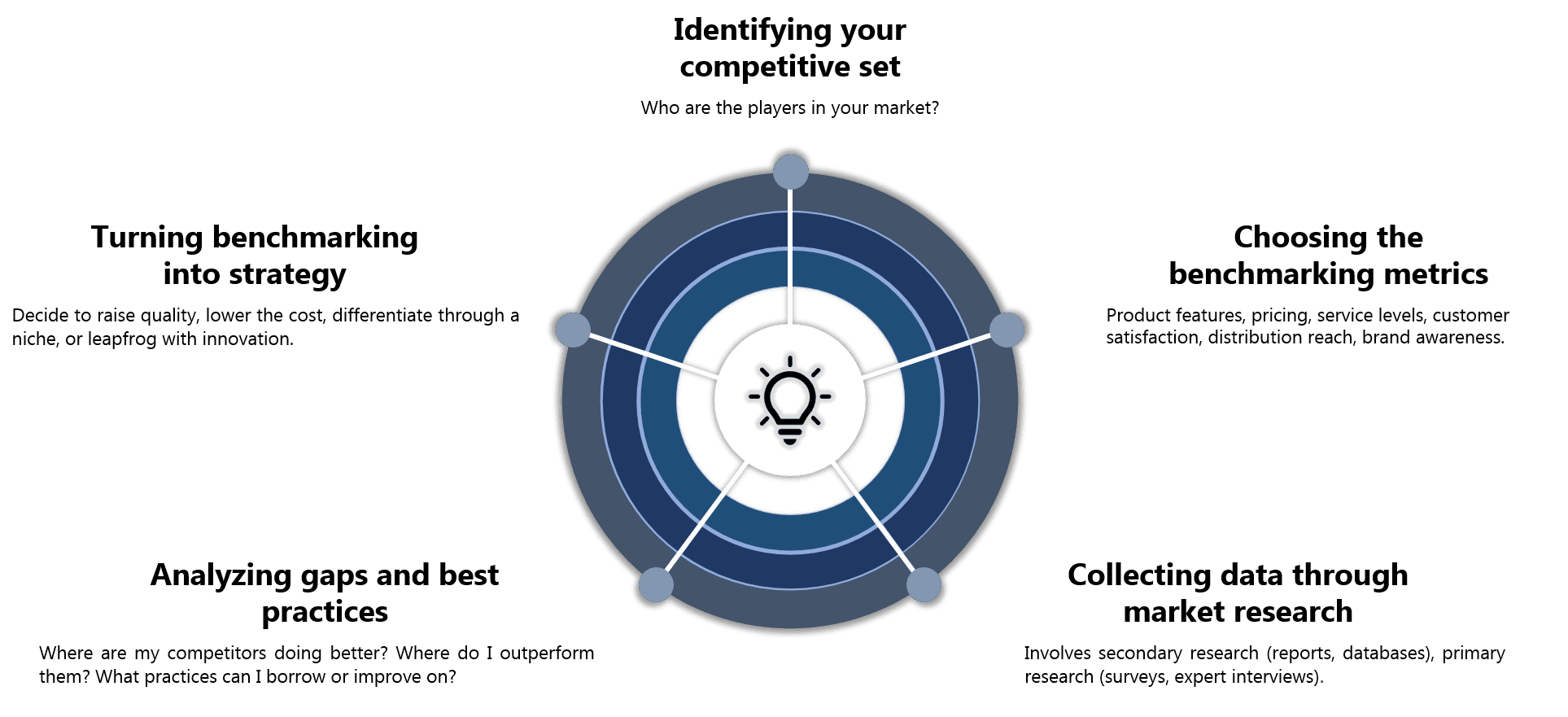
In today’s fast-evolving business environment, every organization operates on the edge of opportunity and competition. New markets are emerging, customer preferences are shifting, and innovation cycles are shortening. At the same time, competitors are strengthening their capabilities, refining their offerings, and targeting the very same audience. In such a landscape, relying on instinct is no longer enough. Businesses need clarity, direction, and evidence-based insights. This is where Competitive benchmarking & SWOT competitor analysis become essential pillars of strategic market research.
Market research is more than collecting numbers or tracking trends. It is about transforming data into actionable intelligence. It answers fundamental business questions: Where do we stand in the market? How are competitors positioning themselves? What gaps exist that we can leverage? By systematically analyzing competitors and industry performance, organizations can shift from reactive decision-making to proactive strategy development.
Understanding Competitive Benchmarking
Competitive benchmarking is the structured process of evaluating your organization’s performance against key competitors and industry standards. It goes beyond surface-level comparisons. Instead, it focuses on identifying performance gaps, operational efficiencies, innovation capabilities, and customer engagement strategies.
A well-executed competitive benchmarking analysis provides clarity on several critical aspects:
-
Performance Metrics: How does your revenue growth, pricing strategy, product quality, or customer satisfaction compare to competitors?
-
Operational Efficiency: Are competitors delivering products faster or at lower cost?
-
Market Positioning: What differentiators are they emphasizing?
-
Innovation and Product Development: How frequently are new offerings introduced, and how well are they received?
The goal is not imitation. Competitive benchmarking is about insight. By understanding how top players operate, businesses can identify best practices worth adapting and uncover weaknesses that create opportunity. For example, if competitors are excelling in digital engagement but lagging in after-sales service, this gap can become your strategic advantage.
Moreover, competitive benchmarking analysis helps organizations anticipate market movements. By tracking innovation cycles and investment patterns, businesses can forecast where the market is heading and prepare accordingly.
The Strategic Value of SWOT Competitor Analysis
While benchmarking provides measurable comparisons, SWOT competitor analysis dives deeper into strategic positioning. SWOT—Strengths, Weaknesses, Opportunities, and Threats—is a structured framework used to evaluate both internal capabilities and external market forces.
When applied to competitor analysis, SWOT helps answer not only what competitors are doing, but why they are succeeding or struggling.
Strengths
What core advantages do competitors possess? These could include brand recognition, distribution networks, technological expertise, or financial stability. Understanding these strengths allows businesses to identify areas where competing directly may require additional investment or differentiation.
Weaknesses
Every competitor has vulnerabilities. These might include limited geographic presence, outdated technology, inconsistent product quality, or negative customer sentiment. Identifying weaknesses provides opportunities to position your brand more effectively.
Opportunities
Opportunities arise from market shifts, regulatory changes, evolving customer needs, or technological advancements. Through SWOT competitor analysis, businesses can identify underserved segments or unmet needs that competitors have not fully addressed.
Threats
Threats may include new entrants, substitute products, changing regulations, or economic instability. By recognizing the threats competitors face, companies can anticipate broader market risks and design mitigation strategies.
When integrated properly, SWOT competitor analysis becomes a powerful decision-making tool. It enables businesses to craft strategies that maximize strengths, minimize weaknesses, seize opportunities, and prepare for threats—ultimately creating a sustainable swot analysis competitive advantage.
 Integrating Competitive Benchmarking and SWOT for Deeper Insight
Individually, competitive benchmarking and SWOT competitor analysis provide valuable insights. Together, they offer a comprehensive 360-degree view of the competitive landscape.
Benchmarking answers the “how well” question—how well competitors perform relative to industry standards. SWOT answers the “why” and “what next” questions—why competitors hold their position and what future risks or opportunities may shape their trajectory.
For instance, benchmarking might reveal that a competitor has superior customer retention rates. A deeper SWOT competitor analysis could uncover that this strength is driven by a strong loyalty program and personalized communication strategy. This layered understanding allows your organization to develop targeted improvements rather than generic responses.
Additionally, combining these tools with broader market frameworks—such as PESTEL analysis or Porter’s Five Forces—strengthens the strategic outlook. Businesses gain insight not only into competitors but also into macroeconomic trends, regulatory influences, and industry power dynamics.
 Moving from Reactive to Proactive Strategy
In highly competitive markets, reacting to competitor moves is rarely sufficient. Sustainable success requires anticipation. Through systematic competitive benchmarking analysis, businesses can detect patterns in pricing shifts, product launches, mergers, and marketing campaigns. These patterns provide early signals of strategic intent.
Meanwhile, SWOT competitor analysis prepares organizations for potential disruptions. If a competitor’s weakness lies in limited digital infrastructure, and the market is rapidly shifting toward online platforms, this insight highlights a timely opportunity. Acting proactively allows businesses to capture market share before competitors adapt.
Furthermore, these tools foster internal alignment. When leadership teams have clear, data-backed insights into the competitive landscape, strategic discussions become more focused and objective. Decisions regarding investment, expansion, partnerships, or product development are grounded in evidence rather than assumption.
Identifying Market Gaps and Innovation Opportunities
One of the most valuable outcomes of competitive benchmarking and SWOT competitor analysis is the identification of market gaps. These gaps may appear in pricing tiers, customer segments, geographic regions, or product features.
For example, benchmarking may reveal that most competitors focus on premium offerings. SWOT analysis might further indicate that mid-tier customers feel underserved. This intersection becomes a strategic entry point.
Similarly, analyzing innovation cycles can help businesses predict emerging trends. If competitors are heavily investing in sustainability initiatives or digital transformation, it signals shifting customer expectations. Aligning your innovation roadmap accordingly ensures long-term relevance.
Building Long-Term Competitive Advantage
The ultimate objective of market research is not merely to understand the competition—it is to outperform it. Competitive benchmarking clarifies performance standards. SWOT competitor analysis uncovers strategic positioning. Together, they enable businesses to design differentiated value propositions.
A sustainable swot analysis competitive advantage arises when companies leverage their unique strengths in areas where competitors are weak and market opportunities are expanding. This alignment creates a defensible position that is difficult to replicate.
Importantly, these processes should not be one-time exercises. Markets evolve continuously. Competitors refine strategies. Customer expectations shift. Regular competitive benchmarking analysis ensures that your organization remains informed and agile.
Related Blogs:-
A story of strategic discovery: How market intelligence services can help you grow
Achieving Growth Through Business Market Intelligence: How UnivDatos Will Help You Grow
FAQs:-
1. What is Competitive Benchmarking?
It is the process of comparing your business performance with competitors to identify gaps and improvement areas.
2. What is SWOT competitor analysis?
It evaluates competitors’ strengths, weaknesses, opportunities, and threats to understand their strategy.
3. Why combine Competitive benchmarking & SWOT competitor analysis?
Together, they provide both performance comparison and strategic insight.
4. How often should competitive benchmarking analysis be done?
Ideally quarterly or biannually, depending on market dynamics.
5. How does SWOT analysis create competitive advantage?
It helps businesses leverage strengths and exploit competitor weaknesses for growth.
Conclusion
In a marketplace defined by rapid change and intense rivalry, knowledge is power. Competitive benchmarking and SWOT competitor analysis provide structured, data-driven methods to understand where your organization stands and how to move forward strategically.
By combining measurable performance comparisons with deep strategic evaluation, businesses gain clarity on strengths, vulnerabilities, opportunities, and risks. The result is informed decision-making, proactive strategy development, and sustainable competitive growth.
Organizations that embrace these tools do more than respond to competition—they anticipate it. With the right insights, competition transforms from a threat into an opportunity for innovation, differentiation, and long-term success.
Let’s talk and explore how we can support your strategy. Contact UnivDatos today to learn how our Market Intelligence services can support your brand goals. Call us at +1 978 733 0253, email contact@univdatos.com, or fill out our contact form to schedule a consultation.

 English
 Arabic
 French
 Spanish
 Portuguese
 Deutsch
 Turkish
 Italiano
 Russian
 Romaian
 Portuguese (Brazil)
 Greek
Greek