


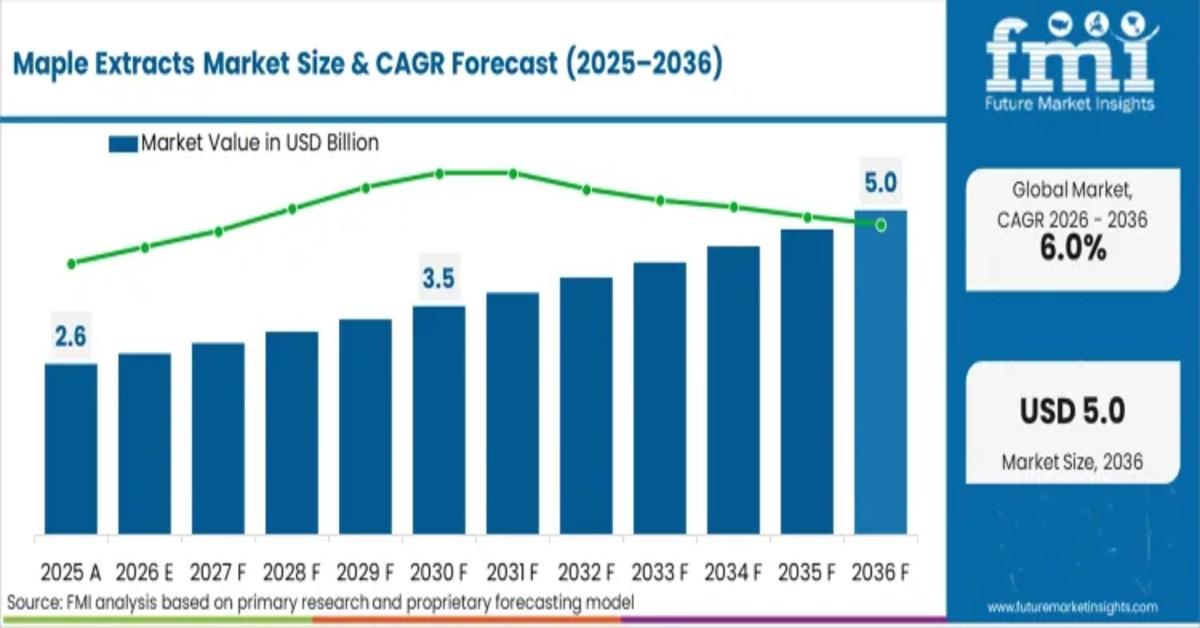
Maple Extracts Market Outlook
The global maple extracts market is entering a structurally transformative decade, driven by procurement reformulation strategies, origin verification mandates, and premiumization across bakery and beverage categories. According to the latest assessment by Future Market Insights (FMI), the market was valued at USD 2.6 billion in 2025 and is estimated to reach USD 2.8 billion in 2026. By 2036, global revenues are projected to climb to USD 5.0 billion, reflecting a steady CAGR of 6.0%.
The projected absolute dollar growth of USD 2.2 billion over the forecast period signals expansion driven less by raw volume spikes and more by procurement specification shifts. Industrial buyers are prioritizing verified natural origin ingredients over synthetic substitutes to comply with increasingly strict clean-label mandates across retail and foodservice channels.
Procurement Strategy Shift Defines Market Evolution
Multinational bakery and beverage chains are restructuring sourcing contracts to secure consistent flavor profiles amid weather-driven crop volatility. As maple sap yields remain dependent on freeze-thaw cycles, buyers are turning toward standardized natural extract formulations that ensure label integrity across geographies.
Nandini Roy Choudhury, Principal Consultant – Food & Beverage at FMI, notes:
“Procurement directors must secure multi-year supply contracts to insulate operations against inherent weather-driven crop yield fluctuations.”
Bulk liquid syrup formats continue to dominate industrial processing lines, reducing secondary extraction costs and supporting margin protection during inflationary cycles.
Market Definition and Scope
Maple extracts refer to concentrated flavorings derived from natural sap tapped from sugar maple trees. These ingredients are distilled into liquid concentrates or powder derivatives for industrial food formulation, particularly in bakery, beverage, dairy, and confectionery manufacturing.
Included within scope:
- Liquid maple concentrates
- Powder extract derivatives
- Pure commercial-grade maple syrups for industrial use
Excluded from scope:
- Synthetic maple-flavored syrups
- High-fructose corn syrup-based substitutes
- Retail-packaged household table syrups
Segmental Performance Highlights
By Product Type (2026 Share):
- Maple Syrup: 41.8% (dominant format due to minimal secondary processing)
- Liquid Extract
- Powder Extract
Industrial processors prefer raw syrup integration into liquid production systems to maintain compliance with clean-label packaging standards.
By Application (2026 Share):
- Bar and Donuts: 47.2%
- Beverages
- Confectionery
- Dairy Products
Commercial bakeries increasingly rely on maple extracts to enhance heat stability in frying applications while delivering complex botanical notes. Beverage formulators are integrating maple profiles into specialty coffee and seasonal menus to justify premium pricing.
Regional Growth Outlook
North America remains the structural supply backbone of the global maple extracts industry, supported by concentrated harvesting infrastructure and export-driven trade flows.
Canada reported export values reaching USD 715.9 million, underscoring strong overseas processing demand. Production capacity expansion includes authorization of 7 million new taps to strengthen supply buffers.
Top Country CAGR (2026–2036):
- China: 6.5%
- Canada: 6.2%
- India: 6.0%
- United States: 5.8%
- Japan: 5.7%
- United Kingdom: 5.5%
China’s expansion is fueled by Western-style bakery chain growth and premium coffee adoption. India demonstrates steady uptake through modern retail dessert formats, while mature markets such as the United States and Japan exhibit stable replacement demand linked to clean-label compliance and premium confectionery launches.
Europe remains a priority region due to stringent chemical additive regulations and high import tariffs that position maple extracts within premium retail tiers. Organic certification has become a baseline requirement for shelf placement in several European grocery networks.
Growth Catalysts and Structural Risks
Key Drivers:
- Global clean-label mandates replacing artificial sweeteners
- Regional sugar taxes penalizing synthetic syrups
- Premium beverage differentiation strategies
- Export momentum from North American production hubs
Restraints:
- Climate volatility affecting sap flow
- Freeze-thaw unpredictability impacting harvest consistency
- Raw material cost fluctuations during poor yield seasons
Producers are deploying advanced sensor networks to optimize sap collection timing and investing in evaporation technologies to maximize extraction yield.
Competitive Landscape and Strategic Alignments
Harvesting remains fragmented, but processing capabilities are consolidated among specialized industrial extractors. Vertically integrated operators controlling forestry assets and evaporation infrastructure dictate global pricing benchmarks.
Recent strategic developments include:
- Valeo Foods’ acquisition of Appalaches Nature to strengthen North American supply integration
- Expansion of tapping infrastructure by Québec Maple Syrup Producers to stabilize long-term ingredient availability
Companies investing in membrane filtration technologies and automated extraction systems are gaining competitive advantage through improved batch consistency and regulatory traceability compliance.
👉 Get Access to the Report Sample: https://www.futuremarketinsights.com/reports/sample/rep-gb-892
Research Methodology
FMI’s forecast relies on a hybrid top-down and bottom-up modeling approach validated through:
- Primary interviews with flavor house executives and cooperative supply managers
- Agricultural board export datasets
- Cross-verification of supplier capacity disclosures against regional trade flows
The model avoids speculative third-party syndicated estimates and is benchmarked against verifiable industrial production metrics.
Frequently Asked Questions (FAQ)
How large is the maple extracts market in 2026?
The market is projected to reach USD 2.8 billion in 2026.
What is the forecast market size by 2036?
Global revenues are expected to total USD 5.0 billion by 2036.
What is the expected CAGR between 2026 and 2036?
The market is anticipated to grow at 6.0% CAGR.
Which product format leads the market?
Maple Syrup dominates with approximately 41.8% share in 2026.
Which application drives the highest consumption?
Bar and Donuts applications account for 47.2% of total demand in 2026.
Which country is growing the fastest?
China leads with a projected CAGR of 6.5% through 2036.
What is the primary growth theme?
Clean-label reformulation and verified natural origin procurement.
Why FMI: https://www.futuremarketinsights.com/why-fmi
Related Reports:
- Herbal Tea Market https://www.futuremarketinsights.com/reports/herbal-tea-market
- Plant-Based Ice Creams Market https://www.futuremarketinsights.com/reports/plant-based-ice-creams-market
- Saffron Market https://www.futuremarketinsights.com/reports/saffron-market
- Air-dried Venison Dog Food Market https://www.futuremarketinsights.com/reports/air-dried-venison-dog-food-market
- Gorse Market https://www.futuremarketinsights.com/reports/gorse-market
About Future Market Insights (FMI)
Future Market Insights (FMI) is a leading provider of market intelligence and consulting services, serving clients in over 150 countries. Headquartered in Delaware, USA, with a global delivery center in India and offices in the UK and UAE, FMI delivers actionable insights to businesses across industries including automotive, technology, consumer products, manufacturing, energy, and chemicals.
An ESOMAR-certified research organization, FMI provides custom and syndicated market reports and consulting services, supporting both Fortune 1,000 companies and SMEs. Its team of 300+ experienced analysts ensures credible, data-driven insights to help clients navigate global markets and identify growth opportunities.
Contact Us:
Future Market Insights Inc.
Christiana Corporate, 200 Continental Drive,
Suite 401, Newark, Delaware - 19713, USA
T: +1-347-918-3531
For Sales Enquiries: sales@futuremarketinsights.com

 English
 Arabic
 French
 Spanish
 Portuguese
 Deutsch
 Turkish
 Dutch
Dutch
 Italiano
 Russian
 Portuguese (Brazil)
 Greek
Greek