


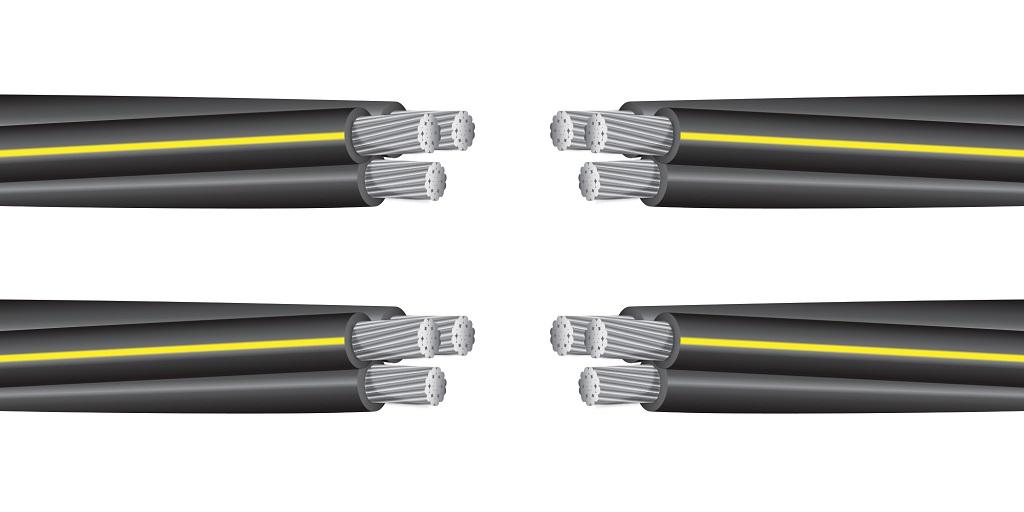
Aluminum triplex wire is a type of power service entry cable that is commonly used in residences as well as in either applications. Perhaps most commonly it is encountered when distributing power entry to homes.
In the simplest terms, aluminum triplex wire consists of three cables twisted around each other. Two of the wires are hot legs, and the third is a neutral wire for the service cable. The latter is typically insulated while the former are protected by insulation.
Aluminum triplex wire is most commonly used for overhead single phase service entry. It is used as a drop cable from a transformer to a home but it can also be used for secondary power distribution between poles, too.
In laymen’s terms, aluminum triplex wire either runs power between the poles, or provides power from the grid to a home, from the transformers on the telephone poles outside.
Voltage and current ratings are bound by the unique specifications of the wire at hand, but triplex wire is commonly rated to 600V and protected by XLP, or cross-linked polyethylene insulation.
Compared to traditional thermoplastic insulation, cross-linked polyethylene is more durable and offers superior mechanical properties. It also affords better protection to the wires underneath against chemical attack.
XLP also offers high heat resistance, resistance to cracking, abrasion, and other physical stresses, and moderate resistance to chemicals such as oil and gas.
Why Aluminum Instead of Copper?
Something else that is noteworthy about aluminum triplex wire is that, obviously, it is made of aluminum instead of copper, despite the fact that electrical conductors are much more frequently made of the latter.
There are several important reasons for this. For one, aluminum is lighter. This makes it not only easier to work with and handle, but much more economical to transport. It also makes it more suitable for overhead installations, for which triplex wire is commonly used (although appropriately-rated grades of triplex wire can also be used for underground power distribution).
Also, while copper does technically have a higher conductivity rating than aluminum, aluminum offers better conductivity to weight, which cannot be discounted and it makes aluminum an excellent choice in some situations.
Cost is another factor and likely the biggest one. Aluminum is far more affordable than copper, and the price of copper isn’t just elevated, it’s actually been rising, which has made construction costs rise as well. The use of aluminum is much more economical here than copper.
One of the big areas in which these cost savings associated with the use of aluminum instead of copper is in construction. Insiders in the industry have observed that the costs of construction for homeowners would be even more untenable than they are if copper were being used for triplex wire, or for other power service entry.
And, for what it’s worth, aluminum is more likely used in electrical power distribution than you think it is. Consider overhead power transmission, specifically high-tension overhead power lines. Typically those use not just aluminum cables, but uninsulated ones.
The aluminum offers plenty of voltage and ampacity capability, but since it is much lighter than copper it is practical for the application. Copper is not just too expensive, but far too heavy, and it would corrode away in a season if it were left uninsulated.
Those in Search of High-Quality Aluminum Triplex Wire
Interested in learning more about aluminum triplex wire or in finding a supplier of high-quality electrical wire and cable?
Visit EWCS Wire. They carry a wide range of options including aluminum wires such as triplex and quadruplex wire. Check out their website and if you have any questions get in touch with them before you buy.
For more information about Belden Fire Alarm Cable and Awg Marine Battery Cable Please visit: Electrical Wire & Cable Specialists.

 English
 Arabic
 French
 Spanish
 Portuguese
 Deutsch
 Dutch
Dutch
 Italiano
 Russian
 Romaian
 Portuguese (Brazil)
 Greek
Greek