


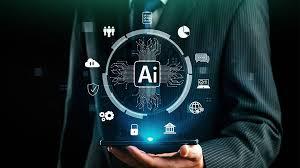
Rethinking Business in the Age of Algorithms
Artificial Intelligence for Business: Complete Guide is not just about implementing tools — it’s about redesigning how organizations think. The companies leading today’s markets are not simply automating tasks; they are building intelligent ecosystems where data, strategy, and technology operate in harmony.
Artificial intelligence is transforming business from intuition-driven management to insight-driven leadership. It replaces delayed reactions with predictive foresight and fragmented systems with connected intelligence.
Understanding the Strategic Meaning of AI in Business
Artificial Intelligence for Business refers to integrating machine learning, predictive modeling, data intelligence, and adaptive systems into core operations to enhance performance and decision-making.
Unlike traditional software that executes predefined commands, AI systems learn from patterns. They improve accuracy over time and adapt to changing variables. This makes AI less of a tool and more of a strategic asset.
At its core, AI allows businesses to answer three critical questions:
-
What is happening?
-
Why is it happening?
-
What is likely to happen next?
That third question changes everything.
The Shift from Reactive to Predictive Organizations
Traditional companies operate reactively. They analyze past reports, respond to problems, and adjust after outcomes occur.
Artificial Intelligence for Business enables predictive operations. Organizations can:
-
Anticipate customer churn before it happens
-
Forecast demand fluctuations
-
Detect operational inefficiencies instantly
-
Identify market opportunities early
Predictive intelligence reduces uncertainty, which directly improves profitability.
Key Areas Where AI Creates Measurable Impact
Intelligent Operations Management
AI monitors workflows continuously. It identifies delays, inefficiencies, and cost leaks that human oversight may overlook. Over time, these micro-optimizations compound into significant savings.
Revenue Acceleration
Through behavior analysis and demand forecasting, AI helps businesses optimize pricing, refine targeting strategies, and personalize marketing efforts. This increases conversion rates and customer lifetime value.
Data-Driven Executive Decisions
Leadership teams gain access to scenario modeling and risk simulations. Instead of relying solely on instinct, executives can evaluate probable outcomes before making strategic commitments.
Customer Intelligence Systems
AI analyzes purchasing behavior, engagement patterns, and support interactions. Businesses can design customer journeys that feel intuitive and personalized rather than generic.
Building an AI-Ready Business Infrastructure
Adopting Artificial Intelligence for Business requires structural alignment.
1. Data Consolidation
Scattered data weakens AI accuracy. Organizations must centralize and standardize data sources to ensure reliable outputs.
2. Clear Strategic Objectives
AI should be aligned with measurable business goals: reducing operational costs, increasing retention rates, improving forecast accuracy, or accelerating product innovation.
3. Incremental Deployment
Start with targeted use cases that offer fast returns. Expand gradually as internal confidence and technical maturity grow.
4. Cross-Functional Collaboration
AI initiatives should involve leadership, operations, IT, and marketing teams. Intelligence becomes powerful when it connects departments.
Financial Perspective: AI as a Growth Multiplier
Artificial Intelligence for Business should not be viewed as a cost center. It is an investment in scalable intelligence.
Return on investment can be measured through:
-
Reduced manual labor expenses
-
Improved demand prediction accuracy
-
Decreased operational waste
-
Faster decision cycles
-
Increased customer retention
Organizations that treat AI as long-term infrastructure rather than short-term experimentation achieve sustainable gains.
Overcoming Common Implementation Barriers
Despite its potential, AI adoption often faces internal resistance.
Skill Gaps
Employees may lack familiarity with data analytics tools. Structured training programs solve this challenge and build confidence.
Legacy Systems
Older software may not integrate easily with AI platforms. Gradual modernization reduces disruption.
Ethical and Privacy Concerns
Transparent data governance policies are essential. Responsible AI usage strengthens brand credibility and customer trust.
The Human-AI Collaboration Model
A common misconception is that AI replaces human talent. In reality, Artificial Intelligence for Business amplifies human capability.
AI handles repetitive analysis. Humans handle interpretation and strategic judgment.
This partnership improves speed without sacrificing creativity or ethical reasoning.
The future enterprise will not be fully automated — it will be intelligently augmented.
Emerging Trends Shaping the Future of AI in Business
The next wave of Artificial Intelligence for Business will introduce deeper integration across enterprise systems.
Expect advancements such as:
-
Self-adjusting pricing engines
-
Real-time competitive intelligence dashboards
-
Predictive workforce planning
-
AI-driven innovation modeling
-
Autonomous supply chain coordination
These developments will redefine operational standards across industries.
Strategic Advantage in a Competitive Market
In highly competitive environments, small efficiency improvements create disproportionate advantages.
Organizations using AI:
-
Respond faster to market shifts
-
Identify profitable niches earlier
-
Minimize operational risk
-
Deliver superior customer experiences
The advantage compounds over time, widening the performance gap between AI-enabled businesses and traditional competitors.
Conclusion: Intelligence as a Core Business Asset
Artificial Intelligence for Business: Complete Guide is ultimately about redefining enterprise capability. AI is not merely a technological trend — it is becoming foundational infrastructure for modern organizations.
Companies that integrate AI strategically will operate with greater clarity, agility, and resilience. They will transform data into foresight and complexity into opportunity.
The future of business will belong to enterprises that do not just collect information — but understand it, learn from it, and act on it intelligently.

 English
 Arabic
 French
 Spanish
 Portuguese
 Deutsch
 Turkish
 Dutch
Dutch
 Italiano
 Romaian
 Portuguese (Brazil)
 Greek
Greek