


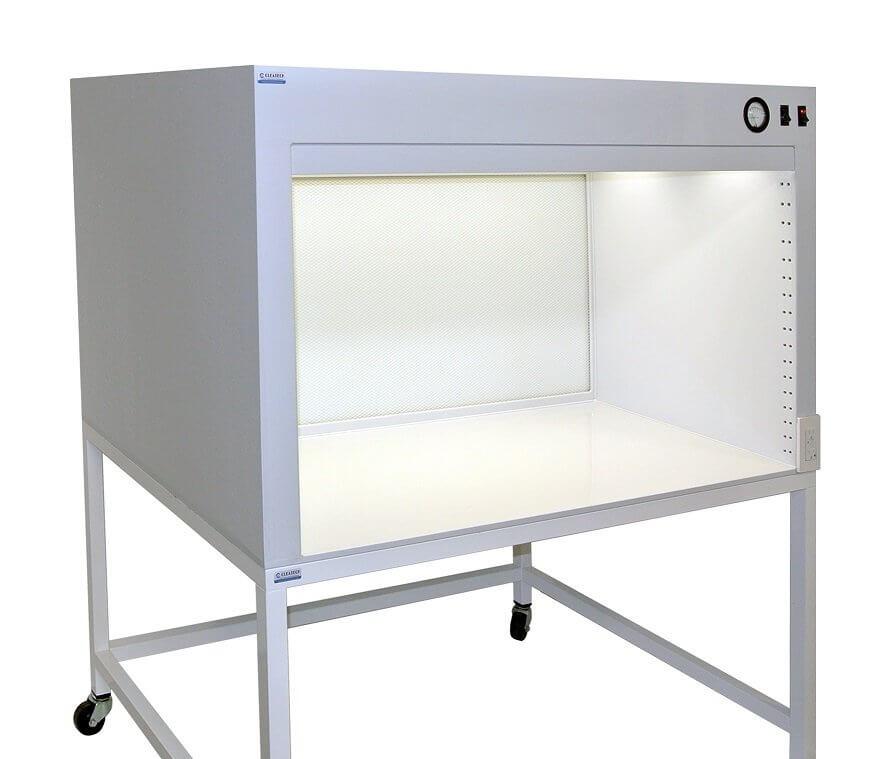
When you’re responsible for sterile assembly, you can’t afford contamination, rework, or compromised product quality. Whether you assemble medical devices, electronics, optics, or pharmaceutical components, your process depends on a controlled, particle-free environment. That’s where a horizontal flow hood becomes essential.
If you want consistent cleanliness, operator comfort, and reliable performance, a horizontal laminar airflow system gives you the control you need—without the complexity of a full cleanroom.
What Is a Horizontal Flow Hood?
A horizontal flow hood, also called a horizontal laminar flow station, pulls air through a high-efficiency particulate air (HEPA) filter and pushes it horizontally across your work surface in a smooth, uniform stream. This constant airflow sweeps contaminants away from your product and toward the operator, preventing particles from settling on sterile components.
Unlike vertical flow systems, the airflow moves directly from the back of the hood toward you. That makes it especially effective when you need maximum product protection during precision assembly tasks.
If you’re considering upgrading your sterile workspace, explore this high-performance Horizontal Flow Hood for sterile assembly applications.
You Get Superior Product Protection
When you assemble sensitive components, contamination often comes from the surrounding room air. A horizontal laminar flow hood creates a continuous curtain of filtered air across your work zone.
Because the airflow moves directly across your product:
- Airborne particles are immediately swept away
- Dust cannot settle on critical surfaces
- Cross-contamination is minimized
- Your sterile components remain protected
If your priority is protecting the product rather than the operator, horizontal flow is often the better choice.
You Improve Assembly Precision
Sterile assembly often involves delicate parts, small tolerances, and detailed handling. With horizontal laminar airflow:
- There’s minimal turbulence
- Air moves in a consistent, unidirectional pattern
- Vibration and disruption are reduced
This stable environment supports precision work such as:
- Medical device assembly
- Optics handling
- Microelectronics integration
- Laboratory sterile packaging
When your work demands accuracy, airflow stability matters.
You Create a Cost-Effective Clean Environment
Building and maintaining a full cleanroom is expensive. If your process only requires localized sterile conditions, a horizontal flow hood gives you targeted contamination control without the overhead of:
- HVAC retrofits
- Structural renovations
- High operational costs
Instead, you can install a laminar flow station directly where you need it. That means faster implementation, lower capital investment, and easier compliance with cleanliness standards.
For reliable clean air systems designed for controlled environments, explore solutions from CleaTech LLC cleanroom equipment specialists.
You Increase Workflow Efficiency
When sterile assembly is streamlined, productivity improves. A horizontal flow hood supports efficient workflow by:
- Offering open front access
- Providing clear visibility
- Allowing comfortable hand positioning
- Reducing the need for constant cleaning
You don’t have to interrupt your process to wipe down surfaces repeatedly because the airflow continuously removes airborne contaminants.
This setup works especially well in production lines where speed and sterility must coexist.
You Simplify Compliance
Many industries must meet strict contamination standards. Whether you follow ISO classifications or internal quality control protocols, horizontal laminar airflow systems help you:
- Maintain consistent particle control
- Document environmental performance
- Support validation and inspection requirements
When your clean air system performs reliably, audits become smoother and compliance becomes less stressful.
You Gain Customization Options
Not all sterile assembly processes are the same. Horizontal flow hoods can be customized to fit your specific needs, including:
- Different work surface materials
- Adjustable heights
- Variable airflow speeds
- Lighting options
- Ionization for static-sensitive applications
By choosing a manufacturer that understands controlled environments, you ensure your hood matches your application instead of forcing your process to adapt to standard equipment.
If you need guidance selecting the right configuration, you can contact us today for expert horizontal laminar flow hood consultation.
You Enhance Long-Term Reliability
Quality construction matters. A well-designed horizontal flow hood includes:
- Durable framing
- High-efficiency HEPA filtration
- Energy-efficient blowers
- Low-maintenance design
When you invest in dependable equipment, you reduce downtime and extend service life. That means lower total cost of ownership and fewer interruptions to your sterile assembly workflow.
When Should You Choose a Horizontal Flow Hood?
A horizontal flow hood is ideal when:
- Your primary goal is product protection
- You perform non-hazardous sterile assembly
- You handle sensitive electronics or medical components
- You want a localized clean zone instead of a full cleanroom
- You need ergonomic front access
However, if you work with hazardous materials or require operator protection from fumes, a different containment system may be more appropriate.
Final Thoughts
If your sterile assembly process demands precision, consistency, and particle control, a horizontal flow hood delivers focused protection where you need it most. It helps you maintain cleanliness, improve workflow, and reduce contamination risks without the cost and complexity of full cleanroom construction.
By selecting the right system from an experienced provider, you gain more than filtered air—you gain confidence in every assembled product.
Frequently Asked Questions
What is the main purpose of a horizontal flow hood?
A horizontal flow hood provides HEPA-filtered air that moves horizontally across the work surface to protect products from airborne contamination during sterile assembly.
Is a horizontal flow hood suitable for hazardous materials?
No. Horizontal laminar flow hoods are designed for product protection, not operator protection. They should not be used with toxic, biohazardous, or volatile substances.
How does a horizontal laminar flow hood differ from a vertical one?
In a horizontal hood, air flows from the back toward the operator. In a vertical hood, air flows downward from the top. Horizontal flow is typically preferred when maximum product protection is required.
Original Source: https://laboratoryquipment.blogspot.com/2026/02/why-choose-horizontal-flow-hood-for.html

 Arabic
 French
 Spanish
 Portuguese
 Deutsch
 Turkish
 Dutch
Dutch
 Italiano
 Russian
 Romaian
 Portuguese (Brazil)
 Greek
Greek