


The industry surrounding Cardiac Microcatheters is evolving alongside rapid technological progress in interventional cardiology. These small diameter catheters assist in delivering therapeutic agents, guidewires, and embolic materials with high precision. Increased adoption of image guided procedures is encouraging further product refinement and performance optimization.
Cardiac Microcatheter Market Growth and Industry Landscape
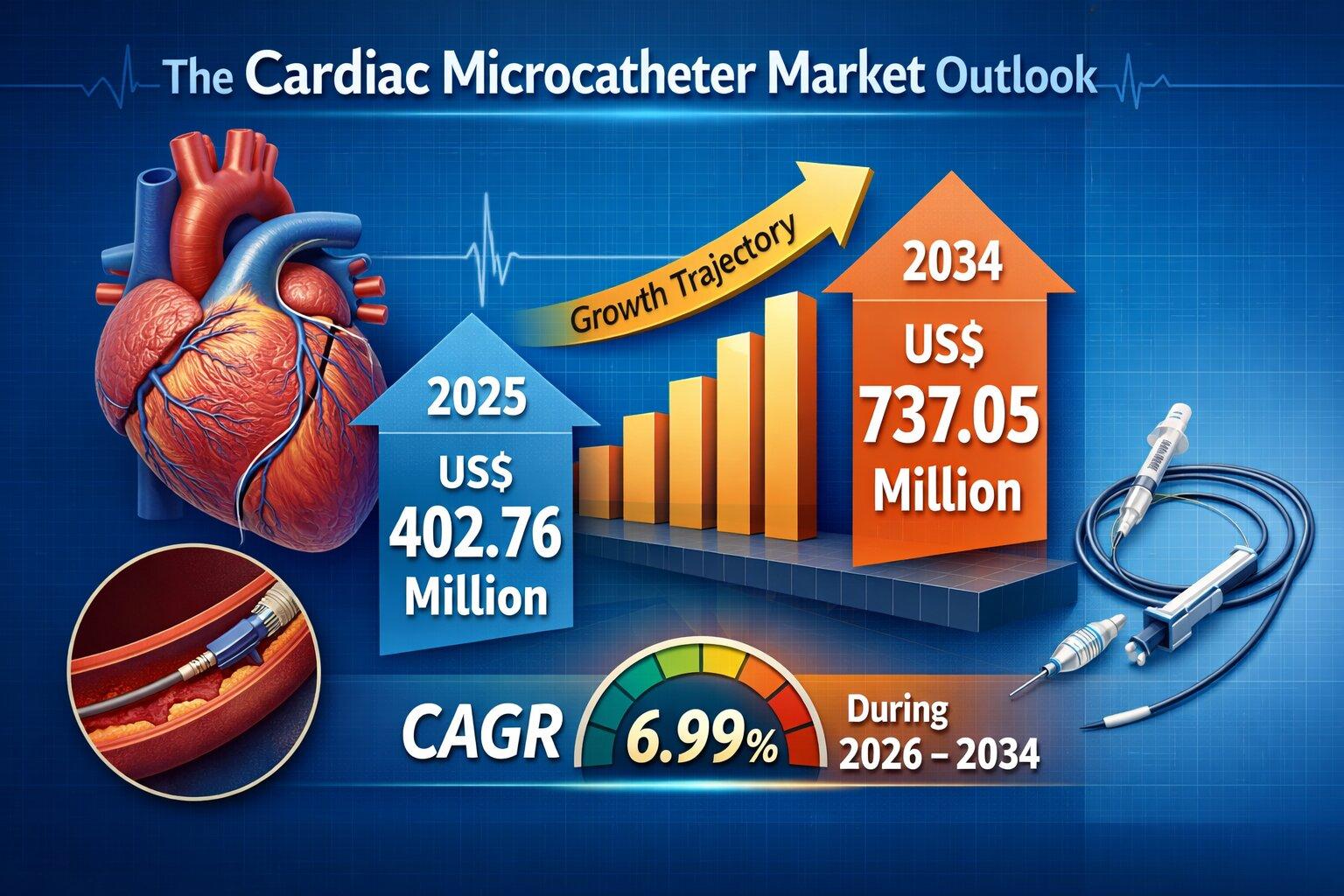
The Cardiac Microcatheter Market is projected to reach US$ 737.05 million by 2034, rising from US$ 402.76 million in 2025, reflecting a CAGR of 6.99% during 2026 to 2034. This steady expansion is closely linked to the growing global burden of cardiovascular diseases and the rising volume of complex coronary interventions. As interventional cardiology evolves, microcatheters have become indispensable tools for precise navigation in challenging vascular anatomies.
Cardiac microcatheters, typically measuring less than 3 French in diameter, are engineered for delicate coronary pathways. They enable targeted delivery of contrast agents, guidewires, stents, and therapeutic drugs. The shift from conventional hydrophilic coated designs to more advanced steerable and flow directed systems highlights the market’s emphasis on procedural precision and vessel safety. The integration of radiopaque markers and PTFE or silicone based lubricious materials enhances visibility and reduces friction during prolonged procedures.
Technological Advancements and Product Innovation
Innovation remains central to competitive differentiation. Manufacturers are focusing on improved torque response, enhanced pushability, and flexible low profile shafts that can navigate tortuous vessels. Hydrophilic coated microcatheters continue to dominate due to superior trackability and reduced risk of vessel spasm or dissection.
Emerging applications in mitral valve repair and pediatric cardiology are also expanding usage. In congenital heart procedures where vessel diameters are small, flexibility and atraumatic tip design are critical. The development of drug eluting and bioabsorbable microcatheters represents a promising frontier, particularly for restenosis prevention in high risk patients.
Regulatory approvals and imaging integration further strengthen technological evolution. For example, in October 2025, Terumo Corp received FDA approval for its OPUSWAVE Dual Sensor Imaging System, combining OFDI and IVUS technologies. In February 2025, Teleflex Inc announced the acquisition of BIOTRONIK’s vascular intervention business to broaden its interventional cardiology portfolio. Additionally, Gentuity secured FDA 510(k) clearance for its HF OCT Imaging System, supporting pre and post PCI assessments.
Market Drivers and Emerging Opportunities
Key Drivers
One of the primary growth drivers is the increasing prevalence of cardiovascular diseases, fueled by aging populations, sedentary lifestyles, and dietary patterns. The global rise in chronic total occlusions and complex coronary lesions has led to higher demand for percutaneous coronary interventions.
The growing adoption of minimally invasive PCI procedures also sustains market momentum. Microcatheters enhance guidewire support and facilitate device delivery in bifurcation stenting and CTO recanalization. Hospitals remain the largest end users due to advanced cath lab infrastructure and skilled interventional cardiologists.
Emerging Opportunities
Opportunities are expanding in Asia Pacific, Latin America, and the Middle East as healthcare infrastructure improves and PCI volumes rise. Localization of manufacturing and portable cath lab solutions offer further growth avenues.
Innovation in steerable catheter systems and imaging compatible designs presents substantial potential. The demand for integrated delivery systems that bundle microcatheters with balloons or guidewires can streamline workflow efficiency and improve procedural outcomes.
Download Sample PDF : https://www.theinsightpartners.com/sample/TIPRE00029957
Segmentation Analysis
The cardiac microcatheter market is segmented by indication, end user, and geography.
By indication, the coronary segment accounts for a major share due to extensive use in PCI procedures. General peripheral vascular applications also contribute significantly, particularly in complex vessel anatomies requiring precise navigation.
By end user, hospitals dominate owing to high procedure volumes and comprehensive facilities. Specialty clinics and ambulatory surgical centers are witnessing increased adoption as minimally invasive procedures expand into outpatient settings, reducing hospital stay durations and overall costs.
Geographically, North America leads the market, supported by strong reimbursement frameworks, high PCI volumes, and advanced interventional centers. Europe maintains a solid position due to robust clinical trial networks and regulatory support for medical technology. Asia Pacific is expected to register the fastest growth, driven by expanding cardiology programs in China and India and rising awareness of early cardiac intervention.
Competitive Landscape and Key Players
The market is moderately fragmented, characterized by competition among established global corporations and specialized vascular device manufacturers. Rivalry focuses on trackability, biocompatibility, imaging compatibility, and procedural safety.
Major Companies Operating in the Cardiac Microcatheter Market
-
Boston Scientific Corp
-
Teleflex Inc
-
Medtronic Plc
-
OrbusNeich Medical Group Holdings Ltd
-
Asahi Intecc USA Inc
-
Merit Medical Systems Inc
-
Nipro Corp
-
Terumo Corp
-
Tokai Medical Products Inc
Strategic initiatives include acquisitions of steerable catheter startups, partnerships for clinical validation in complex anatomies, and regional manufacturing expansion to mitigate supply chain risks.
Future Outlook
The future outlook for the cardiac microcatheter market remains positive, supported by rising interventional cardiology volumes and continuous device innovation. Increasing integration with advanced imaging platforms, greater emphasis on minimally invasive techniques, and expanding access to cardiac care in emerging economies are expected to sustain long term growth. As healthcare systems prioritize early diagnosis and precision based interventions, cardiac microcatheters will remain essential tools in the evolving landscape of cardiovascular treatment.
Other Reports :

 English
 Arabic
 French
 Spanish
 Portuguese
 Deutsch
 Dutch
Dutch
 Italiano
 Russian
 Romaian
 Portuguese (Brazil)
 Greek
Greek