


The internet loves a good wisdom teeth saga. Viral videos of groggy post-anesthesia rambling. Stories of liquid diets lasting weeks. But amid all this drama sits a quiet truth: many people navigate life without ever needing these teeth removed.
How do you know which category you fall into?
The Evolutionary Leftover
Your wisdom teeth are your third molars, the last permanent teeth to arrive. They typically surface between ages 17 and 25, earning their name from the assumption that you've gained some maturity by then. Whether that maturity includes wisdom is another question entirely.
The fundamental problem is size. Modern jaws are smaller than those of our hunter-gatherer ancestors. Early humans relied on these extra teeth to pulverize coarse, uncooked foods. Our culinary evolution has outpaced our physical evolution, leaving many of us with mouths too small for these late arrivals.
Symptoms That Demand Attention
Unrelenting Pain
When wisdom teeth hurt, they're demanding notice. This pain varies widely—some experience constant dull pressure, others intermittent sharp jolts. It might feel like your jaw is being squeezed, or like lightning strikes when you bite down.
Pain is never accidental. It signals that something requires professional intervention.
The Impaction Problem
An impacted tooth fails to erupt properly through the gum tissue. It might be angled incorrectly, pressing against adjacent teeth, or completely trapped beneath the surface.
These imprisoned teeth create multiple hazards. They can compromise neighboring tooth structure, establish protected bacterial reservoirs, and initiate infectious processes that spread rapidly.
Infection Cycles
Frequent infections around wisdom teeth strongly indicate that extraction should be considered. These conditions, termed pericoronitis, develop when food and microorganisms accumulate beneath gum tissue partially covering an emerging tooth.
Characteristic manifestations include localized swelling, malodorous breath, trismus (difficulty opening the mouth), and odynophagia (painful swallowing).
Orthodontic Disruption
Wisdom teeth occasionally generate sufficient mechanical force to displace existing dental alignment. This proves particularly distressing for individuals with previous orthodontic investment. Years of careful positioning can be reversed by these tardy molars.
A dentist near Clementi can employ radiographic imaging to evaluate whether your wisdom teeth currently affect or will eventually compromise your dental arrangement.
Pathological Growths
Though infrequent, wisdom teeth may become associated with cystic development. These fluid-filled collections progressively destroy alveolar bone and may compromise neurovascular structures. Malignant transformation, while exceptionally rare, remains within the realm of possibility.
Systematic dental surveillance enables early identification of such serious developments.
Scenarios Favoring Preservation
Wisdom teeth retention remains appropriate under specific circumstances:
- Complete eruption with favorable positioning
- Accessibility for adequate oral hygiene maintenance
- Absence of symptomatic complaints or pathological changes
- Sufficient maxillofacial space accommodation
Certain individuals maintain functional, healthy wisdom teeth throughout their lifespan. Absent problematic symptomatology, prophylactic removal lacks justification.
Chronological Considerations
Younger patients typically demonstrate enhanced recovery capacity following wisdom teeth procedures. Root development remains incomplete, and bone density is reduced, facilitating technical simplicity and accelerated healing.
Advancing age brings elongated root morphology and increased bone mineralization. Surgical intervention grows technically demanding, and convalescence periods extend proportionally.
Nevertheless, chronological age independently should not drive treatment decisions. Asymptomatic wisdom teeth in middle age may never require intervention.
The Diagnostic Protocol
When consulting a dentist at Clementi regarding wisdom teeth evaluation, anticipate the following sequence:
Initially, comprehensive history-taking occurs. The practitioner inquires regarding symptomatology: pain characteristics, inflammatory swelling, gingival hemorrhage?
Subsequently, clinical examination proceeds. Visual inspection of dental structures and surrounding tissues enables assessment of wisdom tooth positioning.
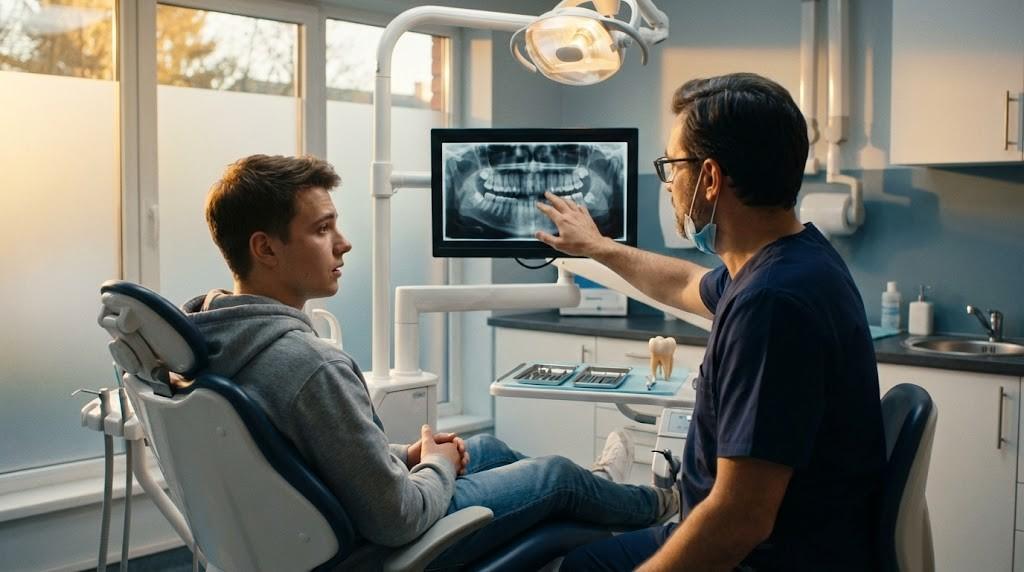
Radiographic evaluation proves essential. These images reveal subgingival pathology, including impaction severity, neurovascular proximity, and spatial relationships.
Synthesizing these data, your dentist near Clementi will formulate recommendations for either continued surveillance or surgical intervention.
Impaction Classification System
Understanding your specific impaction category clarifies procedural complexity:
Soft tissue impaction: Partial eruption with persistent gingival coverage. Food impaction occurs readily.
Partial bony impaction: Significant tooth structure remains embedded within mandibular or maxillary bone. Extraction complexity increases substantially.
Complete bony impaction: Total encasement within osseous structure. Requires surgical extraction with possible osteotomy.
Impaction depth directly correlates with procedural intricacy and recovery duration.
Consequences of Therapeutic Delay
Neglecting pathologic wisdom teeth fails to resolve underlying conditions. Pathology typically intensifies rather than resolving spontaneously.
Infectious processes may disseminate to adjacent anatomical regions or systemic circulation. Damage to neighboring teeth can necessitate extensive restorative rehabilitation. Cystic lesions may expand, creating substantial complications.
While expectant management occasionally represents appropriate strategy, when a dentist at Clementi advises extraction, sound clinical reasoning typically underlies this recommendation.
Decision-Making Framework
Initiate transparent dialogue with your dental provider. Essential inquiries encompass:
- What specific pathological processes are occurring?
- What clinical outcomes might deferred intervention produce?
- What procedural complications should be anticipated?
- What does postoperative recuperation involve?
Comprehensive information acquisition supports educated decision-making.
Anxiety regarding surgical procedures represents normal psychological response. Discussion of available anesthetic and sedative options is encouraged. Contemporary dental practice has evolved considerably in ensuring patient comfort.
Preventive Surveillance
Optimal management involves early pathological identification. Routine dental appointments enable practitioners to monitor wisdom tooth developmental trajectories.
Most providers initiate surveillance during mid-adolescence. This timeline permits strategic planning should intervention become indicated.
Early recognition enables elective scheduling during favorable conditions, avoiding emergency interventions during acute symptomatic episodes.
Concluding Perspectives
Wisdom teeth management requires individualized assessment rather than standardized protocols. Some patients benefit from extraction; others maintain these teeth indefinitely without sequelae.
Maintain vigilance for warning manifestations: discomfort, tissue swelling, infectious episodes, or positional changes. Adhere to consistent dental surveillance schedules.
Should you experience wisdom tooth concerns, arrange consultation with a dentist near Clementi. They will evaluate your unique clinical presentation and recommend appropriate management strategies.
Your oral anatomy is distinctive. Your wisdom teeth may function perfectly, or they may require removal. Regardless, informed collaboration with dental professionals ensures optimal outcomes for your oral health.

 Arabic
 French
 Spanish
 Portuguese
 Deutsch
 Turkish
 Dutch
Dutch
 Italiano
 Russian
 Romaian
 Portuguese (Brazil)
 Greek
Greek