


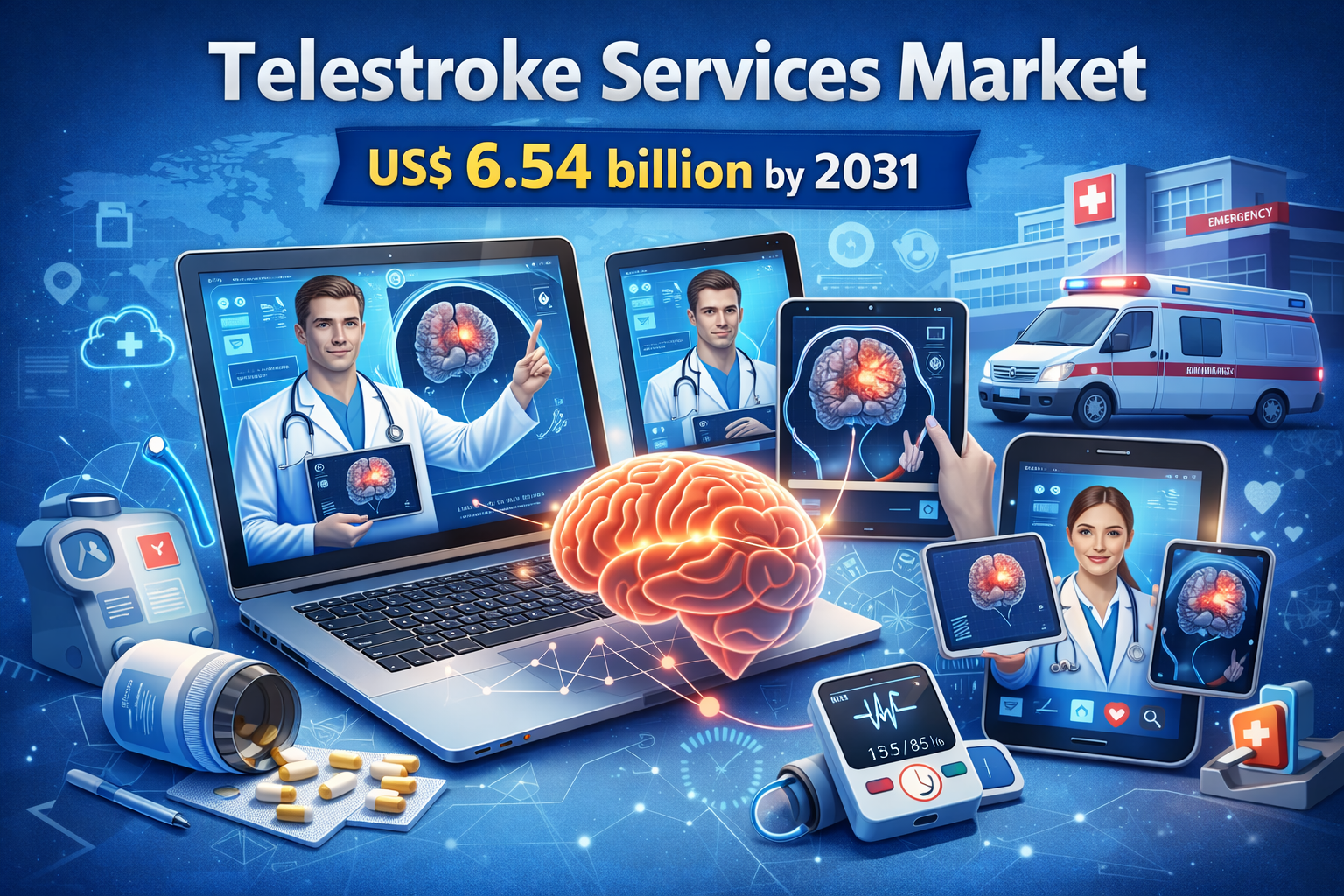
Telestroke services refer to the remote delivery of stroke expertise through secure audio visual and digital communication technologies. These services enable neurologists to assess, diagnose, and guide treatment for stroke patients in real time, regardless of geographic location. By connecting smaller hospitals with specialized stroke centers, telestroke networks significantly reduce treatment delays and improve clinical outcomes.
Market Overview
The telestroke services market is projected to grow from US$ 2.06 billion in 2023 to US$ 6.54 billion by 2031, registering a CAGR of 15.50% during 2023 to 2031. Rapid advancements in telemedicine platforms, rising stroke prevalence, and supportive reimbursement frameworks are driving strong global expansion.
Stroke remains one of the leading causes of death and long-term disability worldwide. According to the World Health Organization, stroke was the second most common cause of death globally in 2016. The burden is expected to increase due to aging populations, sedentary lifestyles, and rising rates of hypertension and diabetes. As public health systems face mounting pressure, telestroke solutions are emerging as a critical strategy to expand access to specialized neurological care.
Cardiovascular diseases are closely linked with stroke incidence. The World Health Organization reported 17.9 million deaths in 2019 due to cardiovascular diseases, accounting for 32% of all global deaths. Heart attacks and strokes represented 85% of these fatalities. Patients with coronary artery disease and atrial fibrillation face significantly higher risks of acute ischemic stroke. This strong association between cardiac disorders and stroke is increasing demand for integrated and rapid response care models supported by telestroke platforms.
Driving Factors
· Rising global prevalence of stroke and cardiovascular diseases
· Growing geriatric population vulnerable to neurological disorders
· Increasing adoption of telemedicine across healthcare systems
· Supportive reimbursement policies for remote stroke care
· Need to reduce door to needle time in acute stroke management
Government initiatives and legislative support are also contributing to growth. The Furthering Access to Stroke Telemedicine Act included in the CHRONIC Care Act of 2017 expanded hospital insurance coverage for telestroke services starting in 2021. Such measures are enabling broader patient access to remote stroke expertise, particularly in underserved and rural areas.
Telestroke Services Trends
· Integration of artificial intelligence in stroke diagnosis
· Deployment of cloud based telehealth platforms
· Expansion of mobile stroke units connected to tele networks
· Increased collaboration between cardiology and neurology specialists
· Investment in advanced imaging and real time data sharing systems
Download Sample PDF: https://www.theinsightpartners.com/sample/TIPRE00018781
Technological innovation remains a central trend. Modern telestroke systems combine high resolution imaging, electronic health records, and secure communication tools to facilitate rapid decision making. AI powered imaging analysis is enhancing early detection of ischemic stroke and improving treatment accuracy.
Telestroke Services Market Growth Opportunities
Emerging economies in Asia Pacific present substantial growth potential. Improved healthcare infrastructure, rising awareness of telemedicine, and increasing investments in digital health are strengthening regional adoption. Governments are prioritizing digital transformation to address disparities in specialist availability, particularly in rural and semi urban regions.
North America continues to hold a significant share due to advanced healthcare facilities, strong reimbursement structures, and high telemedicine adoption rates. Meanwhile, Asia Pacific is expected to witness accelerated expansion supported by technological advancements and product launches. Growing private and public sector partnerships are further creating opportunities for service providers to expand network coverage.
Key Players
· Providence Health & Services
· Partners Telestroke Center
· Medical University of South Carolina
· Granville Health System
· Lakewood Health System
· Vidyo, Inc.
· Nebraska Medicine
· Eagle Telemedicine
· Avizia
These organizations focus on expanding telehealth networks, enhancing digital capabilities, forming strategic collaborations, and improving clinical service offerings to strengthen their market presence.
Future Outlook
The telestroke services market is expected to witness sustained double digit growth through 2031, driven by technological innovation, regulatory support, and rising stroke burden. Artificial intelligence integration, expansion of broadband connectivity, and cross border telehealth collaborations will further enhance service reach and quality. As healthcare systems increasingly emphasize rapid intervention and preventive care, telestroke platforms will play a pivotal role in transforming acute stroke management and improving global neurological outcomes.
FAQs
1. What is driving the growth of the telestroke services market?
The growth is driven by rising stroke prevalence, increasing cardiovascular diseases, telemedicine adoption, and supportive reimbursement policies.
2. How do telestroke services improve patient outcomes?
They enable rapid remote evaluation by neurologists, reduce treatment delays, and support timely administration of life saving therapies.
3. Which region offers strong growth opportunities?
Asia Pacific offers significant growth potential due to improving healthcare infrastructure, digital health investments, and rising awareness of telemedicine solutions.
Related Report
Aesthetic Fillers and Exosomes Market Size, Trends & Forecast 2025-2031

 English
 Arabic
 French
 Portuguese
 Deutsch
 Turkish
 Dutch
Dutch
 Italiano
 Russian
 Romaian
 Portuguese (Brazil)
 Greek
Greek