


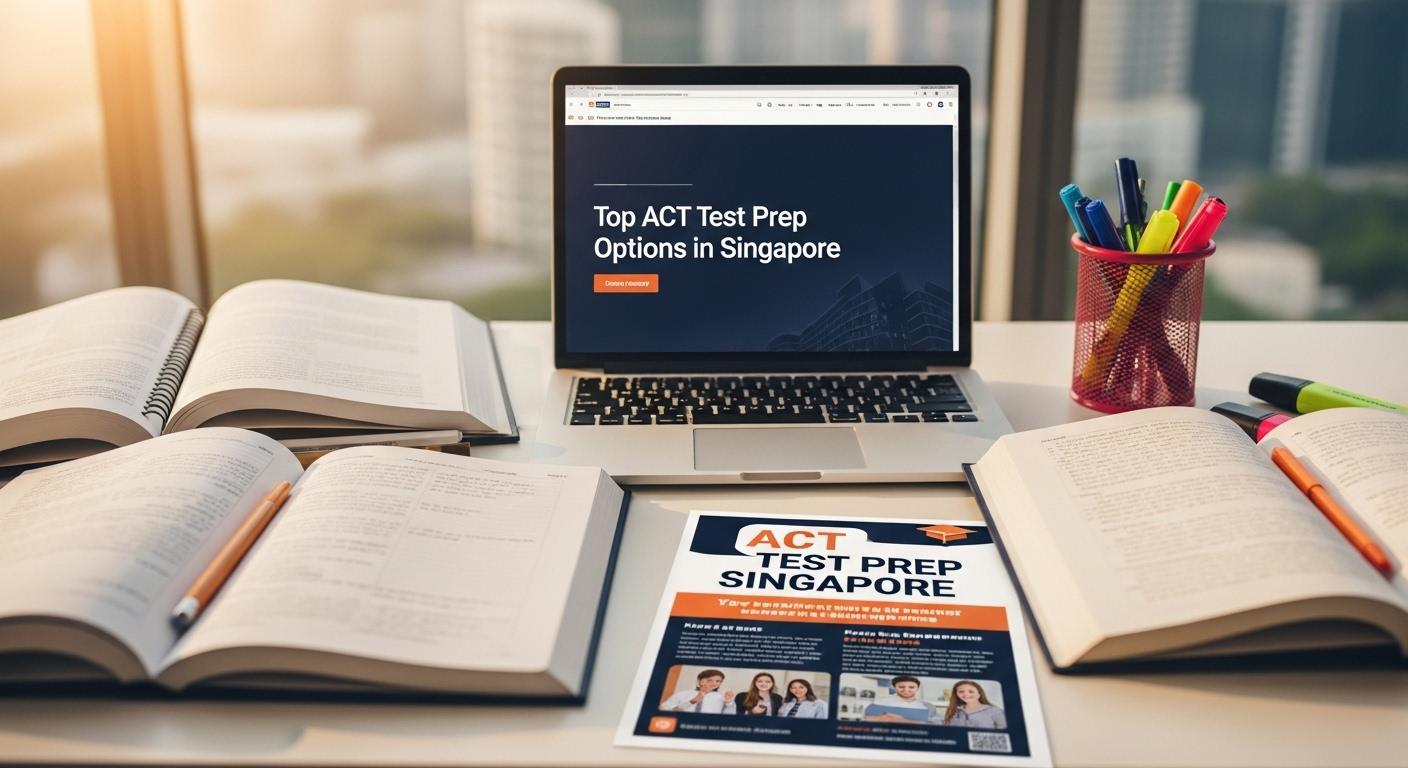
The Prep Format You Choose Shapes the Score You Get
Two Singapore students. Same diagnostic score. Same target. Same number of preparation weeks.
Student A chose an in-person coaching program at a local test prep centre. Three months later, she scored 32.
Student B chose a fully online program with recorded lectures and virtual practice tests. Three months later, he scored 27.
Same starting point. Five-point difference in outcomes.
Was in-person coaching inherently better? Not necessarily. Student B's online program was poorly structured, lacked live instruction, and provided zero personalised feedback.
Had he chosen a quality online program with live teaching and individual support, his outcome could have matched — or even exceeded — Student A's.
The format itself isn't the variable. The quality within that format is.
This guide helps you evaluate every ACT test prep in Singapore option available — online, in-person, and hybrid — so you choose the format that maximises YOUR score improvement.
The ACT Test Prep Landscape in Singapore: 2026 Overview
Singapore's test prep market has evolved dramatically since 2020. Where in-person coaching once dominated completely, online and hybrid options now compete seriously for student attention and results.
Here's what the current landscape looks like:
| Format | Availability in Singapore | Market Share (Estimated) |
| In-person group classes | Widely available | 40% |
| In-person private tutoring | Widely available | 20% |
| Live online classes | Growing rapidly | 25% |
| Self-paced online courses | Abundant | 10% |
| Hybrid (online + in-person) | Emerging | 5% |
Key trend: Live online ACT coaching has grown 300% since 2020. The quality gap between online and in-person has narrowed significantly — but hasn't disappeared entirely.
Understanding Your Options: Five Formats Explained
Format 1: In-Person Group Coaching
How it works: Students attend scheduled classes at a physical location. An instructor teaches ACT strategies, reviews content, and administers practice tests. Class sizes range from 4 to 20+ students.
Typical schedule: 2–3 hour sessions, once or twice weekly, for 8–12 weeks.
What the experience feels like:
Imagine walking into a well-lit classroom at Orchard or Bukit Timah. Six other students are settling in. Your instructor — someone who's taught ACT for years — starts with a quick review of last week's homework errors before diving into today's topic: Science section data interpretation.
You work through three passages as a group. Someone asks a question you hadn't considered. The instructor's answer clarifies something you'd been confused about for weeks. During the timed practice drill, you notice the student beside you finishing faster — which pushes you to pick up speed.
That peer energy is impossible to replicate online.
Format 2: In-Person Private Coaching
How it works: One-on-one sessions at a prep centre, tutor's office, or student's home. Fully customised curriculum.
Typical schedule: 1.5–2 hour sessions, twice weekly, for 10–14 weeks.
What the experience feels like:
Your tutor pulls up your last practice test on screen. "You missed four questions in the English section — all four involved comma placement with nonessential clauses. That's not a knowledge gap. That's a recognition speed issue. Let's drill 30 of those right now."
Every minute is relevant. Nothing is wasted. The tutor knows your patterns better than you know them yourself.
Format 3: Live Online Classes
How it works: Real-time instruction via Zoom, Google Meet, or proprietary platforms. Students see the instructor, interact through chat or voice, and work through problems together.
Typical schedule: 1.5–2 hour sessions, once or twice weekly, for 8–12 weeks.
What the experience feels like:
You're at your desk at home. Headphones on. Your instructor shares a Reading passage on screen. You have 8 minutes 45 seconds — a timer runs visibly. After the drill, the instructor reviews each question, calling on students randomly.
"Wei Lin, why did you choose option C for question 7?"
You explain your reasoning. The instructor identifies where your logic went wrong. Another student in the chat shares a different approach that's faster.
Good online classes feel surprisingly interactive. Bad ones feel like watching YouTube with homework.
Format 4: Self-Paced Online Courses
How it works: Pre-recorded video lessons, automated quizzes, and practice materials. No live instructor. Study whenever you want.
Typical structure: 40–80 hours of content, accessible for 6–12 months.
What the experience feels like:
It's 11 PM. You open your laptop, watch a 15-minute video on ACT Math strategies, complete 20 practice problems, and check your score. The platform tells you that you got 16 right. It doesn't tell you why you got 4 wrong or how to fix your thinking.
You move to the next module. Tomorrow, you'll probably skip it because school was exhausting.
Self-paced courses provide content but lack accountability and personalisation. They work as supplements — rarely as primary preparation.
Format 5: Hybrid Coaching (Online + In-Person)
How it works: Combines live online instruction for regular sessions with periodic in-person workshops for practice tests, intensive reviews, or strategy sessions.
Typical structure: Weekly online sessions + monthly in-person workshops over 10–12 weeks.
What the experience feels like:
During the week, you attend a focused 90-minute online session on English grammar patterns. On Saturday, you go to the prep centre for a full-length, proctored practice test followed by a 2-hour group review session.
This format captures the best of both worlds — online convenience for regular instruction, in-person intensity for practice and feedback.
The Comprehensive Comparison: Online vs In-Person ACT Test Prep in Singapore
Category 1: Learning Effectiveness
| Factor | In-Person | Live Online | Self-Paced Online |
| Instructor engagement | High — physical presence commands attention | Moderate — depends on platform and instructor style | None — pre-recorded content |
| Real-time feedback | Immediate and nuanced | Immediate but less nuanced | Automated only |
| Student focus | Higher — fewer distractions | Lower — home environment has distractions | Lowest — requires extreme self-discipline |
| Concept retention | Strong — multi-sensory learning | Moderate — primarily visual/auditory | Variable — depends on student effort |
Verdict: In-person and quality live online programs produce comparable learning outcomes. Self-paced courses lag significantly.
Category 2: Convenience and Flexibility
| Factor | In-Person | Live Online | Self-Paced Online |
| Commute time | 30–60 min each way typical | Zero | Zero |
| Schedule flexibility | Low — fixed class times | Moderate — some programs offer multiple time slots | Complete flexibility |
| Makeup sessions | Limited — depends on provider | Often recorded for later viewing | Not applicable — always available |
| Compatibility with JC schedule | Challenging during busy periods | Better — no travel time needed | Best — study anytime |
Verdict: Online options win decisively on convenience. For JC students with packed schedules, eliminating commute time recovers 4–8 hours weekly — time that can be redirected to practice.
Category 3: Cost Comparison
Real pricing from the Singapore market:
| Format | Typical Cost (SGD) | What's Usually Included |
| In-person group (6–8 students) | $2,500–$4,500 | 16–24 sessions, practice tests, materials |
| In-person private | $4,000–$8,000 | 20–30 sessions, fully customised |
| Live online group | $1,500–$3,500 | 16–24 sessions, digital materials, recorded replays |
| Live online private | $3,000–$6,000 | 20–30 sessions, fully customised |
| Self-paced online | $300–$1,000 | Video library, practice sets, automated scoring |
| Hybrid | $2,500–$5,000 | Online sessions + in-person workshops |
Verdict: Online formats are typically 30–40% cheaper than equivalent in-person options. The savings come from lower overhead costs — no classroom rental, no physical materials.
Category 4: Accountability and Motivation
This is where the comparison gets genuinely interesting.
In-person advantage:
-
Physical presence creates implicit accountability
-
Instructor notices disengagement immediately (glazed eyes, slouching, phone-checking)
-
Group energy motivates effort
-
Showing up requires intentional commitment
Online challenge:
-
Home environment is full of distractions (phone, snacks, siblings, bed)
-
Camera-off culture lets students disengage invisibly
-
No peer pressure to stay focused
-
Easy to multitask during instruction
However — quality online programs counter this through:
-
Mandatory cameras-on policies
-
Random cold-calling during lessons
-
Breakout room discussions requiring active participation
-
Weekly homework submission with tutor feedback
-
Progress dashboards visible to parents
At Test Prep with The Princeton Review Singapore, online programs include built-in accountability mechanisms specifically because passive online attendance produces poor results.
Verdict: In-person has a natural accountability advantage. But well-designed online programs can close this gap significantly through structural accountability measures.
Category 5: Practice Test Experience
Practice tests are the backbone of ACT test prep in Singapore — regardless of format. But the experience differs meaningfully.
In-person practice tests:
-
Proctored environment mimics real test conditions
-
No temptation to pause, check phone, or extend time
-
Immediate post-test group review with instructor
-
Physical setting builds test-day familiarity
Online practice tests:
-
Taken at home — requires personal discipline for authentic timing
-
Easier to unconsciously extend time or take unofficial breaks
-
Review may be delayed until next session
-
No physical environment conditioning
Verdict: In-person practice tests provide more authentic preparation. However, students who take online practice tests with strict self-imposed conditions (timer running, phone in another room, no breaks) can achieve comparable authenticity.
Pro tip: Even if your overall ACT test prep in Singapore is online, consider taking at least 2–3 practice tests at a library or quiet public space to simulate the unfamiliar-environment factor.
Student Profiles: Which Format Fits Whom?
Profile A: The Disciplined Self-Starter
Characteristics: Highly motivated, completes work without reminders, comfortable with technology, strong time management.
Best format: Live online classes or hybrid
Why: This student doesn't need physical accountability. They'll benefit from the convenience of online learning while maintaining rigorous practice independently.
Profile B: The Social Learner
Characteristics: Energised by group interaction, competitive, asks questions actively, learns through discussion.
Best format: In-person group classes
Why: Peer energy and collaborative learning directly boost this student's engagement and motivation. Removing social dynamics would reduce their performance.
Profile C: The Struggling Student
Characteristics: Scoring below 23, significant skill gaps, needs foundational work, easily discouraged.
Best format: In-person private tutoring
Why: This student needs individualised attention, patience, and immediate feedback that only face-to-face private instruction provides effectively. Online learning adds unnecessary barriers.
Profile D: The High Achiever Targeting 33+
Characteristics: Already scoring 29–31, needs surgical precision on specific weaknesses, highly analytical.
Best format: Online private tutoring or hybrid
Why: At this level, instruction focuses on micro-adjustments — specific question types, pacing nuances, and error pattern elimination. This granular work translates well to online one-on-one sessions where screen sharing enables detailed question-by-question analysis.
Profile E: The Overwhelmed JC Student
Characteristics: Juggling A-Level prep, school commitments, CCAs, and ACT preparation. Minimal free time. High stress levels.
Best format: Live online classes with recorded replays
Why: Eliminating commute time and having replay access for missed sessions provides the flexibility this student desperately needs. Rigid in-person schedules would add stress rather than reduce it.
The Quality Indicators: What Separates Good From Great
For In-Person ACT Test Prep in Singapore
✅ Class size below 10 students
✅ Instructor with personal 33+ ACT score
✅ Diagnostic test administered before program begins
✅ Weekly practice tests with individual score analysis
✅ Singapore-adapted curriculum (not generic American materials)
✅ Comfortable, quiet physical learning environment
✅ Makeup session policy for unavoidable absences
For Online ACT Test Prep in Singapore
✅ Live instruction (not just recorded videos)
✅ Cameras-on policy enforced consistently
✅ Interactive elements (polls, breakout rooms, cold-calling)
✅ Screen sharing for real-time problem solving
✅ Recorded session replays available within 24 hours
✅ Digital practice test platform with analytics
✅ Direct messaging access to instructor between sessions
Universal Red Flags (Both Formats) 🚩
❌ No diagnostic assessment before starting
❌ Instructor teaches multiple different standardised tests without ACT specialisation
❌ No practice tests included in the program
❌ Vague promises without documented score improvement data
❌ No mechanism for individual feedback
❌ High-pressure sales tactics during enrollment
The Emerging Winner: Why Hybrid Is Gaining Ground
After analysing outcomes across hundreds of Singapore students, a clear trend is emerging:
Hybrid programs consistently produce the highest satisfaction scores AND the strongest score improvements.
Why Hybrid Works Best
| Component | Purpose | Format |
| Weekly strategy sessions | Learn techniques and review content | Online (saves commute time) |
| Bi-weekly practice tests | Build stamina and simulate test conditions | In-person (authentic environment) |
| Error analysis reviews | Deep dive into individual mistakes | Online (screen sharing is ideal) |
| Pre-test intensive workshop | Final strategy review and confidence building | In-person (group energy matters) |
Cost of Hybrid vs Pure Formats
| Format | Typical Cost | Average Improvement |
| Pure in-person group | $3,000–$4,500 | 3–5 points |
| Pure live online | $1,500–$3,500 | 3–4 points |
| Hybrid (online + in-person) | $2,500–$5,000 | 4–6 points |
The hybrid premium is small, but the improvement premium is significant.
Making Your Decision: The 5-Minute Framework
Answer these five questions honestly. Your answers point directly to the best format.
Question 1: Does my child complete homework consistently without reminders?
-
Yes → Online is viable
-
No → In-person is safer
Question 2: Does my child have more than 10 hours weekly available for ACT prep (including class time)?
-
Yes → Any format works
-
No → Online saves commute time; prioritise it
Question 3: Is my child's starting score above or below 25?
-
Below 25 → In-person private or small group recommended
-
Above 25 → Any format can work effectively
Question 4: Is my child motivated by peer competition?
-
Yes → Group format (online or in-person)
-
No → Private tutoring (online or in-person)
Question 5: What's our maximum budget?
-
Under $2,000 → Live online group class
-
$2,000–$4,000 → In-person group or hybrid
-
$4,000+ → Private tutoring (online or in-person) or premium hybrid
Frequently Asked Questions
Is Online ACT Test Prep in Singapore as Effective as In-Person?
Quality live online programs produce comparable results to in-person coaching for self-disciplined students. The key differentiator is live instruction with interactive elements — not just recorded videos. Self-paced online courses without live teaching consistently underperform both formats.
What Technology Do I Need for Online ACT Test Prep in Singapore?
You need a reliable laptop or desktop computer (not a phone), stable internet connection (minimum 10 Mbps), a webcam, a microphone, and a quiet study space. Some programs use proprietary platforms requiring specific browser compatibility — check technical requirements before enrolling.
Can I Switch Between Online and In-Person ACT Test Prep in Singapore?
Many providers offer flexibility to switch formats mid-program. However, switching disrupts continuity and may involve administrative fees. Choose your format carefully upfront using the decision framework in this guide to minimise the need for changes.
How Do Online ACT Test Prep in Singapore Programs Handle Practice Tests?
Quality programs administer practice tests through secure digital platforms with strict timing enforcement. Some mail physical test booklets for home administration. The best programs combine digital practice with periodic in-person proctored tests for authentic simulation.
Which Format Is Better for Science and Reading Sections Specifically?
For Science, both formats work equally well since instruction focuses on data interpretation strategy rather than content. For Reading — the most challenging section for Singapore students — in-person instruction provides slightly better engagement for passage discussion and strategy practice, though quality online programs with active discussion features close this gap effectively.
Do Parents Get Progress Updates With Online ACT Test Prep in Singapore?
Reputable online programs provide regular parent updates — typically bi-weekly or monthly. These include practice test scores, attendance records, homework completion rates, and instructor observations. If a program doesn't offer parent communication, consider it a significant red flag.
What's the Minimum Duration for Effective ACT Test Prep in Singapore?
Regardless of format, minimum effective preparation is 8 weeks. Programs shorter than this don't allow sufficient time for skill building, practice test cycles, and score consolidation. Optimal duration is 10–14 weeks for most Singapore students.
Should I Combine Self-Paced Online Resources With Live ACT Test Prep in Singapore?
Absolutely. Self-paced resources make excellent supplements to live instruction. Use them for additional practice between live sessions, reviewing recorded explanations of tricky concepts, and extra drilling on weak question types. Just don't rely on them as your primary preparation method.
The Best Prep Is the Prep That Gets Done
Here's the uncomfortable truth that cuts through all comparison charts and data tables:
The most effective ACT test prep in Singapore program is the one your child will actually complete — consistently, energetically, and with genuine effort.
A $6,000 in-person program produces zero improvement if your child dreads attending and mentally checks out during sessions. A $1,500 online program produces remarkable improvement if your child engages actively, completes every assignment, and shows up hungry to learn.
Format matters. Quality matters. Cost matters.
But commitment matters most.
Choose the format that aligns with your child's personality, schedule, and learning style. Verify the quality using the indicators in this guide. Invest within your means.
Then trust the process. Show up. Do the work. And watch the score climb.
The right prep program isn't just an expense — it's an investment in a future your child hasn't even imagined yet. Make it count.

 English
 Arabic
 French
 Spanish
 Portuguese
 Turkish
 Dutch
Dutch
 Italiano
 Russian
 Romaian
 Portuguese (Brazil)
 Greek
Greek