


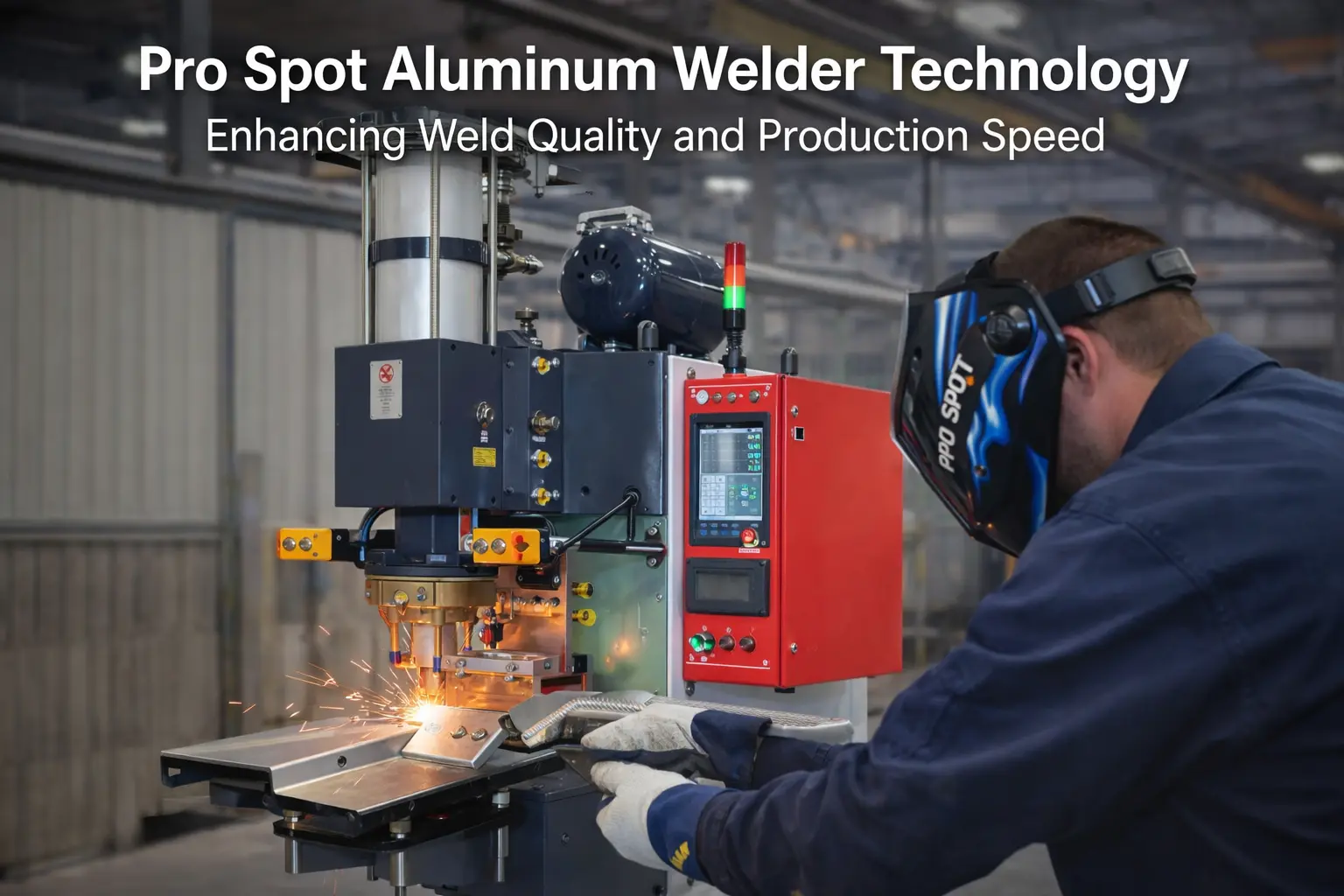
In modern manufacturing, joining aluminum components efficiently and reliably is a critical challenge for engineers and production managers. Aluminum’s high thermal conductivity and oxide layer make welding more complex compared to steel, requiring specialized equipment and expertise. An aluminum spot welder is the industry-standard solution for high-speed, repeatable, and high-quality welds in automotive, aerospace, electronics, and industrial applications.
Heron Welder, a global leader in resistance welding and metal-joining solutions, offers advanced aluminum spot welding systems designed to maximize productivity, maintain consistent quality, and integrate seamlessly into automated production lines.
What is an Aluminum Spot Welder?
An aluminum spot welder is a type of resistance welding machine that joins two or more aluminum sheets by applying pressure and passing a high electrical current through the contact area. The resistance of the metal at the contact point generates heat, which melts the aluminum locally, forming a strong metallurgical bond once it cools under pressure.
Key advantages of aluminum spot welding include:
-
Fast cycle times for high-volume production
-
Consistent weld quality with minimal operator intervention
-
Compatibility with automated and robotic systems
-
Reduced material distortion compared to fusion welding
Heron’s aluminum spot welders are engineered to handle thin-gauge aluminum sheets and complex assemblies, making them ideal for OEMs and industrial manufacturers who demand precision and efficiency.
Principles of Aluminum Spot Welding
Aluminum presents unique challenges in resistance welding due to:
-
High thermal conductivity, which causes heat to dissipate quickly.
-
Oxide layer formation, which increases electrical resistance at the surface.
-
Lower melting point, requiring precise control to avoid burn-through.
To address these challenges, modern aluminum spot welders incorporate:
-
MFDC (Medium-Frequency Direct Current) technology for precise current control
-
Adaptive electrode force management to ensure consistent weld nugget formation
-
Advanced cooling systems to maintain electrode temperature and prolong tool life
By controlling these variables, manufacturers achieve strong, repeatable welds while minimizing scrap and downtime.
Applications of Aluminum Spot Welders
Aluminum spot welding is widely used across industries where lightweight, corrosion-resistant, and high-strength assemblies are essential. Common applications include:
Automotive and EV Manufacturing
Aluminum spot welders are extensively used in body-in-white (BIW) assembly, battery enclosures, and chassis components. Heron’s systems are compatible with robotic integration for high-speed production lines, ensuring consistent weld quality for every vehicle.
Aerospace Components
In aerospace, aluminum alloys are standard due to their strength-to-weight ratio. Spot welding provides reliable joining without compromising structural integrity, especially for interior panels, brackets, and enclosures.
Electronics and Appliances
Thin aluminum sheets in electronic enclosures, heat sinks, and HVAC components require precise welding to avoid deformation. Heron’s advanced spot welders deliver uniform welds even on delicate assemblies.
Industrial Equipment
Heavy machinery, HVAC systems, and metal furniture often combine aluminum components that benefit from rapid, high-quality resistance welding, reducing assembly time and improving production efficiency.
Aluminum vs. Steel Spot Welding: Key Differences
While the principles of resistance welding are similar, aluminum requires more careful control compared to steel.
| Feature | Aluminum | Steel |
|---|---|---|
| Thermal Conductivity | High – heat dissipates quickly | Low – heat concentrates locally |
| Surface Oxide | Thick oxide layer, higher resistance | Thin oxide, minimal effect |
| Welding Current | Higher current, shorter duration | Lower current, longer duration |
| Electrode Wear | Faster, requires advanced cooling | Slower, simpler maintenance |
Heron’s aluminum spot welders are optimized for these differences, ensuring reliable welding performance even under demanding production conditions.
Best Practices for Aluminum Spot Welding
To maximize performance and weld quality, manufacturers should follow these best practices:
-
Clean aluminum surfaces to remove oxides and contaminants.
-
Use MFDC-controlled welders for precise current and pulse timing.
-
Regularly maintain electrodes and ensure proper alignment.
-
Monitor weld nugget formation through testing and real-time monitoring systems.
-
Integrate automation to reduce variability and improve throughput.
By combining equipment precision with proper process management, manufacturers can achieve consistent, high-strength welds with minimal defects.
Why Choose Heron for Aluminum Spot Welding?
Heron Welder provides:
-
Customizable spot welding systems tailored to production needs
-
Robust automation integration for factory lines and robotics
-
Expert technical support for process optimization and troubleshooting
-
Global manufacturing experience serving OEMs, industrial producers, and automation integrators
With Heron, manufacturers gain not just equipment, but a reliable partner in improving efficiency, quality, and production speed.
FAQs
1. Can aluminum spot welders handle different alloy types?
Yes, modern MFDC aluminum spot welders are designed to work with various aluminum alloys, including 5xxx and 6xxx series, with adjustable parameters for optimal weld quality.
2. How do I maintain electrode life?
Regular cleaning, proper cooling, and using high-quality copper electrodes significantly extend tool life while ensuring consistent welds.
3. Is aluminum spot welding compatible with robotics?
Absolutely. Heron’s spot welders can be fully integrated into robotic automation systems for precise, high-speed production.
4. What thickness of aluminum can be welded?
Typical applications range from 0.5 mm to 5 mm sheets, with custom solutions available for thicker assemblies.
5. How can I ensure weld consistency?
Implementing real-time monitoring, proper electrode maintenance, and precise MFDC-controlled parameters ensures repeatable, high-quality welds.
Ready to Optimize Your Aluminum Welding Process?
Heron Welder offers advanced aluminum spot welding solutions that combine precision, speed, and reliability for modern manufacturing lines. Whether you are an OEM, automation integrator, or production manager, Heron can provide customized systems, process consultation, and technical support to meet your unique requirements.
Request a quote today or consult our experts to discover how Heron’s aluminum spot welders can elevate your manufacturing efficiency and product quality.

 English
 Arabic
 French
 Spanish
 Portuguese
 Deutsch
 Dutch
Dutch
 Italiano
 Russian
 Romaian
 Portuguese (Brazil)
 Greek
Greek