


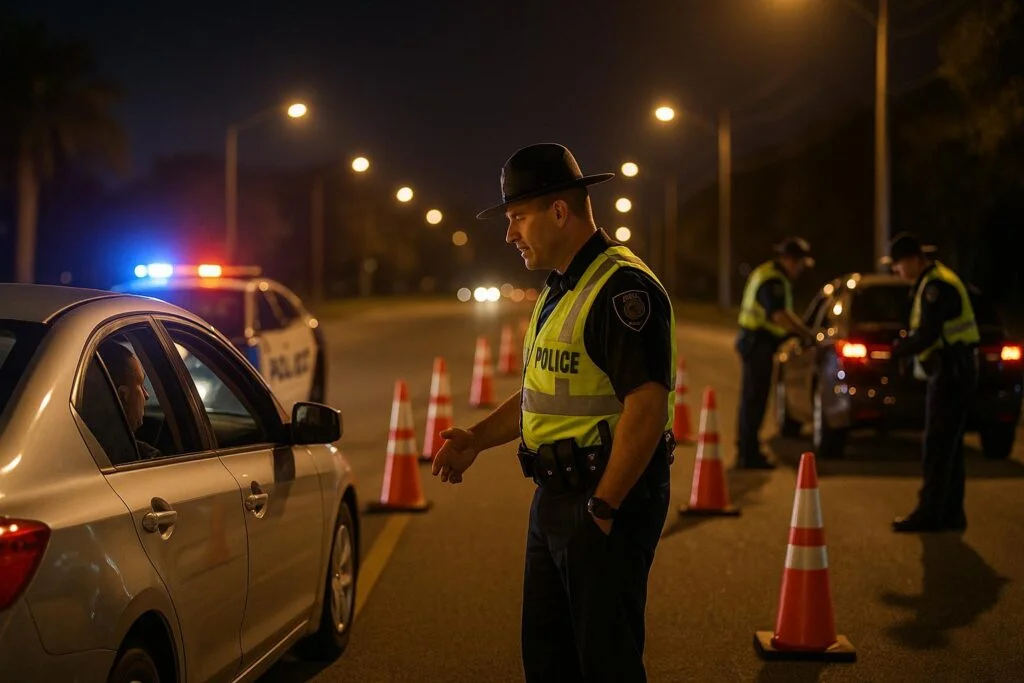
DUI Checkpoints in Florida: What Police Can and Cannot Do
DUI checkpoints are a common source of confusion and anxiety for drivers across Florida. Many people are unsure whether these checkpoints are legal, what police officers are allowed to ask, and what rights drivers have when approaching one. In Fort Pierce and throughout St. Lucie County, DUI checkpoints are used as part of law enforcement efforts to reduce impaired driving, but they must follow strict legal rules.
Understanding how DUI checkpoints work and where police authority ends can help drivers protect their rights and make informed decisions. This guide explains what Florida law allows, what officers can and cannot do, and why knowing these boundaries matters if a DUI arrest occurs.
Are DUI Checkpoints Legal in Florida?
Yes, DUI checkpoints are legal in Florida, but they are not unlimited in scope. Florida courts allow sobriety checkpoints only when law enforcement follows specific constitutional guidelines designed to protect drivers from unreasonable searches and seizures.
Unlike random traffic stops, DUI checkpoints must be planned in advance and conducted according to neutral criteria. Officers cannot arbitrarily stop vehicles or use checkpoints as a pretext to investigate unrelated crimes.
This balance between public safety and individual rights is central to how Florida evaluates the legality of DUI checkpoints.
What Police Must Do at a Florida DUI Checkpoint
For a DUI checkpoint to be lawful, law enforcement agencies must follow established procedures. While drivers may not see these plans, they exist to ensure fairness and constitutional compliance.
Generally, police must:
-
Follow a predetermined plan approved by supervising officers
-
Stop vehicles using a neutral pattern, such as every third or fifth car
-
Clearly identify the checkpoint with signs, cones, and marked patrol vehicles
-
Limit the duration and scope of the stop
Officers are allowed to briefly interact with drivers to check for signs of impairment. However, the encounter is intended to be short unless specific indicators justify further investigation.
If these requirements are not met, the legality of the checkpoint—and any resulting arrest—may be challenged by a dui defense attorney in fort pierce, fl.
What Police Can Ask You at a DUI Checkpoint
During a DUI checkpoint stop, police officers are typically permitted to request basic information, such as:
-
A driver’s license
-
Vehicle registration
-
Proof of insurance
Officers may also ask brief questions to determine whether the driver appears impaired. Observations may include speech patterns, odor of alcohol, or physical coordination.
Importantly, drivers are not required to answer questions about where they have been, what they drank, or whether they have consumed alcohol. Understanding this distinction can help drivers avoid unintentionally providing information that may be used later.
What Police Cannot Do at a DUI Checkpoint
Florida law places clear limits on police conduct at DUI checkpoints. Officers generally may not:
-
Detain drivers longer than necessary without reasonable suspicion
-
Search a vehicle without consent or legal justification
-
Stop vehicles randomly outside the checkpoint’s neutral pattern
-
Use checkpoints to investigate unrelated criminal activity
If an officer exceeds these boundaries, it may raise constitutional concerns. In such situations, a dui defense attorney in fort pierce, fl can evaluate whether a driver’s rights were violated and whether evidence should be excluded.
Can You Refuse Field Sobriety Exercises at a Checkpoint?
Field sobriety exercises are commonly used during DUI investigations, but they are not mandatory. Drivers may decline to perform these exercises, which are subjective and often influenced by factors unrelated to alcohol impairment.
Refusing field sobriety exercises does not automatically mean guilt, though officers may still rely on other observations. Understanding the role and limitations of these tests is an important part of knowing your rights at a checkpoint.
What Happens If You Are Arrested at a DUI Checkpoint?
If an officer believes there is probable cause, a DUI arrest may occur following a checkpoint stop. An arrest can trigger both criminal proceedings and administrative actions related to driving privileges.
At this stage, the details of how the checkpoint was conducted become highly relevant. Issues such as improper planning, lack of supervision, or extended detention times may affect the strength of the case.
A knowledgeable dui defense attorney in fort pierce, fl can review checkpoint procedures, officer conduct, and testing methods to determine whether the arrest complied with Florida law.
Why Knowledge of DUI Checkpoints Matters
Many DUI cases hinge on technical legal issues rather than assumptions of guilt. DUI checkpoints, while legal, are closely scrutinized by courts because they involve brief stops without individualized suspicion.
Drivers who understand their rights are better positioned to protect themselves and recognize when law enforcement crosses legal boundaries. Education and awareness are essential tools in navigating these encounters responsibly.
The Importance of Local Legal Insight
DUI checkpoint enforcement can vary by jurisdiction, including how local agencies plan and execute these operations. Fort Pierce cases are handled within the St. Lucie County court system, where local practices and procedures may influence how DUI cases are evaluated.
Consulting a dui defense attorney in fort pierce, fl provides insight into how local courts assess checkpoint legality and DUI evidence under Florida law.
Final Thoughts on DUI Checkpoints in Florida
DUI checkpoints are designed to promote road safety, but they must operate within strict legal limits. Knowing what police can and cannot do helps drivers remain calm, informed, and protected during these encounters.
If a checkpoint stop leads to legal concerns, understanding your rights and available options is a critical first step. Education not assumption is the key to navigating DUI checkpoint situations in Fort Pierce and throughout Florida.
For More Information Visit: https://lawofficeofjordizaragoza.com/
Frequently Asked Questions
Are DUI checkpoints announced in advance in Florida?
Law enforcement agencies often publicize checkpoints ahead of time, though advance notice alone does not determine legality. Proper planning and execution are what matter most.
Do I have to answer questions at a DUI checkpoint?
Drivers must provide identification and vehicle documents, but they are generally not required to answer questions about alcohol consumption.
Can a DUI checkpoint stop be challenged in court?
Yes. If a checkpoint was conducted improperly or violated constitutional guidelines, it may be challenged as part of a DUI defense.

 Arabic
 French
 Spanish
 Portuguese
 Deutsch
 Turkish
 Dutch
Dutch
 Italiano
 Russian
 Romaian
 Portuguese (Brazil)
 Greek
Greek