


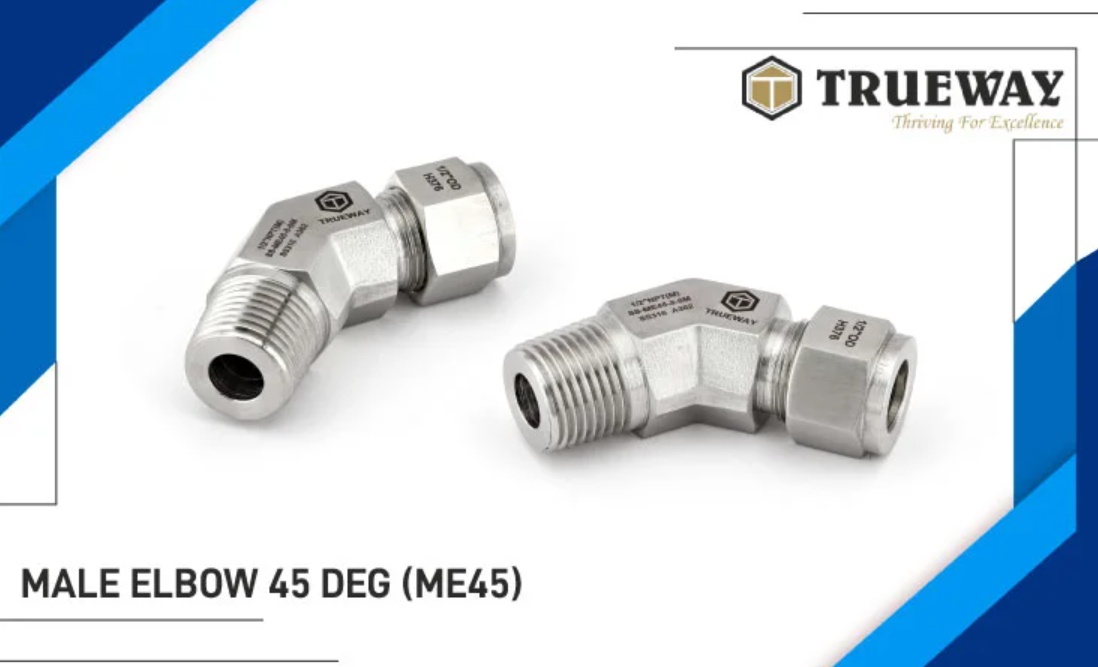
In the complex architecture of industrial plants, piping systems act as the veins and arteries of the facility. While the pipes carry the bulk of the fluids and gases, the tube fittings are the critical joints that ensure the system remains sealed, secure, and functional. Without these precision-engineered components, managing high-pressure, high-temperature, or corrosive media would be impossible.
For engineers and procurement managers in the Indian market, selecting the right tube fittings manufacturers is a decision that impacts the safety and efficiency of the entire operation. This guide breaks down the essential roles these components play and why brands like Trueway India are at the forefront of this industry.
1. What Exactly are Tube Fittings?
Tube fittings are mechanical components used to connect two or more tubes, or to connect a tube to a pipe, valve, or manifold. Unlike standard plumbing fittings, instrument tube fittings are designed to provide a leak-proof, metal-to-metal seal that can withstand extreme industrial environments without the need for welding.
The primary function of these fittings is to "grip" the tubing so securely that it cannot be blown out by internal pressure, while simultaneously creating a seal that prevents even microscopic gas molecules from escaping.
2. Key Roles in Industrial Piping Systems
Tube fittings perform several vital roles that keep a plant running smoothly:
Change of Direction: Elbow fittings allow piping to navigate around obstacles and through tight spaces.
Flow Distribution: Tees and crosses allow a single source of fluid to be diverted to multiple instruments or process lines.
Size Adaptation: Reducers allow the system to transition between different tube diameters while maintaining pressure integrity.
System Termination: Caps and plugs provide a secure way to close off a line for maintenance or future expansion.
3. The Superiority of Double Ferrule Systems
In critical industrial piping, the double ferrule compression design is the industry standard. This design, perfected by tube fitting manufacturers in India like Trueway India, utilizes a two-step mechanical process:
The Front Ferrule: Creates a pressure-tight seal against the fitting body and on the tube outside diameter.
The Back Ferrule: Mechanically grips the tube to prevent movement and provides vibration dampening.
This "spring-loaded" design allows the fitting to expand and contract during thermal cycling (heating and cooling) without losing its seal, making it ideal for high-pressure steam and chemical processing.
4. Why Material Choice is Non-Negotiable
In industrial piping, the media being transported—whether it's sour gas, sulfuric acid, or high-purity oxygen—dictates the material of the fitting. Most tube fittings manufacturers offer a range of alloys:
SS 316/316L: Provides excellent corrosion resistance and strength for most industrial applications.
Monel & Hastelloy: Used in highly corrosive marine or chemical environments.
Brass: A cost-effective choice for low-pressure air and water systems.
Using the wrong material can lead to "stress corrosion cracking," a leading cause of catastrophic pipe failure.
5. Sourcing Quality: The Rise of India's Manufacturing
The landscape of tube fitting manufacturers in India has evolved significantly. Companies are no longer just domestic suppliers; they are global exporters of high-precision hardware.
Trueway India, for instance, utilizes advanced CNC machining to ensure that every fitting meets international standards like ASTM F1387 and ISO 9001. Their focus on "zero-leak" technology ensures that Indian-made fittings are intermixable and interchangeable with global premium brands, offering world-class quality at competitive price points.
6. Maintenance and Reusability in Industrial Piping
One of the most valuable roles of a high-quality fitting is its ability to be disassembled and reassembled. In an industrial setting, instruments must be removed for calibration or repair regularly.
Reliable fittings feature silver-plated nuts to prevent "galling" (thread seizure), allowing maintenance teams to take the system apart and put it back together multiple times while maintaining a leak-proof seal. This reusability significantly lowers the total cost of ownership for the piping system.
Conclusion: The Backbone of Process Safety
Tube fittings may be small in size, but their role in industrial piping is monumental. From preventing environmental disasters to ensuring the accuracy of control instruments, these components are the backbone of process safety. By choosing precision-engineered instrument tube fittings from a trusted partner like Trueway India, you are investing in the long-term reliability of your facility.

 Arabic
 French
 Spanish
 Portuguese
 Deutsch
 Turkish
 Dutch
Dutch
 Italiano
 Russian
 Romaian
 Portuguese (Brazil)
 Greek
Greek