


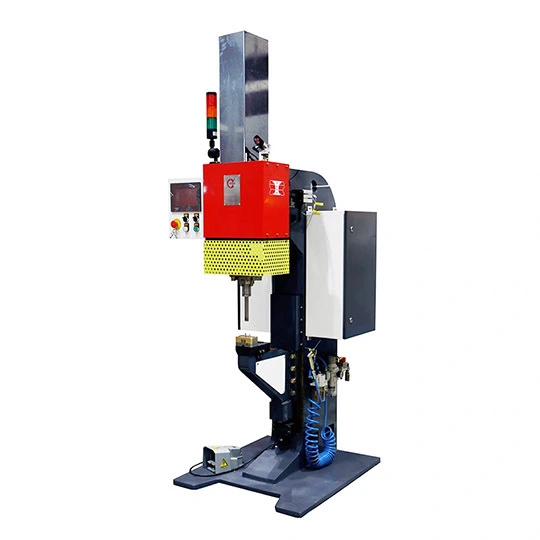
In today’s fast-paced manufacturing world, efficiency, reliability, and precision are non-negotiable. For industries such as automotive, aerospace, and metal fabrication, joining dissimilar metals without compromising structural integrity is a key challenge. Self pierce riveting (SPR) has emerged as a versatile solution, offering high-speed, consistent, and strong joints in sheet metal assemblies. Heron Welder, a global leader in industrial welding and metal-joining technologies, provides state-of-the-art SPR systems that optimize production and enhance automation capabilities.
What is Self Pierce Riveting?
Self pierce riveting is a mechanical fastening process that joins two or more layers of sheet metal using a semi-tubular rivet. Unlike traditional riveting methods, SPR does not require pre-drilled holes, making it ideal for high-volume production lines. The process involves driving a rivet through the top sheet and flaring it in the bottom sheet, forming a robust mechanical interlock.
Key advantages include:
-
Compatibility with dissimilar materials such as aluminum, steel, and coated sheets.
-
No need for heat or welding, reducing thermal distortion and material stress.
-
High-speed operation, ideal for automated assembly lines.
-
Consistent, repeatable joint quality, supporting industry standards.
Heron’s SPR solutions are engineered for precision and efficiency, ensuring reliable metal joining for complex assemblies.
How Self Pierce Riveting Works
The SPR process relies on three core components: the rivet, the die, and the riveting press or gun. Here’s a simplified step-by-step explanation:
-
Rivet Positioning – A semi-tubular rivet is aligned with the top sheet at the desired joint location.
-
Piercing Action – The rivet is driven through the top sheet by a hydraulic or servo-controlled press.
-
Flare Formation – The rivet pierces the bottom sheet without cutting through, creating a flange that locks the materials together.
-
Joint Completion – The result is a clean, strong joint with minimal deformation, ready for subsequent assembly operations.
Heron’s automated SPR systems integrate precision controllers and adjustable dies to ensure uniform rivet flaring and minimal cycle time, supporting lean manufacturing practices.
Applications of Self Pierce Riveting
Self pierce riveting is widely used across industries where high-strength, visually clean, and efficient metal joining is critical:
Automotive Manufacturing
-
Body-in-white assembly for passenger vehicles
-
Aluminum-intensive structures for lightweight vehicles
-
Joining dissimilar metals in EV battery enclosures
Aerospace & Aviation
-
Airframe assembly requiring high-strength, vibration-resistant joints
-
Interior panels and structural reinforcements
Industrial & Consumer Goods
-
Sheet metal fabrication for appliances, HVAC systems, and enclosures
-
Machinery panels and protective covers
SPR is particularly valuable in high-volume production environments where traditional welding may compromise aesthetics, material properties, or cycle time.
SPR vs. Traditional Welding
Understanding the differences between self pierce riveting and conventional welding helps manufacturers select the right joining method:
| Feature | Self Pierce Riveting | Resistance / Spot Welding |
|---|---|---|
| Heat Input | Minimal | High, can cause distortion |
| Material Compatibility | Dissimilar metals easily joined | Limited to similar metals |
| Surface Finish | Clean, minimal marks | Potential burn marks |
| Automation | High-speed automated lines | Requires precise electrode management |
| Cycle Time | Very short | Medium, may need cooling periods |
Heron Welder’s SPR systems combine the speed of automation with high joint quality, often outperforming traditional welding in both versatility and aesthetic quality.
Best Practices for Effective SPR Implementation
To maximize the benefits of self pierce riveting, consider these best practices:
-
Material Assessment – Evaluate the thickness, coating, and type of metal sheets to select the correct rivet and die combination.
-
Joint Design – Plan rivet placement to optimize strength and minimize distortion.
-
Quality Monitoring – Use inline sensors or vision systems to detect misfires or misalignment.
-
Automation Integration – Pair SPR machines with robotic arms or automated conveyors for consistent, high-volume production.
-
Maintenance & Calibration – Regularly inspect rivet tooling, dies, and press parameters to maintain precision and reduce downtime.
Heron provides end-to-end support, from consultation and joint design to turnkey automated SPR systems, ensuring manufacturers achieve reliable results on every line.
FAQs About Self Pierce Riveting
1. Can SPR join aluminum to steel?
Yes, self pierce riveting is ideal for joining dissimilar metals like aluminum and steel, making it perfect for lightweight automotive structures.
2. Does SPR require pre-drilled holes?
No, the rivet pierces the top sheet directly, eliminating the need for pre-drilled holes and reducing cycle time.
3. What industries benefit most from SPR?
Automotive, aerospace, industrial machinery, and consumer appliance manufacturing are the primary sectors leveraging SPR for high-strength, clean joints.
4. How does SPR compare to spot welding in terms of cycle time?
SPR typically achieves faster cycle times with minimal thermal distortion, supporting high-speed automated production lines.
5. Can SPR be integrated with robotics?
Absolutely. Heron’s automated SPR systems are designed for robotic integration, enabling precise, high-volume assembly with consistent quality.
Why Choose Heron for SPR Solutions
Heron Welder has decades of experience in industrial welding, metal joining, and automation solutions. Our self pierce riveting machines are:
-
High precision and adaptable for multiple materials and thicknesses
-
Automation-ready for modern factory lines
-
Backed by technical support for installation, calibration, and maintenance
Whether you’re a manufacturing engineer, OEM, or production manager, Heron delivers customized SPR systems that streamline assembly, reduce downtime, and improve product quality.
Take the Next Step in Advanced Metal Joining
Self pierce riveting is reshaping industrial assembly with speed, precision, and reliability. Heron Welder’s advanced SPR solutions help manufacturers stay ahead in competitive industries.
Request a quote or consult with our experts today to explore SPR machines, automated lines, and other welding solutions tailored to your production needs. Visit Heron Welder to connect with a specialist and optimize your metal joining processes.

 English
 Arabic
 French
 Spanish
 Portuguese
 Deutsch
 Turkish
 Dutch
Dutch
 Italiano
 Romaian
 Portuguese (Brazil)
 Greek
Greek