


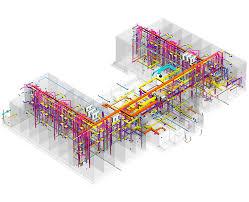
High-rise and large-scale developments have become a defining feature of the UAE’s urban landscape. Cities like Dubai and Abu Dhabi are home to some of the world’s tallest towers, expansive mixed-use complexes, and mega infrastructure projects. These developments demand highly efficient, coordinated, and reliable building systems. Mechanical, Electrical, and Plumbing systems play a critical role in the performance, safety, and comfort of such buildings, and managing them using traditional methods is increasingly challenging. This is where MEP BIM Services have become essential for successful project delivery in the UAE.
Understanding MEP BIM Services
MEP BIM Services involve the creation of intelligent 3D models for mechanical, electrical, and plumbing systems within a building. These models include detailed information about HVAC systems, power distribution, lighting, water supply, drainage, and fire protection. Unlike conventional 2D drawings, BIM models integrate spatial, technical, and data-driven information into a single coordinated environment.
For high-rise and large-scale developments in the UAE, this integrated approach allows design teams to visualize how complex MEP systems interact with the building structure and architectural elements, reducing uncertainty and improving overall project efficiency.
Complexity of MEP Systems in High-Rise Buildings
High-rise buildings present unique challenges for MEP design. Vertical distribution of services, high-capacity HVAC systems, pressure management for plumbing, and reliable electrical networks must all function seamlessly across dozens of floors. In large-scale developments such as airports, hospitals, and commercial hubs, these challenges are multiplied by scale and operational demands.
MEP BIM Services help manage this complexity by enabling engineers to design and analyze systems in a three-dimensional environment. This allows for better planning of shafts, plant rooms, risers, and service corridors, which is critical in UAE projects where space optimization and performance are key priorities.
Improved Coordination Across Disciplines
One of the most significant advantages of MEP BIM Services is enhanced coordination between disciplines. In high-rise and large-scale developments, clashes between MEP systems and structural or architectural elements can lead to costly delays and rework if not identified early.
Through BIM, MEP models are coordinated with structural and architectural models to detect clashes before construction begins. This is particularly valuable in UAE projects that follow fast-track schedules and involve multiple stakeholders. Early clash detection helps maintain timelines, control costs, and improve collaboration between consultants and contractors.
Enhancing Design Accuracy and System Performance
Accuracy is crucial in large and tall buildings, where even small design errors can have significant consequences. MEP BIM models provide precise layouts, dimensions, and system specifications, reducing the risk of errors that often occur with manual drafting.
By simulating system performance within the BIM environment, engineers can evaluate airflow, load distribution, and system capacity more effectively. This leads to better-performing buildings that meet the UAE’s high expectations for comfort, reliability, and energy efficiency.
Supporting Energy Efficiency and Sustainability Goals
The UAE has placed increasing emphasis on sustainability and energy efficiency through initiatives such as Estidama, LEED, and the UAE Net Zero strategy. MEP systems are a major contributor to a building’s energy consumption, especially in high-rise developments with intensive cooling requirements.
MEP BIM Services support sustainable design by enabling energy analysis, system optimization, and accurate equipment selection. Designers can test different scenarios and select solutions that reduce energy consumption while maintaining performance. This aligns well with the UAE’s vision for sustainable urban development and environmentally responsible construction.
Streamlining Construction and Installation Processes
In large-scale developments, the installation of MEP systems is a complex and resource-intensive process. BIM models provide contractors with clear and coordinated information, reducing ambiguity during installation.
MEP BIM Services allow for detailed shop drawings and prefabrication-ready models, which are increasingly common in UAE projects. Prefabrication improves quality, reduces waste, and accelerates installation, making it ideal for high-rise buildings with tight site constraints and demanding schedules.
Improving Cost Control and Risk Management
Cost overruns are a major concern in large and complex projects. MEP BIM models enable more accurate quantity take-offs and cost estimation, helping stakeholders manage budgets more effectively.
By identifying potential issues early, BIM reduces the risk of unexpected changes during construction. For developers and contractors in the UAE, this proactive risk management approach is essential for maintaining financial control in high-value projects.
Facilitating Compliance and Authority Approvals
High-rise and large-scale developments in the UAE must comply with strict regulations and authority requirements. MEP BIM models provide a clear and comprehensive representation of system design, making it easier to demonstrate compliance with local codes and international standards.
Authorities and consultants can review coordinated BIM outputs more efficiently than traditional drawings. This clarity can help streamline approval processes and reduce delays, which is particularly important for landmark projects with high public visibility.
Long-Term Value for Building Owners and Operators
The value of MEP BIM Services extends beyond design and construction into the operational phase of a building. Accurate as-built BIM models serve as a valuable resource for facility management, maintenance planning, and future upgrades.
For large-scale UAE developments such as commercial towers, hotels, and healthcare facilities, having reliable digital documentation of MEP systems improves operational efficiency and reduces long-term maintenance costs. This lifecycle benefit supports the growing adoption of smart building technologies across the region.
The Contribution of Specialized BIM Service Providers
Delivering effective MEP BIM Services requires technical expertise, advanced tools, and an understanding of local project requirements. Experienced service providers play a crucial role in ensuring that BIM implementation delivers real value rather than just digital models.
ENGISOFT ENGINEERING is one such provider offering MEP BIM Services that support high-rise and large-scale developments in the UAE. By focusing on coordination, accuracy, and compliance, their services help project teams manage complex MEP systems more efficiently and achieve smoother project execution.
Conclusion
MEP BIM Services have become a cornerstone of successful high-rise and large-scale developments in the UAE. By addressing complexity, improving coordination, enhancing sustainability, and supporting lifecycle management, BIM enables project teams to meet the demanding requirements of modern construction.
As UAE cities continue to grow vertically and expand in scale, the role of MEP BIM will only become more significant. With the support of experienced providers like ENGISOFT ENGINEERING, developers and consultants can deliver efficient, compliant, and future-ready buildings that reflect the UAE’s vision for innovation and excellence in the built environment.

 English
 Arabic
 French
 Spanish
 Portuguese
 Deutsch
 Turkish
 Italiano
 Russian
 Romaian
 Portuguese (Brazil)
 Greek
Greek