


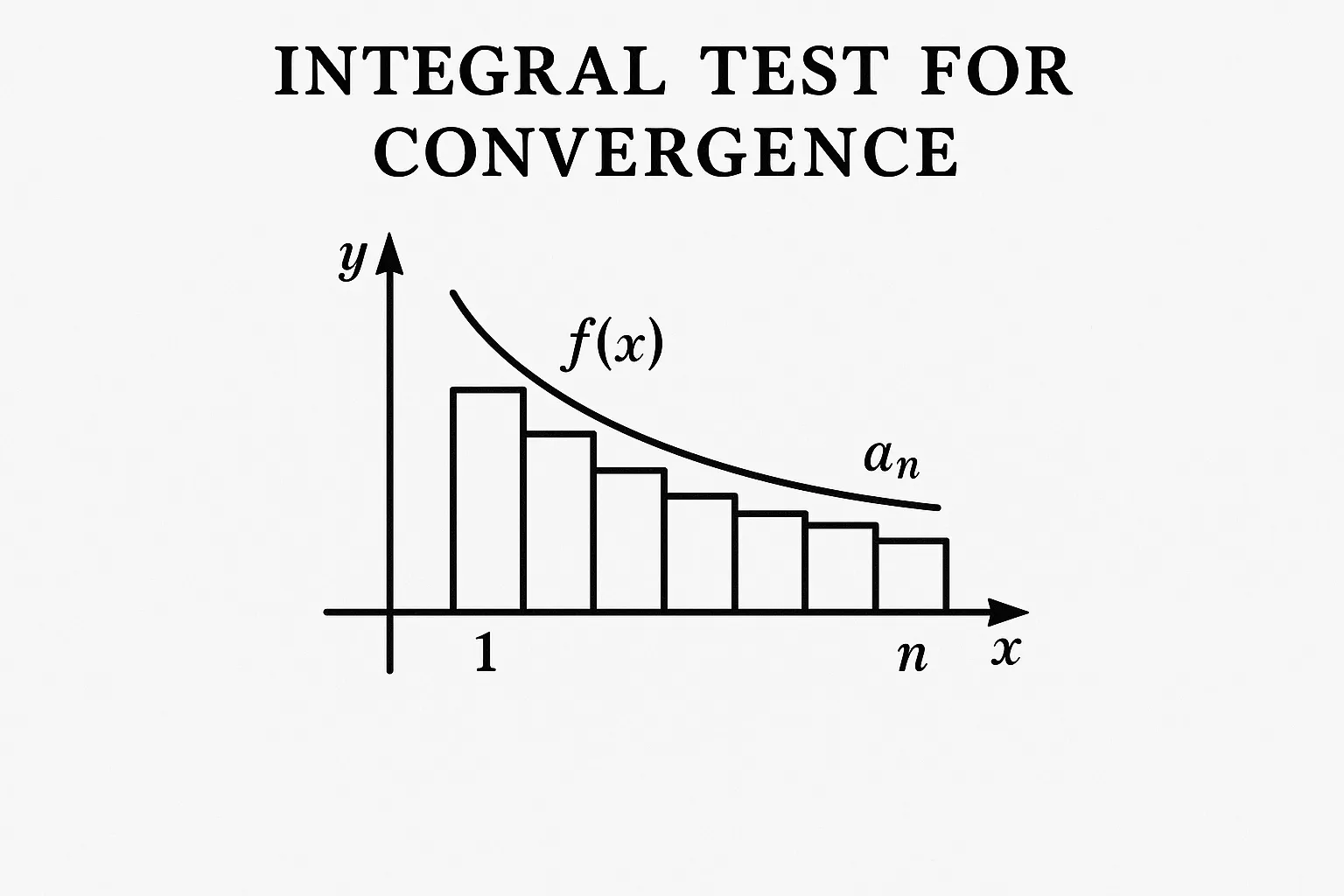
Infinite series are foundational in calculus and mathematical analysis, but determining whether a series converges or diverges can be challenging. One of the most powerful tools for this purpose is the integral test for convergence, a method that connects infinite series with integrals to determine their behavior.
In this article, we’ll explore integral test for convergence in depth, explain how and when to use it, walk through illustrative examples, and provide tips to apply it confidently.
What Is the Integral Test for Convergence?
The integral test for convergence is a technique used to determine whether an infinite series converges by comparing it to an improper integral. Specifically, if you have a series:
∑𝑛=1∞𝑎𝑛n=1∑∞an
and a function 𝑓(𝑥)f(x) such that 𝑓(𝑛)=𝑎𝑛f(n)=an for all 𝑛n, and if 𝑓(𝑥)f(x) is positive, continuous, and decreasing for 𝑥≥𝑁x≥N, then the behavior of the series is tied to the behavior of the integral:
∫𝑁∞𝑓(𝑥) 𝑑𝑥∫N∞f(x)dx
-
If the improper integral converges, then the series converges.
-
If the integral diverges, then the series also diverges.
This correlation makes the integral test an elegant bridge between discrete sums and continuous integration.
When to Use the Integral Test
The integral test is particularly useful when working with series whose terms are generated by a function that is easy to integrate. Typical cases where this test applies include:
-
Series involving rational functions
-
Series with logarithmic or power expressions
-
Series that resemble known integrable functions
However, the conditions for applicability — continuity, positivity, and monotonic decrease — must always be checked before applying the test.
How the Integral Test Works: Step-by-Step
To apply the integral test, follow these general steps:
-
Define the corresponding function:
Let 𝑓(𝑥)=𝑎𝑥f(x)=ax such that 𝑓(𝑛)=𝑎𝑛f(n)=an. -
Verify conditions:
Ensure that 𝑓(𝑥)f(x) is positive, continuous, and decreasing for all 𝑥≥𝑁x≥N. -
Set up the improper integral:
Evaluate the integral:
∫𝑁∞𝑓(𝑥) 𝑑𝑥∫N∞f(x)dx -
Analyze the integral:
If the integral converges, conclude that the series converges; if it diverges, the series diverges.
The power of this test lies in converting a potentially complicated sum into an integral that may be easier to evaluate.
Example 1: p-Series
Consider the p-series:
∑𝑛=1∞1𝑛𝑝n=1∑∞np1
Let 𝑓(𝑥)=1𝑥𝑝f(x)=xp1. Since 𝑓(𝑥)f(x) is positive, continuous, and decreasing for 𝑝>1p>1, we evaluate:
∫1∞1𝑥𝑝 𝑑𝑥∫1∞xp1dx
This integral converges if and only if 𝑝>1p>1. By the integral test, the series converges when 𝑝>1p>1 and diverges when 𝑝≤1p≤1. This result is a classic outcome in series analysis.
Example 2: Logarithmic Series
Now consider:
∑𝑛=2∞1𝑛(ln𝑛)𝑝n=2∑∞n(lnn)p1
Let 𝑓(𝑥)=1𝑥(ln𝑥)𝑝f(x)=x(lnx)p1. For 𝑥>2x>2, this function is positive and decreasing for 𝑝>1p>1. Evaluate:
∫2∞1𝑥(ln𝑥)𝑝 𝑑𝑥∫2∞x(lnx)p1dx
Using substitution 𝑢=ln𝑥u=lnx, this integral converges if and only if 𝑝>1p>1. Therefore, the series converges for 𝑝>1p>1 and diverges otherwise.
Advantages of the Integral Test
The integral test offers several key benefits:
-
Clear criteria: It provides a direct comparison between a series and an integral.
-
Useful for many functions: Especially effective for series that resemble continuous functions.
-
Helps classify broad classes of series: Many common series fall neatly into cases where the integral test applies.
Limitations and Considerations
While powerful, the integral test has limitations:
-
It does not provide the sum of the series — only convergence or divergence.
-
It requires the function to be positive, continuous, and monotonically decreasing. If these conditions aren’t met, the test cannot be applied.
-
Other tests like comparison, ratio, or root tests may be more appropriate depending on the series.
Integral Test vs Other Convergence Tests
It’s helpful to compare the integral test with other common tests:
-
Comparison Test: Compares series with known benchmarks.
-
Ratio Test: Uses limits of term ratios, useful for factorial or exponential terms.
-
Root Test: Based on nth roots of terms.
Each test has its strengths; choosing the right one depends on the form of the series.
Conclusion
The integral test for convergence is a fundamental tool in mathematical analysis that provides a powerful way to determine the behavior of infinite series. By translating a series into an integral, this method allows mathematicians and students alike to analyze convergence with clarity and precision.
Whether tackling p-series, logarithmic expressions, or other complex series, the integral test remains a reliable and insightful technique in the study of mathematical series.

 English
 Arabic
 French
 Spanish
 Portuguese
 Deutsch
 Turkish
 Dutch
Dutch
 Italiano
 Russian
 Romaian
 Greek
Greek