


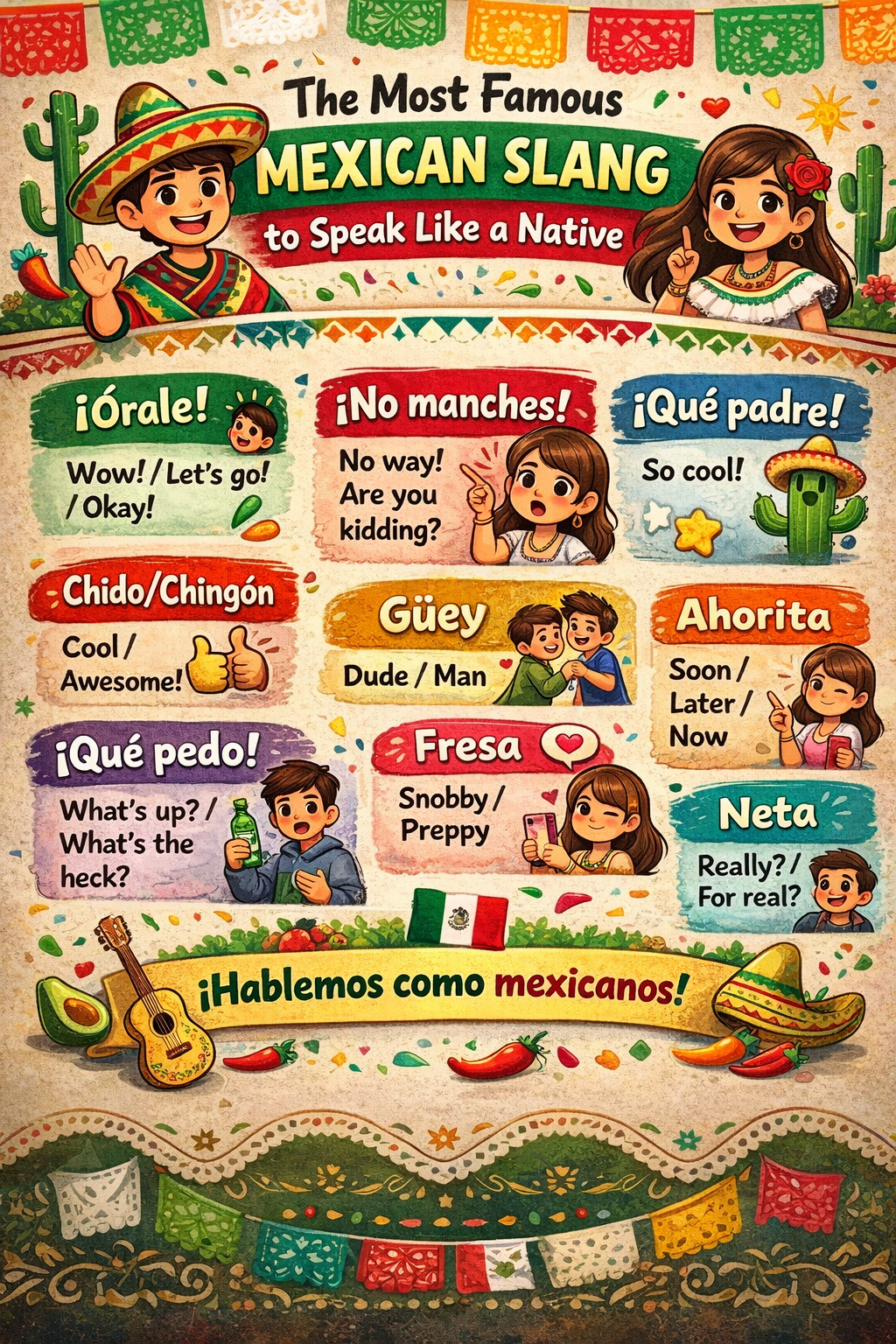
Slang terms have taken over the world. There are hardly any countries in the world where the locals do not communicate in a language of their own. Even if you learn the language, there are always certain slang words and phrases that make you feel like an outsider, which is why learning about these slang terms can be useful when visiting any new country.
If you are planning a visit to Mexico, whether for pleasure or for work, being familiar with the most famous Mexican slang terms can be very useful, as they allow you to communicate efficiently with the locals without any issues. This guide tells you about the most famous slang terms that are used by people in Mexico and other Latin nations.
Exploring the most common and popular Mexican slang terms
-
Güey
This term is one of the most famous slang terms not only in Mexico, but all Spanish-speaking countries. The word is similar to ‘dude’ in English, which means that people use it to refer to their close friends or acquaintances. In some unpleasant situations, the term also refers to strangers sarcastically. The pronunciation of the term is like 'whey' in English.
-
Neta
Neta is yet another term that you will undoubtedly come across in movies, TV shows, and also from your Mexican friends. The word means 'the truth' or 'for real' in a very basic way. Besides that, questioning and exclaiming its truth are also forms of use.
-
Chavo or Chava
This is a very common word that is a part of people’s vocabulary in Mexico. Chavo/Chava is used by people to refer to young ones, whether children or teens. Chav is used for boys, whereas chava is used for girls. The term has a similar connotation as ‘kid’ in English.
-
No manches
No manches! (Really? or Are you kidding?) is a sentence that you would utter when a friend reveals to you a fantastic event or something you doubt its existence. You can also use ¡No mames! which is another expression for the same thing, but it is a bit more vulgar (like damn!).
-
¡Órale!
This word carries several meanings, among them: to express amazement, to give a thumbs-up, to show excitement, and even to comply with commands.
-
¡Aguas!
The word is strange, yet it does not refer to the physical state of being wet. It means the opposite of being stunned and losing awareness of your surroundings.
-
Pinche
Typically, it is an adjective used to denote something as ugly, terrible, or of very low quality. It might also be a curse word that strengthens an insult and brings out the features of that insult (like "fucking" in English).
-
Chido
For instance, Mexicans usually say "chido" to anything that they consider cool or that has a nice atmosphere. It can be said about people, things, or events.
-
No hay bronca
To start with, the term "bronca" is commonly employed to refer to the state of having a problem or being irritated. So, you can pretty much visualize that "no hay bronca" equals no problem - everything is just fine.

 English
 Arabic
 French
 Spanish
 Portuguese
 Turkish
 Dutch
Dutch
 Italiano
 Russian
 Romaian
 Portuguese (Brazil)
 Greek
Greek