


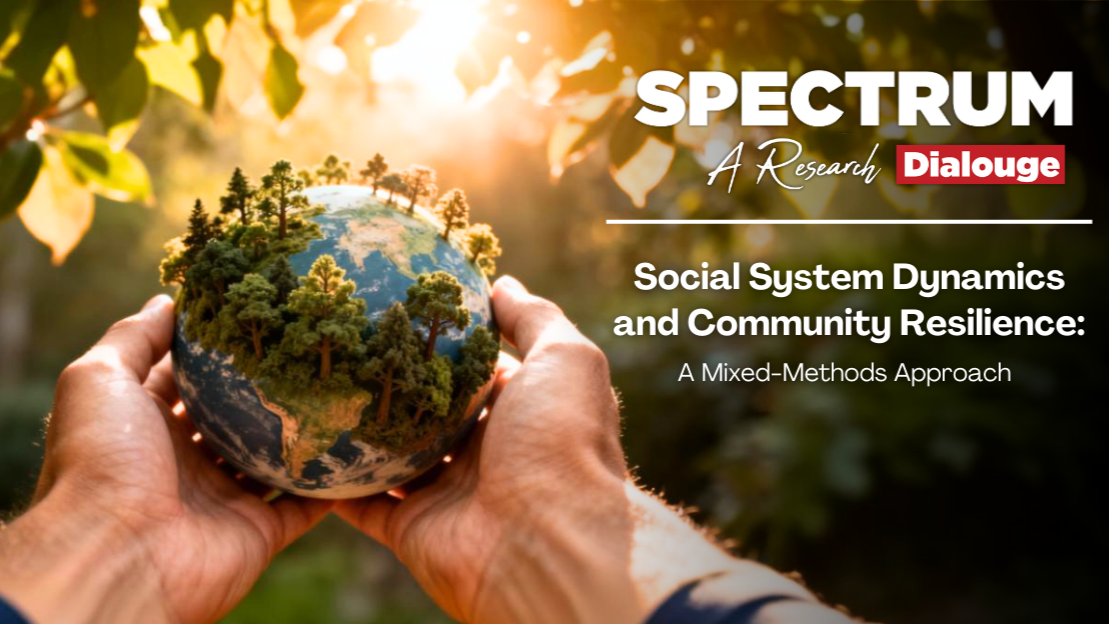
KL University is elated to announce a significant contribution to research on the global study of community resilience. It was led by Dr. A. Jagdish Mohan Rao from the Department of Commerce. At a time when societies worldwide are dealing with climate pressures, economic instability, and random urban transitions, his study brings clarity to the social forces that enable communities to adapt, recognize, and recover.
Community resilience is often understood through physical systems and infrastructure, but Dr Rao’s research shifts the focus to the social dynamics that make communities strong from within. His publication, “Social System Dynamics and Community Resilience: A Mixed-Methods Approach,” featured in the Journal of Infrastructure, Policy and Development (Vol. 8, Issue 15), examines how relationships, governance practices, and collective behavior shape a community’s ability to respond to disruptions.
The study uses a mixed-methods approach, bringing together quantitative data and qualitative insight to map how communities function under stress. It identifies three core elements that influence resilience:
- The way people connect, communicate, and collaborate
- How governance decisions are shaped, interpreted, and implemented
- How social systems reorganize when faced with uncertainty
Rather than viewing resilience as a reaction, the research frames it as an ongoing system created through daily social processes. These findings underline the need to strengthen social cohesion and governance as much as physical infrastructure.
This really matters now because communities across the world are navigating challenges that test their stability at multiple levels. Dr Rao’s work offers an evidence-based framework for policymakers, planners, and development practitioners looking to understand the deeper forces behind community adaptability. It also reinforces a central insight: strong social systems form the backbone of long-term resilience.
Dr Rao’s work is part of a larger research ecosystem within KL University, where faculty explore themes such as community development, governance systems, socio-economic processes, and resilience modeling. The department encourages collaboration, interdisciplinary thinking, and real-world engagement, offering students opportunities to participate in field studies and community-based projects.
This culture of inquiry reinforces KL University’s position among the top universities in Vijayawada, known for fostering research that connects academic scholarship with real societal needs. Studies like this help chart pathways toward communities that are adaptive, inclusive, and equipped to face the uncertainties of the future.

 Arabic
 French
 Spanish
 Portuguese
 Deutsch
 Turkish
 Dutch
Dutch
 Italiano
 Russian
 Romaian
 Portuguese (Brazil)
 Greek
Greek