


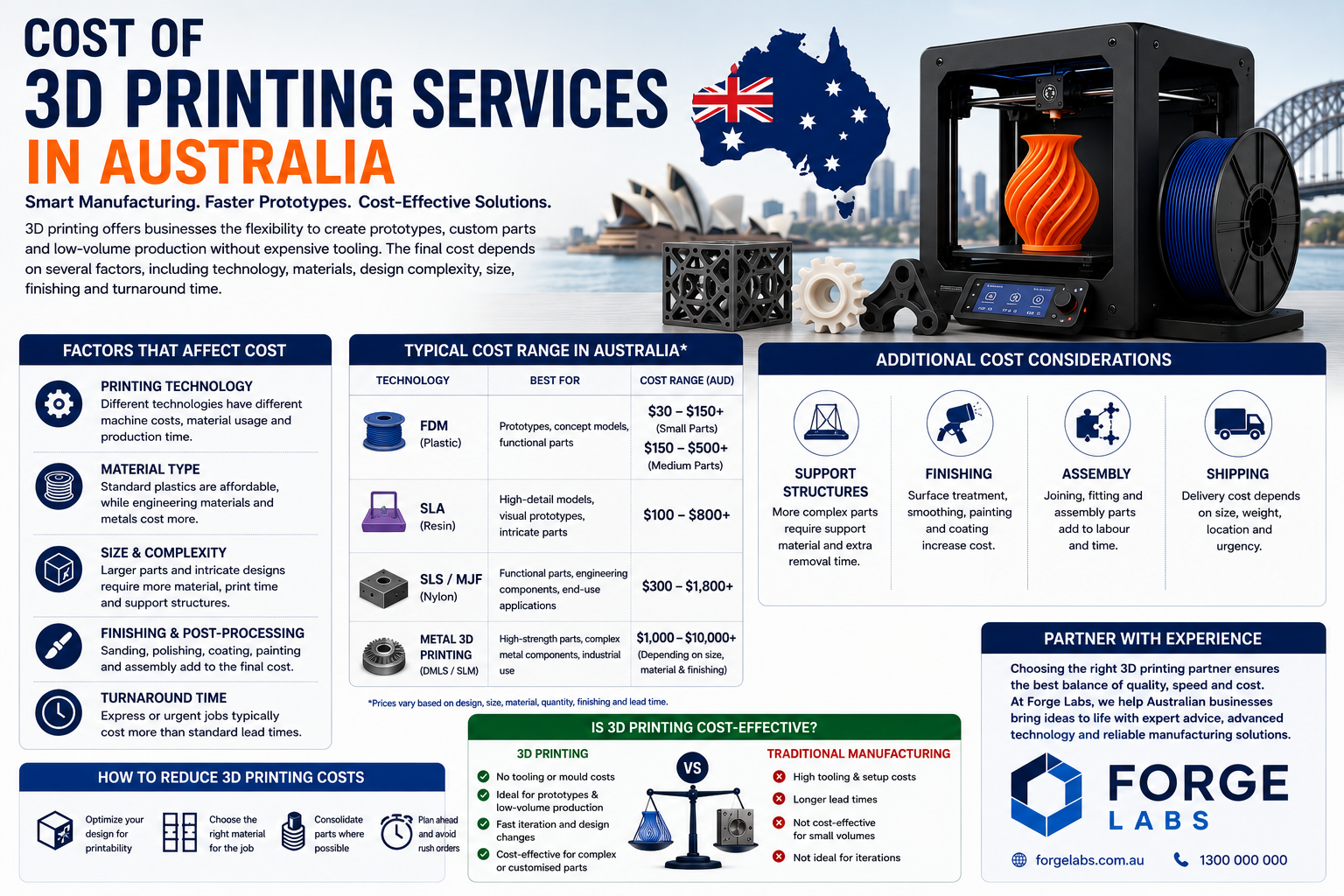
3D printing has become a valuable manufacturing solution for Australian businesses looking to develop products faster and more efficiently. From prototypes and engineering parts to customised products and low-volume manufacturing, additive manufacturing offers flexibility that traditional production methods often cannot match. However, one of the most common questions businesses ask is — how much do 3D printing services cost in Australia?
The answer depends on several factors, as 3D printing pricing is usually tailored to the specific project.
Understanding 3D Printing Pricing
Unlike traditional manufacturing methods that require expensive tooling and moulds, 3D printing pricing is generally based on production requirements.
Professional 3D printing providers often calculate cost using:
- Material consumption
- Machine operating time
- Design complexity
- Labour and setup
- Finishing requirements
- Delivery timelines
This pricing structure makes 3D printing suitable for both simple prototypes and complex industrial components.
Printing Technology and Cost Differences
The type of 3D printing technology used has a major impact on pricing.
FDM Printing
FDM is often the most budget-friendly option.
It is commonly used for:
- Concept models
- Product prototypes
- Functional plastic parts
- Design testing
Because machine and material costs are relatively low, FDM works well for affordable prototyping.
SLA Resin Printing
SLA printing delivers smooth finishes and greater detail.
This technology is popular for:
- Presentation models
- Precision prototypes
- Dental and medical applications
- Small detailed components
While SLA provides higher visual quality, resin materials and curing processes usually make it more expensive than FDM.
SLS and Nylon Printing
SLS and powder-based printing technologies produce stronger and more durable parts.
These methods are often used for:
- Functional engineering parts
- Mechanical testing
- Industrial components
- Production applications
The improved strength and industrial performance typically involve higher costs.
Metal 3D Printing
Metal printing is the premium end of additive manufacturing.
Industries using metal printing include:
- Aerospace
- Medical manufacturing
- Automotive
- Industrial engineering
Because of specialised machinery and metal materials, metal printing usually carries the highest production costs.
Material Choice Influences Cost
Materials play a major role in final pricing.
Common options include:
- PLA and ABS plastics
- Nylon
- Resin
- Carbon-fibre composites
- Engineering plastics
- Metal powders
Basic plastics remain affordable, while advanced engineering materials and metals increase production costs due to performance and handling requirements.
Selecting the right material helps balance cost, strength, and functionality.
Size and Complexity Matter
Part size and design complexity significantly influence pricing.
Larger and more detailed parts often require:
- More material
- Longer print times
- Additional support structures
- Greater machine usage
- Extra finishing work
Complex designs may also increase labour and post-processing requirements.
Optimising designs before production can often reduce unnecessary expenses.
Finishing and Post-Processing Costs
Printing is often only part of the manufacturing process.
Additional finishing may include:
- Sanding
- Polishing
- Painting
- Vapour smoothing
- Surface coating
- Assembly
These services improve aesthetics and functionality but can increase total project cost.
Businesses should consider these requirements when planning budgets.
Turnaround Time and Delivery
Delivery speed can also affect pricing.
Standard production schedules are usually the most affordable, while urgent or express manufacturing often attracts premium charges due to prioritised machine and labour allocation.
Planning projects early can help reduce overall manufacturing costs.
Why 3D Printing Can Be Cost-Effective
Despite varying prices, 3D printing often delivers strong value compared with traditional manufacturing.
It helps businesses avoid:
- Expensive tooling
- Long setup times
- Large minimum production runs
- Costly design changes
This makes additive manufacturing particularly useful for:
- Rapid prototyping
- Product testing
- Engineering revisions
- Custom manufacturing
- Low-volume production
The flexibility to update and improve designs quickly often saves businesses money over time.
Choosing the Right 3D Printing Provider
Price is important, but reliability and expertise matter just as much.
Businesses should compare providers based on:
- Print quality
- Technical expertise
- Material capability
- Customer support
- Delivery timelines
- Manufacturing experience
Experienced companies such as Forge Labs help businesses manage costs effectively through expert guidance, material recommendations, and dependable manufacturing support.
Final Thoughts
The cost of 3D printing services in Australia depends on technology, materials, complexity, finishing, and delivery requirements.
Affordable plastic prototypes and advanced industrial components both have their place depending on project goals. By understanding these cost factors and working with an experienced provider like Forge Labs, businesses can achieve high-quality results while keeping manufacturing efficient and cost-effective.

 English
 Arabic
 Spanish
 Portuguese
 Deutsch
 Turkish
 Dutch
Dutch
 Italiano
 Russian
 Romaian
 Portuguese (Brazil)
 Greek
Greek