


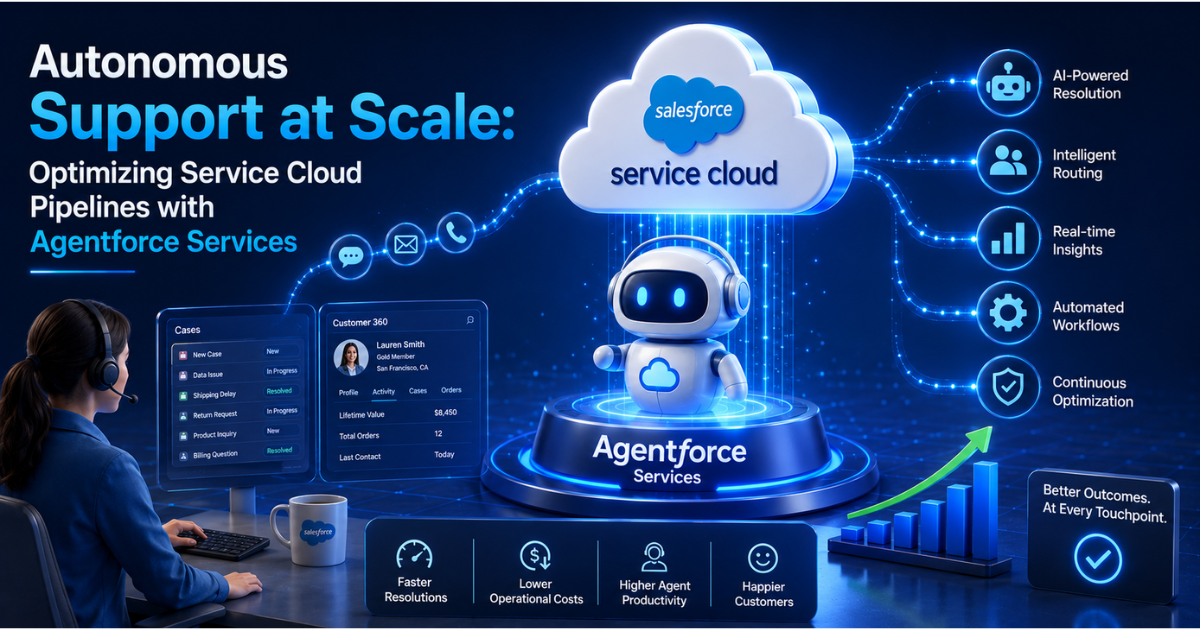
The operational parameters of enterprise customer support are shifting rapidly. Standard contact center frameworks are struggling under the weight of high ticket volumes and complex system routing. Historically, corporations tried to manage this burden by deploying traditional, rule-based chatbots.
These early automation tools relied on rigid decision trees. They failed when customers used complex phrasing or deviated from strict, linear scripts. This technical limitation forced human agents to handle repetitive, low-value tickets constantly, which increased operational costs and delayed resolution times.
Recent financial performance updates from Salesforce show a major shift toward autonomous enterprise operations. In early 2026, combined Agentforce and Data 360 annual recurring revenue surpassed $3.4 billion, tripling year-over-year. Enterprises have processed over 3.8 billion agentic work units across production environments.
This growth shows that global organizations are moving past simple pilots. They are actively integrating autonomous engines into their primary systems. This guide provides a detailed technical breakdown of Salesforce Agentforce Development. It focuses on how specialized implementations optimize Service Cloud pipelines to handle autonomous customer support at scale.
Technical Architecture of the Agentforce Framework
Unlike classic conversational tools that generate text summaries, Agentforce relies on an autonomous execution engine. The platform evaluates goals, creates multi-step resolution paths, and executes backend transactional tools independently.
1. The Atlas Reasoning Engine
The Atlas Reasoning Engine serves as the core intelligence layer of the system. When an inbound interaction enters the pipeline, the engine does not look for exact keyword matches. Instead, it analyzes the user input to determine customer intent.
The engine cross-references this intent against an enterprise semantic metadata graph. It then designs a logical sequence of steps to fulfill the user's request. This design process repeats continuously during a conversation, allowing the agent to adapt if the customer changes requirements mid-stream.
2. Topics, Actions, and Guardrails Definition
Developers organize agent behavior by defining precise structural components inside the system configuration:
-
Topics: These represent the primary functional categories of your support pipeline. Examples include Billing Inquiries, Technical Troubleshooting, or Order Modifications.
-
Actions: These act as the operational tools available to the agent. Actions can include standard Salesforce Flows, specific Apex classes, or external REST API endpoints.
-
Guardrails: These establish strict behavioral and data access boundaries. Guardrails prevent the system from executing unauthorized actions or discussing topics outside the defined corporate scope.
The Data Foundation: Fueling Agents with Harmonized Profiles
An autonomous support engine requires access to real-time, high-fidelity customer records. If an agent operates with stale data, it will execute incorrect business logic.
1. Real-Time Data Cloud Ingestion
Advanced Salesforce Agentforce Development Services connect the reasoning layer to Salesforce Data Cloud. The platform utilizes zero-copy data federation to stream information from corporate repositories like Snowflake or Google BigQuery.
This infrastructure merges distinct data points, including recent commerce transactions, open service cases, and website telemetry logs. It compiles these inputs into a single, comprehensive customer profile.
2. Supplying Deep Contextual Relevance
When a customer contacts the help center, the agent queries this unified profile engine instantly. It checks the user's loyalty tier, reviews recent fulfillment statuses, and looks up past satisfaction ratings.
This immediate data access eliminates the need for customers to repeat information. It ensures the autonomous agent can make safe, context-aware decisions during complex interactions.
Technical Mechanisms for Optimizing Service Cloud Pipelines
Integrating an autonomous agent layer transforms how tickets flow through your support organization. The system shifts from a reactive triage model to an autonomous resolution framework.
1. Smart Case Creation and Automatic Classification
When an interaction requires human intervention, the agent handles the case creation process programmatically. It analyzes the conversation history to classify the record automatically.
The system uses natural language processing to extract key variables, populate custom metadata fields, and assign correct priority levels. This automated processing removes manual triage steps from the support pipeline.
2. Advanced Skill-Based Routing Orchestration
The system goes beyond basic keyword matching to route complex issues. It evaluates the conversational context and matches it against an internal human skills matrix.
For instance, if a commercial buyer reports a specific hardware failure, the system identifies field engineers holding relevant technical certifications. It routes the case directly to the optimal specialist, reducing internal transfers and accelerating case resolutions.
Building Custom Tool Extensions for Autonomous Agents
To execute backend transactions, agents require functional connections to internal core logic. Developers build these pathways by linking the agent layer to existing Salesforce automation assets.
1. Integrating Platform Flows and Core Apex Logic
Developers can expose standard Salesforce Flows to the reasoning engine directly. The engine reads the flow's input and output metadata schemas automatically to understand its function.
When a customer requests an allowed transaction, such as changing an installation date, the agent maps the conversation variables into the flow parameters and executes the script. For complex calculations, developers write invocable Apex classes to execute highly optimized backend operations.
2. Exposing External Microservices via MuleSoft APIs
Enterprise service workflows often require data from legacy software systems running outside the Salesforce platform. Developers bridge this gap using MuleSoft API integrations.
They expose legacy mainframe routines as secure, OpenAPI-compliant REST endpoints. This setup allows the agent to check inventory databases, update legacy billing registries, and verify logistics schedules across the enterprise.
| Integration Pathway | Primary Use Case | Execution Engine | System Overhead |
| Salesforce Flow | Internal CRM data updates and record modifications | Native Platform Flow Engine | Low |
| Invocable Apex | Complex programmatic calculations and heavy filtering | Core Apex Runtime | Medium |
| MuleSoft REST API | Connecting to external legacy enterprise mainframes | Distributed API Gateway | Medium to High |
Securing the Agentic Pipeline and Enforcing Trust
Deploying autonomous agents requires strict adherence to corporate security and data privacy rules. Organizations must ensure that large language models protect customer records at all times.
1. Configuring the Einstein Trust Layer
Professional Salesforce Agentforce Development Services configure the Einstein Trust Layer to secure all AI operations. This gateway scrubs incoming customer text to mask personally identifiable information (PII), such as credit card numbers or national identity codes, before sending payloads to external language models.
The trust layer also inspects outbound model responses through automated toxicity and compliance scanners. This screening blocks inappropriate or inaccurate content before it reaches the customer interface.
2. Implementing Strict Role-Based Access Controls
Autonomous agents operate under the same data security frameworks that govern human employees. Developers implement strict role-based access controls (RBAC) within the agent profiles.
If a specific user profile lacks permission to view wholesale pricing tables, the agent cannot access that data. This architecture prevents data leaks and maintains corporate compliance standards.
Observability, Lifecycle Management, and Continuous Testing
Maintaining high support standards requires ongoing visibility into how autonomous agents behave. Production code needs regular monitoring and systematic testing frameworks.
1. Monitoring the Reasoning Trail via Agentforce Analytics
Administrators track agent performance using advanced observability dashboards. The system records the complete reasoning trail for every customer conversation.
These audit logs show exactly how the Atlas engine evaluated intent, selected specific topics, and triggered backend actions. This transparency allows engineering teams to identify logic errors and optimize prompt templates quickly.
2. Implementing Automated Regression Testing
Because the system interprets natural language dynamically, minor prompt modifications can alter agent responses across various use cases. Developers protect core workflows by running automated regression testing suites.
These tools simulate thousands of parallel support conversations to evaluate agent accuracy. Testing tools verify that new configurations do not cause regression errors or bypass safety guardrails before deploying updates to production.
Real-World Benefits of Automated Support Architecture
Transitioning from legacy chatbots to a fully integrated, autonomous agent framework delivers measurable financial and operational improvements. Organizations track several core metrics to measure project success.
-
Faster Ticket Resolutions: Automated case processing and contextual execution allow the system to resolve routine issues up to 30% quicker.
-
Higher First-Contact Resolutions: Access to real-time data from Data Cloud helps the agent solve complex queries immediately, resulting in a 65% first-contact resolution rate.
-
Lower Operating Costs: Automating high-volume, repetitive tasks reduces human agent workloads, lowering contact center operating expenses by 15% to 30%.
-
Improved Operational Scalability: The autonomous engine processes thousands of customer interactions simultaneously, allowing support pipelines to scale fluidly without increasing headcounts.
Conclusion
Deploying autonomous support at scale requires a clear, technical strategy. Rigid, rule-based chatbots cannot satisfy modern customer expectations. Salesforce Agentforce Development provides a robust, alternative framework that replaces brittle conversational loops with a dynamic reasoning engine and integrated backend execution tools.
Utilizing professional Salesforce Agentforce Development Services connects your artificial intelligence models directly to your primary data layers. This structural approach ensures your autonomous agents operate with clean customer records, execute safe automation scripts, and follow strict corporate guardrails. This comprehensive engineering strategy helps enterprises scale their customer service pipelines, reduce support costs, and maintain high performance across their entire support ecosystem.

 English
 Arabic
 French
 Spanish
 Portuguese
 Turkish
 Dutch
Dutch
 Italiano
 Russian
 Romaian
 Portuguese (Brazil)
 Greek
Greek