


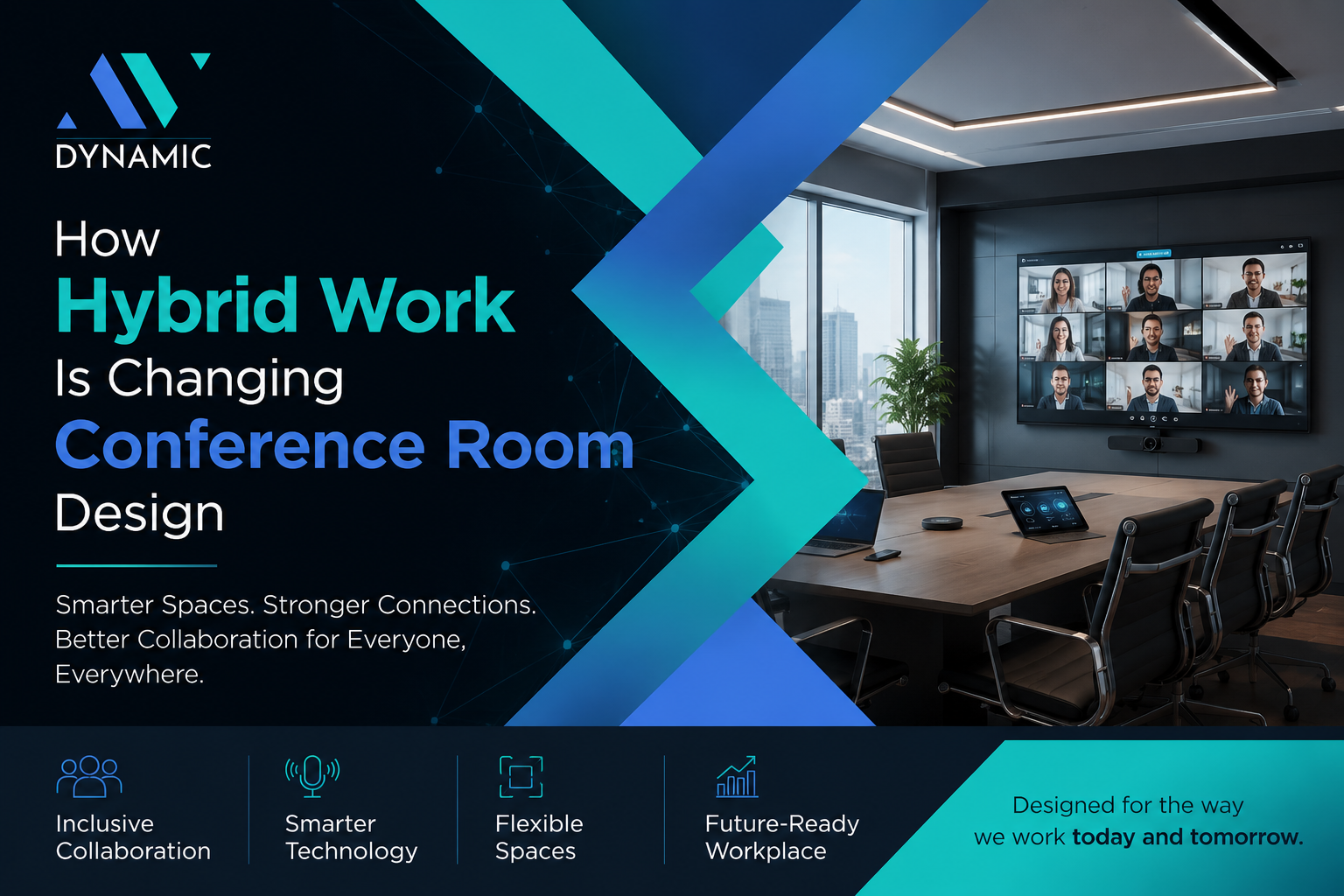
A few years ago, conference rooms were designed for one simple purpose gather everyone in the same room and start the meeting.
That approach no longer works.
Today’s meetings often include people joining from different cities, home offices, coworking spaces, and even mobile devices. Hybrid work has changed the way teams communicate, and because of that, businesses are rethinking how meeting spaces should function.
Conference rooms are no longer just physical spaces with a table and projector. They are becoming collaboration environments built for both in-person and remote participation.
The Meeting Room Experience Has Changed
In traditional office setups, most people attending a meeting were physically present in the room. Remote attendees were usually treated as secondary participants.
Hybrid work changed that completely.
Now, remote employees are part of everyday operations. If they cannot hear properly, see clearly, or participate naturally, the entire meeting experience suffers.
This shift has forced organizations to redesign conference rooms around communication quality instead of just room appearance.
The focus today is:
Can every participant feel equally involved?
Modern Conference Rooms Need Better Technology
One of the biggest changes in conference room design is the integration of smarter AV technology.
Businesses are investing in:
- Intelligent video conferencing systems
- High-quality microphones
- Auto-tracking cameras
- Wireless presentation tools
- Smart room controls
The reason is simple.
People expect meetings to start quickly and run smoothly without technical delays. Employees no longer want to spend the first ten minutes fixing audio or reconnecting devices.
A modern meeting room should feel effortless.
Smaller Spaces Are Becoming More Useful
Large boardrooms are no longer the center of workplace collaboration.
Hybrid work has increased the need for smaller meeting areas where teams can connect quickly without booking massive conference spaces.
Many offices are now creating:
- Huddle rooms
- Quick collaboration spaces
- Focus meeting zones
- Flexible discussion areas
These smaller rooms are easier to manage and often deliver better meeting experiences because the technology setup is more controlled.
For many organizations, multiple smaller rooms are proving more practical than one oversized conference hall.
Audio Quality Is Now a Top Priority
Video matters, but audio matters more.
People can continue a conversation with average video quality. They cannot continue if voices are unclear.
Poor sound creates constant interruptions:
- People repeat themselves
- Discussions lose momentum
- Remote participants disconnect mentally
- Meetings become exhausting
Because of this, businesses are paying more attention to acoustics, microphone placement, and noise control while designing meeting spaces.
Clear communication is becoming the foundation of conference room planning.
Flexibility Matters More Than Formality
Older conference rooms were designed to look formal and impressive.
Today, businesses want rooms that adapt easily.
Hybrid work requires flexibility because meeting styles constantly change. One meeting may involve presentations, while another may be a brainstorming session with remote participants joining online.
Modern conference room designs now focus on:
- Movable furniture
- Wireless connectivity
- Multi-purpose layouts
- Easy device integration
- Comfortable collaboration environments
The goal is to support productivity rather than maintain rigid office traditions.
Smart Features Are Becoming Standard
Automation is slowly becoming part of everyday meeting spaces.
Many conference rooms now include features like:
- One-touch meeting launch
- Automatic camera framing
- Occupancy detection
- Voice-controlled systems
- Wireless screen sharing
These small improvements reduce friction during meetings and improve user experience.
Employees want technology that works quietly in the background without requiring constant technical support.
Hybrid Work Is Influencing Office Design Overall
Conference rooms are only one part of a larger workplace transformation.
Businesses are redesigning offices to support:
- Collaboration instead of fixed seating
- Flexible work schedules
- Remote team participation
- Shared work environments
As a result, meeting spaces are becoming more dynamic, technology-focused, and user-friendly.
The office is evolving from a place where people simply “come to work” into a place designed for communication and collaboration.
Final Thoughts
Hybrid work is not a temporary trend anymore. It has permanently changed how organizations operate.
Conference room design is evolving because businesses now understand that successful meetings depend on more than just physical space.
Modern meeting rooms must support seamless communication between people working from anywhere.
Companies that adapt to this shift are creating workplaces that are more connected, efficient, and prepared for the future of collaboration.

 English
 Arabic
 French
 Portuguese
 Deutsch
 Turkish
 Dutch
Dutch
 Italiano
 Russian
 Romaian
 Portuguese (Brazil)
 Greek
Greek