


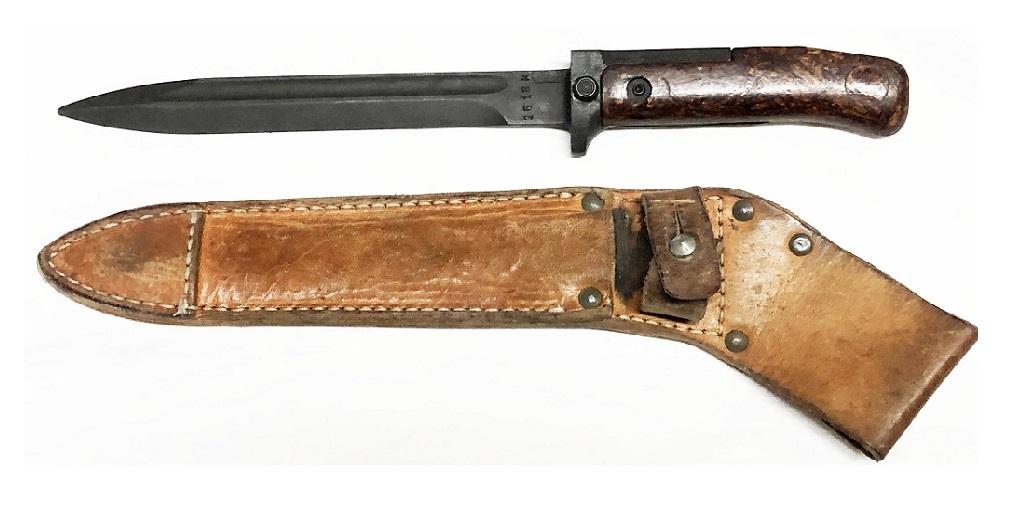
The M9 bayonet is only one of many official models that have served in the hands of American soldiers since the turn of the last century. Among these were the sword-style M1905, the M1 (a shortened version intended for and compatible with the Garand rifle), and the M5, designed for use in the Korean War, and which was easier to fix and remove with heavy gloves on.
The M9 was introduced in 1986 as a replacement for the earlier M7 bayonet; both were designed for the M16 rifle which is still in service.
Also known as the M9 Phrobis III, the M9 bayonet can be somewhat of a polarizing model. Here’s what to know.
What Users Have Liked
The M9 bayonet was ultimately designed to be a multi-purpose tool that could serve not only as an auxiliary weapon to a firearm, but as a field knife imbued with much farther-reaching utility.
It sports a 7-inch blade, a generous crossguard, and is issued with a scabbard that has a lug on it. This lug corresponds to a hole in the blade near the tip. The two can be attached, and the knife can be used as a pair of impromptu shears or wire cutters. This bayonet can also be used as a bottle opener and screwdriver.
There have been some persistent tales about the fragility of the M9 bayonet, but the truth is that it features both a thicker blade and a more robust stock than the earlier M7, so it definitely gets points for this among those who have carried it that recognize this.
One other value-added feature of the M9 is that it generally sports a sawback blade which gives it the ability to cut more efficiently through wood, rope, plastic or other similar materials. That said, this feature is sometimes seen as a detriment, which will be explored in the next section.
And Not So Much
It is the case that the M9 is a highly utilitarian tool that has a lot of fans, and it is an enduring model that has not just been used by American servicemen but by others in official service around the world.
That being said, the design is not without its flaws and there are some that have commented on this. There are two main commonly cited shortcomings.
The main is that there are some pervasive myths that the bayonet is prone to breakage, and that the M7 is a better design. However, as has been stated, the M9 is actually made with a thicker blade and stouter tang, so whether or not this is just a rumor is subject to doubt.
That being said, the allegations persist, and there are some that believe this, whether or not they have actually carried or used an M9. The claims follow the bayonet around.
The other, and there is some merit to this, is that in most M9 bayonets and replicas the serrations on the spine are too wide and too shallow to be used effectively for most tasks that require a saw.
However, there are some replicas based on the M9 that offer more practical serrations, so if that feature appeals to you, just be discerning before you commit to a purchase. Some are better than others.
Where to Get an M9 Bayonet
If after reading this you are still interested in getting an M9 bayonet or a replica for your collection, visit SARCO. They carry an exhaustive collection of military collectibles, including knives, swords and bayonets for sale in addition to guns and parts.
Check out their collection and if you have questions about specifications, authenticity, compatibility, care or otherwise before you buy, get in touch with them.
For more information about 1911 Build Kit and Parts Kit Please visit: Sarco Inc.

 English
 Arabic
 French
 Spanish
 Portuguese
 Deutsch
 Turkish
 Dutch
Dutch
 Russian
 Romaian
 Portuguese (Brazil)
 Greek
Greek