


Walk into any factory floor where machines run 18 hours a day and you’ll notice something interesting — most equipment failures don’t start with massive breakdowns. They start with tiny connection issues. A loose bolt. A mismatched washer. The wrong thread pitch. I’ve seen production lines stop over a ₹5 component more times than most people would believe.
That’s the thing about fasteners.
They look small. They’re not small.
For engineering businesses, construction firms, OEM manufacturers, and fabrication units, choosing the right fastening solution isn’t just procurement work. It affects safety, vibration resistance, maintenance cycles, and honestly… reputation too.
At Anello Fasteners, we’ve worked with businesses that needed everything from heavy-load industrial bolts to precision locking systems using circlip solutions and stainless steel dowel pins. And honestly? The biggest mistake companies make is treating all fasteners like interchangeable hardware.
They aren’t.
Why Engineering Industries Depend So Much on the Right Fastening System
A bad weld fails visibly.
A poor fastener choice fails silently first.
Thus, fastening systems constructed to the exacting standards of an engineering discipline rely on the ability to distribute load, resist corrode, endure vibration, expand and contract with thermal changes and maintain tensile strength. This is especially so in assemblies in the automotive industry, heavy machinery, rail systems and industrial automation.
And here’s where many purchasing teams get it wrong — they focus only on price per unit instead of lifecycle performance.
Cheap fasteners usually become expensive maintenance.
The Most Common Types of Fasteners Used in Engineering
Engineering applications use different fastening systems depending on load, alignment, movement, pressure, and environmental exposure. Let’s break down the major ones.
Bolts and Nuts — The Backbone of Industrial Assembly
If you’re dealing with structural frameworks, machinery mounting, or industrial fabrication, bolts and nuts are unavoidable.
No surprise there.
The combination of fasteners screws bolts remains one of the most reliable joining methods because it allows disassembly without damaging components. That matters in maintenance-heavy industries.
Common Engineering Bolts
-
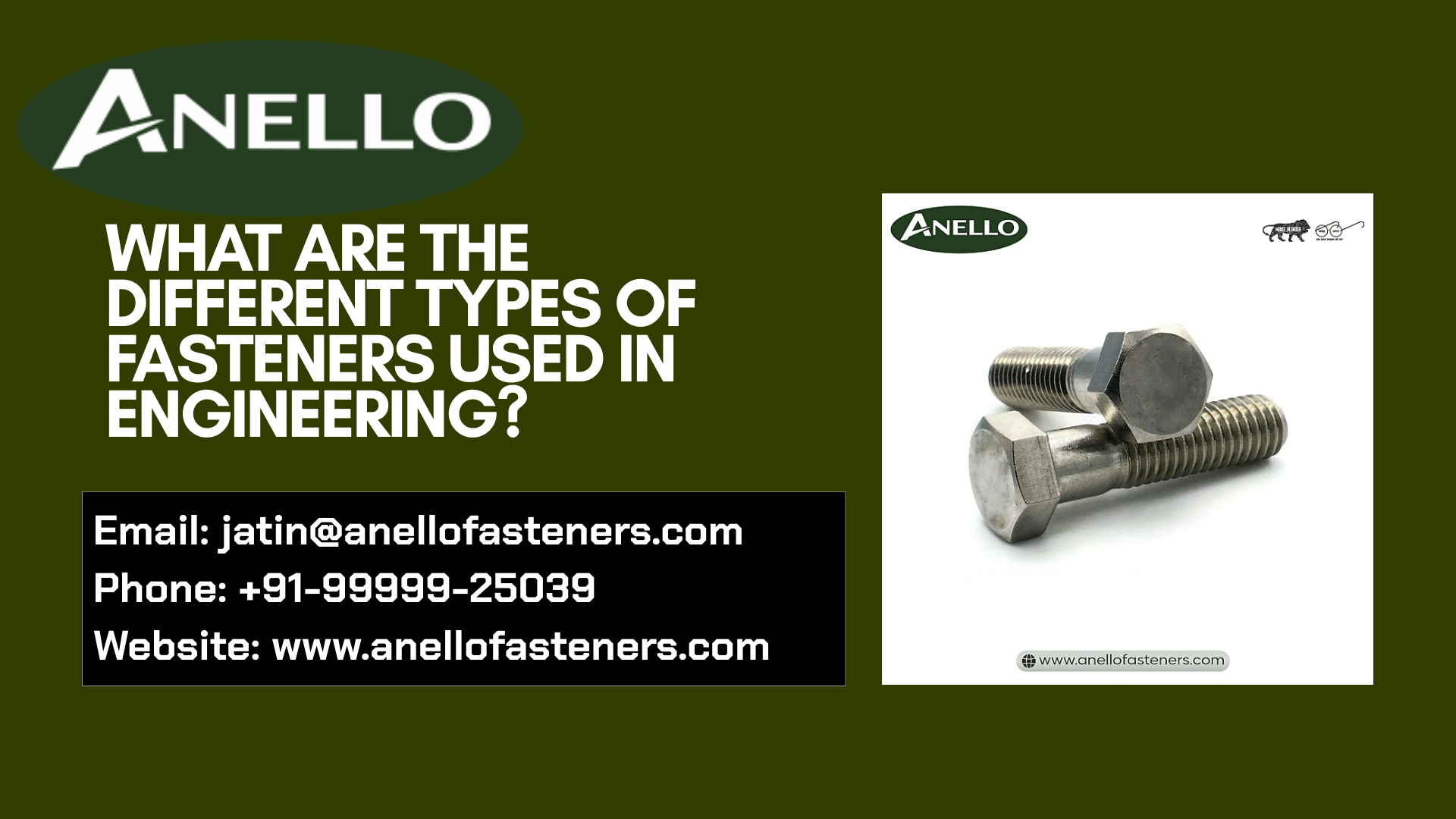
Hex bolts
-
Carriage bolts
-
Flange bolts
-
Anchor bolts
Each serves a different purpose. A flange bolt distributes pressure better. Anchor bolts handle concrete mounting. Simple difference… huge operational impact.
We’ve seen OEM manufacturers shift to higher-grade alloy bolts simply because vibration fatigue kept damaging assemblies during transport.
And honestly? That upgrade alone solved recurring service complaints.
Nuts Matter More Than People Think
Lock nuts, coupling nuts, wing nuts, castellated nuts — different environments need different holding strength.
A standard nut in a high-vibration application is asking for trouble.
Screws Aren’t Just “Small Bolts”
A lot of buyers casually group screws and bolts together. Technically? They behave differently.
Fitting screws are usually designed to create their own mating action or work with threaded holes directly. They’re heavily used in electronics, sheet metal assemblies, automotive interiors, and precision engineering.
Popular Screw Types in Engineering
Machine Screws
Used where precision threads are already created.
Self-Tapping Screws
Perfect for softer materials and quick assembly work.
Socket Head Screws
Common in machinery where high torque and compact fitting are required.
You’d be surprised how often improper screw selection causes stripped threads in production environments.
Actually… maybe you wouldn’t.
The Role of Circlip Systems in Modern Engineering
Now this is where engineering gets interesting.
A circlip may look insignificant, but it performs a critical retaining function in rotating assemblies. Bearings, shafts, gear systems, transmissions — they rely heavily on properly installed retaining rings.
And yet many companies still overlook circlip quality.
Internal and External Circlips — What’s the Difference?
Internal circlips and external circlips
-
Internal circlips fit inside bores or housings.
-
External circlips fit around shafts.
Simple distinction. Completely different applications.
The wrong size or material grade can lead to axial movement, bearing failure, and shaft misalignment.
Not immediately though. That’s what makes it dangerous.
Why Engineering Firms Focus on Reliable Circlip Solutions
Good retaining rings must handle:
-
Rotational stress
-
Thermal variation
-
High-speed motion
-
Repeated load cycles
That’s why businesses often work with experienced Circlip Suppliers and trusted Circlip Dealers in India rather than generic hardware vendors.
Because consistency matters.
Really matters.
Understanding Circlip Sizes
One wrong measurement and installation integrity disappears.
Proper circlip sizes depend on:
-
Groove diameter
-
Shaft tolerance
-
Housing dimensions
-
Load requirements
A professional Fasteners Manufacturer in India usually provides engineering tolerance support — which saves enormous troubleshooting time later.
Dowel Pins — Small Components, Precision-Level Importance
Honestly, dowel pins don’t get enough attention in manufacturing discussions.
But ask any precision machining team.
They know.
What Are Dowel Pins Used For?
Dowel Pins are cylindrical fastening elements used for accurate positioning and alignment between machine parts. Unlike threaded fasteners, they’re mainly about precision rather than clamping force.
And precision matters everywhere:
-
Tooling fixtures
-
CNC assemblies
-
Automotive dies
-
Aerospace components
-
Gear housings
A few microns of misalignment can destroy assembly accuracy.
Types of Precision Dowel Pins
Precision dowel pins
Designed for tight tolerance engineering applications where alignment must remain exact across repeated operations.
Stainless steel dowel pins
Ideal for corrosive or moisture-prone environments. Common in food processing and pharmaceutical machinery.
Hardened Steel Dowel Pins
Used in high-wear industrial applications.
Many OEM buyers specifically look for reliable Dowel Pins Suppliers in India because imported batches sometimes create tolerance inconsistencies across large production runs.
And that creates assembly headaches nobody wants.
Choosing Reputable Dowel Pin Manufacturers
A lot comes down to the accuracy of machining and consistency in hardness.
Partnering with a good Dowel Pins Manufacturer or one of the established Dowel Pins Manufacturers in India usually means:
-
Better dimensional control
-
Consistent material quality
-
Reliable surface finishing
-
Reduced rejection rates
That’s not marketing talk. That’s shop-floor reality.
Washers — The Most Ignored Engineering Component
People underestimate washers constantly.
Then vibration loosens the joint.
Flat washers distribute load. Spring washers reduce loosening under dynamic movement. Lock washers improve retention strength.
Tiny part. Big responsibility.
Especially in industrial machinery exposed to repeated shock loads.
Rivets Still Matter — Especially in Permanent Assemblies
You’d think rivets became outdated. They didn’t.
Aircraft manufacturing, sheet metal fabrication, and structural engineering still rely heavily on riveted joints because they perform exceptionally well under shear stress.
And unlike threaded systems, rivets resist loosening over time.
Different application. Different engineering logic.
Material Selection Changes Everything
Here’s the thing most catalog buyers miss…
The fastener type is only half the decision. Material matters just as much.
Common Engineering Fastener Materials
Stainless Steel
Excellent corrosion resistance.
Carbon Steel
Affordable and strong for general industrial use.
Alloy Steel
Higher tensile performance for demanding loads.
Brass & Aluminum
Used where conductivity or lightweight assembly matters.
We’ve seen coastal manufacturing plants switch entirely to stainless systems because standard steel fasteners failed within months due to humidity exposure.
Environment changes everything.
Why Businesses Prefer Experienced Fasteners Suppliers
Engineering procurement isn’t only about inventory availability anymore.
Buyers want:
-
Consistent quality
-
Dimensional accuracy
-
Material traceability
-
On-time delivery
-
Technical guidance
That’s why experienced Fasteners Suppliers and every serious Leading Fasteners Supplier in India invests heavily in quality inspection and precision manufacturing.
Because one defective batch can halt production across multiple client facilities.
And honestly… no serious manufacturer can afford that risk.
FAQs
What are the main types of fasteners used in engineering?
The most popular fasteners when it comes to engineering are bolts, nuts, screws, washers, rivets, circlip systems, and Dowel Pins. They can be used for many different mechanical and structural applications.
What is the difference between bolts and screws?
Bolts are used with nuts for clamping purposes, while screws will fasten into materials, or into threaded holes, without the need of a nut.
Why are circlips important in machinery?
Circlips, both internal and external, are key components that are used to maintain the position of parts along a shaft or within a housing, thus preventing undesirable endwise movement of parts in a rotary mechanism.
What are stainless steel dowel pins used for?
Stainless steel dowel pins are used in precision engineering applications where important factors of that application are corrosion resistance and alignment accuracy.
How do I choose the right fastener supplier?
The best fasteners manufacturers supply material certifications, ensure dimensions are uniform, provide help when needed, and stick to the time lines of promised deliveries.
Closing Comments
Engineering failures rarely happen because of dramatic design mistakes. Most of the time, it’s smaller decisions stacking up quietly — poor tolerance control, weak retaining systems, incorrect thread selection, cheap materials.
That’s why smart manufacturers don’t just buy fasteners anymore. They source engineered reliability.
And honestly? Businesses that work with experienced Fasteners Manufacturer in India partners, trusted Circlip Suppliers, and reliable Dowel Pins Suppliers usually spend less time fixing preventable problems later.
That’s the real cost calculation most companies eventually learn.
The real details start below — dive into the full blog now.

 English
 French
 Spanish
 Portuguese
 Deutsch
 Turkish
 Dutch
Dutch
 Italiano
 Russian
 Romaian
 Portuguese (Brazil)
 Greek
Greek