


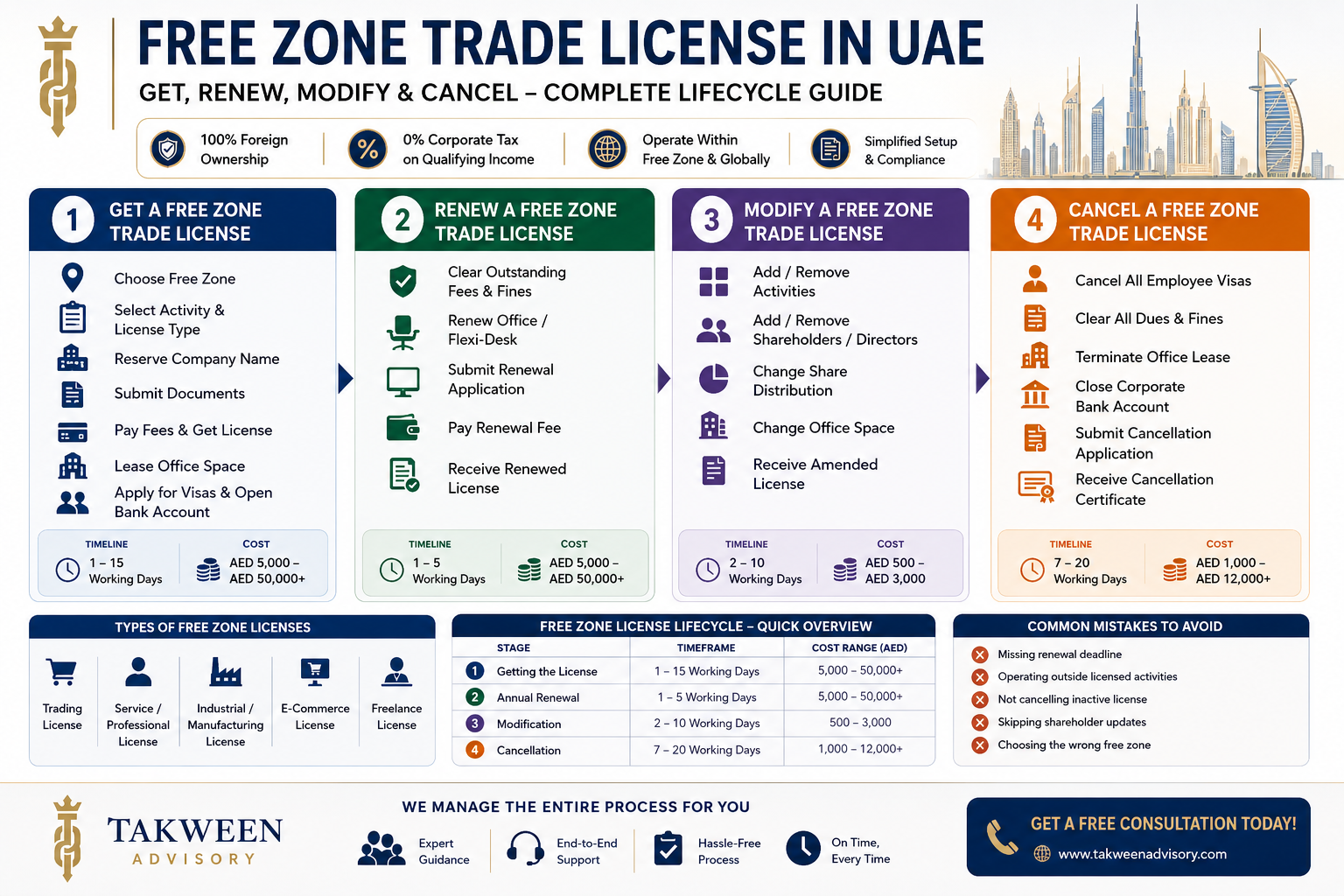
Setting up a business in one of the UAE's free zones is one of the most popular choices for entrepreneurs and international investors. With 100% foreign ownership, zero corporate tax on qualifying income, and simplified regulations, a free zone trade license in the UAE gives you a strong legal foundation to operate.
But getting the license is only the beginning.
Every business owner needs to understand what happens after the license is issued - how to renew it on time, how to modify it when your business changes, and how to cancel it properly if you decide to close or restructure.
This guide covers all four stages of the free zone trade license lifecycle in the UAE: getting, renewing, modifying, and cancelling - with step-by-step processes, required documents, costs, and timelines for 2026.
What is a Free Zone Trade License in UAE?

A free zone trade license is an official permit issued by a UAE free zone authority that allows a company to legally conduct business activities within that free zone and internationally.
Unlike a mainland license issued by the Department of Economic Development (DED), a free zone trade license is issued and regulated by the specific free zone authority - such as DMCC, IFZA, JAFZA, RAKEZ, SHAMS, or Meydan Free Zone.
Types of Free Zone Licenses in UAE
There are several types of free zone licenses depending on your business activity:
- Trading License - for import, export, distribution, and product resale
- Service / Professional License - for consultants, agencies, IT firms, and service providers
- Industrial / Manufacturing License - for production, packaging, and assembly businesses
- E-Commerce License - for online retail and digital marketplace businesses
- Freelance License - for individual professionals operating independently
Choosing the right license type and the right free zone for your activity is the first and most important step. You can explore your options with our Free Zone Company Setup consultants in Dubai.
How to Get a Free Zone Trade License in UAE

Step 1 - Choose the Right Free Zone
The UAE has over 40 free zones. Each has its own focus, pricing, visa quotas, and regulations. For example:
- DMCC - best for commodities, trading, and financial services
- IFZA - popular for startups and SMEs due to competitive pricing
- JAFZA - ideal for logistics, manufacturing, and heavy trade
- RAKEZ - affordable option for industrial and service businesses
- SHAMS - suited for media, publishing, and creative businesses
Selecting the wrong free zone can affect your visa quota, cost, and ability to operate. A consultation with a business setup advisor helps you match your activity to the most suitable free zone.
Step 2 - Select Your Business Activity and License Type
Free zones have a defined list of permitted activities. You must select your activities before applying. Adding too many unrelated activities can delay approval or increase costs.
Step 3 - Reserve Your Company Name
Company names must follow UAE naming conventions - no offensive words, no religious references, no names similar to existing companies.
Step 4 - Prepare Your Documents
Standard documents required for a free zone trade license application:
- Passport copies of all shareholders and directors
- Recent passport-sized photographs
- Completed application form
- Business plan (required by some free zones)
- No Objection Certificate (NOC) if the applicant is employed in the UAE
Step 5 - Submit Application and Pay Fees
Once documents are submitted and approved, you pay the license fee and receive your trade license. Some free zones issue the license within 1–3 working days; others may take up to 2 weeks depending on the activity type.
Step 6 - Lease Office Space (If Required)
Most free zones require at least a flexi-desk or registered address. Physical offices and warehouses are required for industrial or manufacturing licenses.
Step 7 - Apply for Visas and Open a Bank Account
After receiving your license, you can apply for investor visas, employee visas, and open a corporate bank account.
Estimated Cost: Free zone trade licenses in the UAE start from AED 5,000 and can go up to AED 50,000+ depending on the free zone, number of activities, and office requirements.
How to Renew a Free Zone Trade License in UAE

A free zone trade license is valid for one year and must be renewed annually. Missing the renewal deadline can lead to fines, visa complications, and operational disruption.
When to Start the Renewal Process
Most free zones recommend starting the renewal process 30 to 45 days before expiry. Some authorities send automated reminders; others do not.
Do not wait until the last week - late processing can result in your license expiring before the renewal is confirmed, which creates complications for employee visa renewals and bank KYC requirements.
Step-by-Step Free Zone Trade License Renewal Process
Step 1 - Clear Outstanding Fees and Fines
Any unpaid fines, overdue invoices, or outstanding government fees must be cleared before renewal is approved.
Step 2 - Renew Your Office Space or Flexi-Desk
Your tenancy contract or registered address must be valid and renewed alongside the license. Most free zones require a valid lease agreement as a condition for license renewal.
Step 3 - Submit Renewal Application
Log in to your free zone's online portal and submit the renewal application. Some free zones still require in-person submission or document upload.
Step 4 - Pay the Renewal Fee
Once the application is reviewed and approved, pay the renewal fee via the portal or bank transfer.
Step 5 - Receive the Renewed License
The renewed license is typically issued within 1–5 working days after payment.
Documents Required for Free Zone License Renewal
- Existing trade license copy
- Valid tenancy contract or flexi-desk agreement
- Passport copies of shareholders (updated if expired)
- Emirates ID copies of shareholders (if UAE residents)
- No outstanding fines or dues
Cost of Free Zone License Renewal in UAE
Renewal fees vary by free zone and license type. As a general guide:
- Budget free zones (IFZA, UAQ, Ajman): AED 5,000 – AED 12,000
- Mid-tier free zones (RAKEZ, SHAMS, Meydan): AED 10,000 – AED 20,000
- Premium free zones (DMCC, JAFZA, DIFC): AED 15,000 – AED 50,000+
These figures include the license renewal fee and office/flexi-desk costs. Visa renewal fees are separate.
What Happens If You Miss the Renewal Deadline?
If your free zone license expires without renewal:
- Daily or monthly fines begin accumulating
- Employee visa renewals may be blocked
- Your corporate bank account may be flagged during KYC review
- The free zone authority may begin cancellation proceedings if the license remains expired for an extended period
How to Modify a Free Zone Trade License in UAE
Businesses evolve. When your company changes - whether it is the business activity, company name, shareholder structure, or office location - you need to formally modify your free zone trade license.
Operating with outdated license details is a compliance risk and can complicate banking, contracts, and visa applications.
Common Types of Free Zone License Modifications
- Adding or removing business activities
- Changing company name
- Adding or removing shareholders or directors
- Changing share distribution or ownership percentage
- Upgrading or changing office space
- Changing the company's legal structure
Step-by-Step Free Zone License Modification Process
Step 1 - Identify the Type of Modification
Different modifications go through different internal departments. Knowing exactly what you need to change avoids unnecessary delays.
Step 2 - Prepare the Required Documents
Documents vary by modification type. Activity changes may require a fresh NOC or regulatory approval. Shareholder changes require updated passport copies and notarized agreements.
Step 3 - Submit the Modification Application
Submit via the free zone's online portal or in-person service desk, depending on the authority. Include supporting documents as required.
Step 4 - Pay Modification Fees
Each type of modification carries a separate government fee. These typically range from AED 500 to AED 3,000 depending on the free zone and modification type.
Step 5 - Receive the Amended License
After review and approval, the free zone issues an updated trade license reflecting the changes. Timelines range from 2 to 10 working days.
Documents Required for Free Zone License Modification
- Existing trade license copy
- Board resolution or shareholder resolution (for structural changes)
- Updated passport copies (for shareholder or director changes)
- NOC from relevant authority (for regulated activities)
- Tenancy contract (if office change is included)
Important Notes on Activity Modifications
Not all activities are permitted in every free zone. Before adding a new business activity, confirm that the activity is on the free zone's approved list. If your new activity requires a different license category, you may need to apply for a separate license or transfer to a more suitable free zone.
For guided support on license modifications, visit our Free Zone Trade License Modification in UAE service page.
How to Cancel a Free Zone Trade License in UAE
Whether you are closing your business, restructuring into a new entity, or relocating operations, cancelling a free zone trade license must be done formally and legally.
Simply stopping operations is not enough. An uncancelled license continues to accumulate renewal fees, fines, and regulatory obligations - even if the company is not trading.
When Should You Cancel a Free Zone License?
- You are closing the business permanently
- You are restructuring and setting up under a new entity
- You are relocating to mainland or another free zone
- The business is no longer active and renewal costs are not justified
Step-by-Step Free Zone License Cancellation Process
Step 1 - Cancel All Employee Visas
All active employee and investor visas sponsored under the company must be cancelled before the license can be cancelled. This includes the Emirates ID deactivation.
Step 2 - Clear All Outstanding Dues
All pending fees, fines, utility bills, and government charges must be settled. The free zone authority will not process cancellation with any outstanding balance.
Step 3 - Terminate Office Lease or Flexi-Desk Agreement
Your tenancy or office agreement must be formally terminated. Some free zones handle this automatically; others require a separate notice period.
Step 4 - Close the Corporate Bank Account
Most free zones require confirmation that the company's bank account has been closed or a no-objection letter from the bank.
Step 5 - Submit the Cancellation Application
Submit the cancellation request through the free zone portal or in-person. Include all clearance certificates and supporting documents.
Step 6 - Deregister for Tax (If Applicable)
If your company is VAT registered, you must file a deregistration application with the Federal Tax Authority (FTA) before or alongside the license cancellation.
Step 7 - Receive the Cancellation Certificate
After all clearances are verified, the free zone authority issues an official cancellation certificate - this is your formal proof that the company has been legally closed.
Documents Required for Free Zone License Cancellation
- Original trade license
- Visa cancellation confirmation for all sponsored individuals
- Clearance letters from relevant authorities (MOHRE, immigration)
- Bank account closure confirmation
- Lease termination letter
- Shareholders' resolution to dissolve the company
- Passport copies of all shareholders
Cost of Free Zone License Cancellation in UAE
Cancellation costs vary by free zone and company complexity. Typical cost ranges:
- Government cancellation fee: AED 500 – AED 2,000
- Visa cancellation fees (per person): AED 300 – AED 800
- Outstanding fines (if any): Variable
- Liquidation fees (if applicable): AED 2,000 – AED 10,000+
Timeline for Free Zone License Cancellation
The cancellation process typically takes 7 to 20 working days, depending on the number of visas, outstanding dues, and how quickly clearances are obtained.
For step-by-step support, see our Free Zone Trade License Cancellation service.
Free Zone License Lifecycle - Quick Comparison Table
| Stage | Timeframe | Estimated Cost | Key Requirement |
| Getting the License | 1–15 working days | AED 5,000 – AED 50,000+ | Activity selection, office space |
| Annual Renewal | 1–5 working days | AED 5,000 – AED 50,000+ | Clear dues, valid lease |
| Modification | 2–10 working days | AED 500 – AED 3,000 | Supporting documents, NOC if needed |
| Cancellation | 7–20 working days | AED 1,000 – AED 12,000+ | Cancel visas, clear dues, close bank account |
Common Mistakes to Avoid with Your Free Zone Trade License
1. Missing the renewal deadline
Late renewal leads to fines and blocks employee visa renewals. Set a calendar reminder 45 days before expiry.
2. Operating outside your licensed activities
Conducting business outside your approved activities is a compliance violation. If your business has grown beyond your original scope, file a modification before expanding.
3. Not cancelling the license when the business closes
Inactive companies that keep a live license accumulate fees and fines. Formal cancellation protects you from ongoing financial liability.
4. Skipping shareholder updates
If a shareholder leaves or joins the company, update the license immediately. Outdated shareholder records create problems with banking and future applications.
5. Choosing the wrong free zone for your activity
Not every free zone supports every business activity. Verify before applying to avoid rejection or delays.
How Takween Advisory Can Help
Managing the full lifecycle of a free zone trade license - from setup to renewal, modification, and cancellation - involves multiple government authorities, documentation requirements, and deadlines.
At Takween Advisory, our team handles the entire process on your behalf. Whether you are applying for a new free zone license in UAE, renewing an existing one, making changes to your company structure, or formally closing a business - we ensure every step is done correctly, on time, and without unnecessary complications.
Get a free consultation today and let our advisors guide you through the right process for your specific situation.
Frequently Asked Questions
Q: How long is a free zone trade license valid in the UAE?
A: Free zone trade licenses are valid for one year and must be renewed annually before the expiry date.
Q: Can I add new business activities to my existing free zone license?
A: Yes, you can add activities through a modification application. The new activity must be permitted by your free zone authority.
Q: What happens if my free zone license expires without renewal?
A: Fines begin accumulating, visa renewals are blocked, and the free zone authority may begin cancellation proceedings. Banks also flag expired licenses during annual KYC reviews.
Q: Do I need to cancel my employee visas before cancelling the license?
A: Yes. All sponsored visas must be cancelled before the license cancellation process can be completed.
Q: Can I transfer my free zone license to a different free zone?
A: You cannot directly transfer a license between free zones. You would need to apply for a new license in the target free zone and cancel the existing one.
Q: How long does free zone license cancellation take in the UAE?
A: Typically 7 to 20 working days, depending on the number of visas, clearances required, and outstanding dues.
Q: Is it mandatory to close the corporate bank account before cancelling the free zone license?
A: Most free zones require confirmation that the corporate bank account is closed or a bank no-objection letter as part of the cancellation process.

 English
 Arabic
 French
 Spanish
 Portuguese
 Deutsch
 Turkish
 Dutch
Dutch
 Russian
 Romaian
 Portuguese (Brazil)
 Greek
Greek