


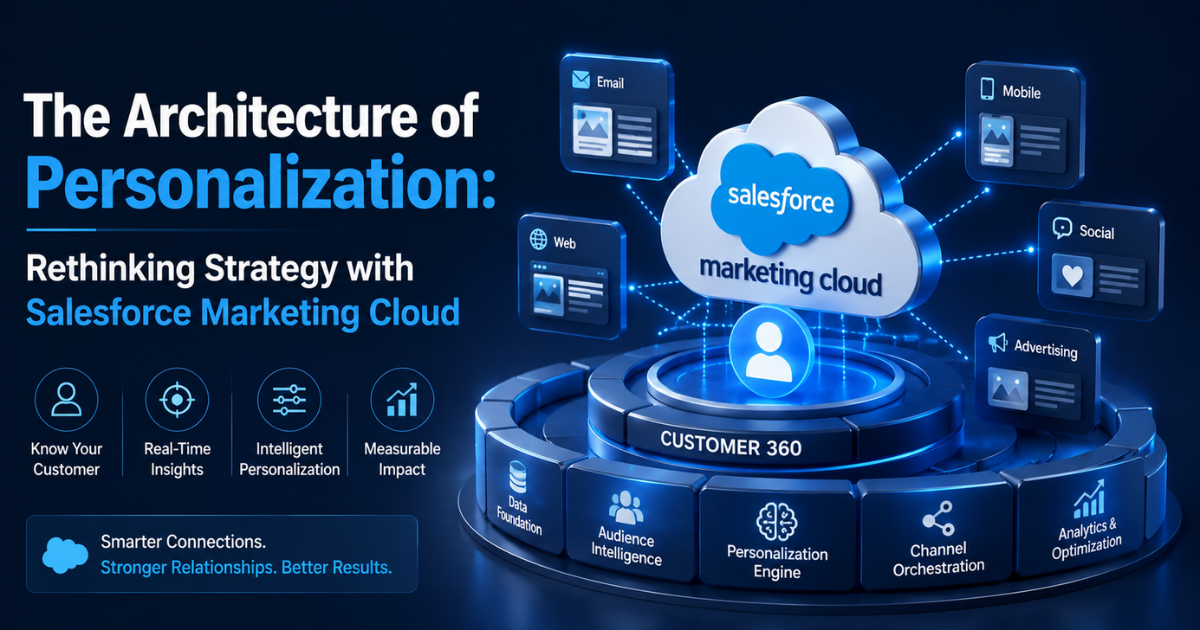
Modern marketing requires more than broad messages. Customers expect brands to know their preferences instantly. Static campaigns no longer produce high returns. Today, businesses must build a technical foundation for real-time engagement. Salesforce Marketing Cloud provides the tools to create this foundation. However, success depends on a solid architectural strategy. Companies often turn to Salesforce Marketing Cloud Services to align their technical setup with business goals.
The Shift Toward Individualized Data Models
In the past, marketers grouped people into large segments. They sent the same email to thousands of users. This "batch and blast" method is dying. Statistics show that 80% of consumers are more likely to purchase from brands that offer personalized experiences. Furthermore, 71% of consumers feel frustrated when a shopping experience is impersonal.
To solve this, Salesforce Marketing Cloud uses a relational data model. You must move away from flat files. A flat file contains all data in one table. This limits your ability to personalize. Instead, use multiple Data Extensions (DEs). Link these tables using a unique identifier like a "Subscriber Key."
Key Components of the Data Architecture
-
Contact Builder: This tool manages your data relationships. It creates an Attribute Group to link your core customer data to their purchase history.
-
Data Extensions: These are custom tables. They hold your customer attributes, product catalogs, and behavioral data.
-
Data Designers: Use these to map how different data points relate. For example, link a "User ID" to an "Order ID" and then to a "Product SKU."
This structure allows you to pull specific details into a message. You can mention the exact item a customer left in their cart. You can also suggest a matching accessory based on their last purchase.
Technical Implementation of Real-Time Personalization
Personalization must happen in milliseconds. If a customer visits your site, your email or SMS should reflect that visit immediately. This requires advanced scripting and automation.
1. Using AMPScript for Dynamic Content
AMPScript is the proprietary scripting language of Salesforce Marketing Cloud. It runs at the time of the send. It allows you to insert logic directly into your HTML.
Example: If a customer’s preferred language is Spanish, the system pulls the Spanish version of the header. If they are a "Gold" member, it displays a specific loyalty discount code.
Consultants providing Salesforce Marketing Cloud Services often focus on optimizing these scripts. Poorly written AMPScript slows down your send speeds. Efficient code ensures your messages reach the inbox during peak engagement windows.
2. Server-Side JavaScript (SSJS)
SSJS handles more complex tasks than AMPScript. Use it for data manipulation and API calls. For instance, you can use SSJS to fetch the latest weather data for a customer's zip code. You can then suggest rain gear or sunblock in the same message.
Building the Journey Strategy
A journey is a series of automated interactions. It follows a customer through their lifecycle. Salesforce Marketing Cloud uses Journey Builder to coordinate these paths.
1. Behavioral Triggers
Do not wait for a scheduled time to send a message. Use behavioral triggers instead.
-
Abandoned Cart: Send a reminder one hour after a user leaves the site.
-
Post-Purchase: Send a "thank you" note with a setup guide.
-
Win-Back: Trigger an offer if a customer has not logged in for 30 days.
Statistics reveal that triggered emails have a 70% higher open rate than traditional newsletters. They also generate 9x more revenue. This is because the message is relevant to the user’s current action.
2. Decision Splits and Paths
A journey should not be a straight line. Use "Decision Splits" to move people based on their behavior. If a user opens an email but does not click, send them a follow-up via SMS. If they click but do not buy, show them a targeted ad on social media. This cross-channel approach keeps your brand visible.
Integrating Data Cloud for a Unified Profile
The modern enterprise has data in many places. It sits in the CRM, the website, and the customer support portal. This fragmentation blocks personalization. Salesforce Data Cloud solves this by creating a "Unified Profile."
Salesforce Marketing Cloud Services now emphasize "Zero-Copy" data sharing. This means you do not have to move data back and forth between systems. Data Cloud connects directly to your external data lakes. It cleans and matches records to create a "Single Source of Truth."
-
Identity Resolution: It recognizes that "john.doe@email.com" in your marketing list is the same "John Doe" in your support tickets.
-
Calculated Insights: It calculates a "Lifetime Value" or "Churn Score" for every user.
-
Real-Time Segments: It creates audiences that update the moment a customer takes an action.
This level of integration ensures that your marketing is always accurate. You won't send a promotional email for a product the customer just complained about to a support agent.
The Role of Artificial Intelligence in Strategy
Artificial Intelligence (AI) is no longer a luxury. It is a technical necessity. Einstein AI is built directly into the platform. It helps marketers make better decisions without manual analysis.
1. Einstein Engagement Scoring
This tool predicts how a customer will interact with your messages. It assigns a score to every contact.
-
Loyalists: They open and click almost everything.
-
Window Shoppers: They open but rarely click.
-
Selective Subscribers: They only open specific types of content.
2. Send Time Optimization (STO)
Do not send all your emails at 9:00 AM. Every person has a different habit. Einstein STO analyzes historical data to find the best moment for each individual. If a user checks their phone at lunch, the system delivers the message at 12:15 PM. This simple change can increase click-through rates by over 20%.
Managing Complex Global Requirements
Large companies face challenges with scale and compliance. They operate in different regions with different laws. Salesforce Marketing Cloud provides a technical structure to handle this complexity.
1. Business Units (BUs)
Use Business Units to separate data and content by region or brand. A team in Europe can follow GDPR rules while a team in the US follows local laws. BUs also prevent users from seeing data they do not need. This improves security and keeps the workspace clean.
2. Content Builder Templates
Standardization is key to efficiency. Create global templates that regional teams can localize.
-
Locked Content Blocks: Protect brand logos and legal disclaimers.
-
Editable Zones: Allow local teams to change the text and images.
-
Reference Blocks: Update a block once, and it changes across every email using it.
This approach reduces production time. Research indicates that template-based workflows can cut campaign creation time by 40%.
Measuring the Impact of Personalization
You must prove that your technical strategy works. Many companies look at "Vanity Metrics" like open rates. While important, these do not show the full picture. Salesforce Marketing Cloud Services help you implement more advanced analytics.
Using Intelligence Reports (Datorama)
Intelligence Reports provide a deep view of your performance. You can see which segments drive the most revenue. You can also track "Email Fatigue." This happens when you send too many messages. The system shows you when your engagement begins to drop.
| Metric | Why it Matters | Industry Benchmark |
| Conversion Rate | Shows if the message led to a sale. | 2% - 5% |
| Click-to-Open Rate (CTOR) | Measures the relevance of the content. | 10% - 15% |
| Unsubscribe Rate | Indicates if the frequency is too high. | Below 0.5% |
| Revenue Per Email | Connects marketing directly to the bottom line. | Varies by industry |
Overcoming Technical Debt
Technical debt occurs when you build quick fixes instead of scalable solutions. In marketing technology, this often looks like messy data extensions and broken automations.
Experts in Salesforce Marketing Cloud Services suggest an annual audit.
-
Delete Unused Data: Old data slows down the system and creates security risks.
-
Consolidate Automations: Use a few large automations instead of dozens of small ones.
-
Refresh Subscriber Lists: Remove "unengaged" users who haven't opened an email in over six months.
Cleaning your system improves your "Sender Reputation." This ensures that ISPs like Gmail and Outlook deliver your emails to the inbox. A poor reputation can lead to your messages being marked as spam, costing you millions in potential sales.
Future Trends: The Move to Agentic Marketing
The next phase of personalization involves AI agents. These agents do not just follow a path; they make decisions. In the near future, an AI agent might notice a drop in a customer's engagement. It will then automatically research the customer’s past preferences and create a unique offer. It will choose the best channel and timing without any human input.
Salesforce Marketing Cloud is already moving in this direction. The integration of Agentforce allows for autonomous campaign adjustments. This shifts the marketer’s role from a builder to an orchestrator. You set the goals, and the technology manages the execution.
Conclusion
Rethinking your strategy with Salesforce Marketing Cloud requires a technical mindset. You must treat data as your most valuable asset. Personalization is not just a marketing tactic; it is an architectural challenge.
By building a relational data model, you create a foundation for deep insights. By using AMPScript and SSJS, you ensure your messages are dynamic. By leveraging Journey Builder and Einstein AI, you meet the customer exactly where they are.
Success requires a balance of technology and strategy. Salesforce Marketing Cloud Services can help you navigate this complexity. However, the goal remains the same: deliver the right message to the right person at the right time. When you achieve this, you stop being a nuisance and start being a resource. In the competitive world of 2026, that is the only way to win.

 English
 Arabic
 French
 Spanish
 Portuguese
 Deutsch
 Turkish
 Dutch
Dutch
 Russian
 Romaian
 Portuguese (Brazil)
 Greek
Greek