


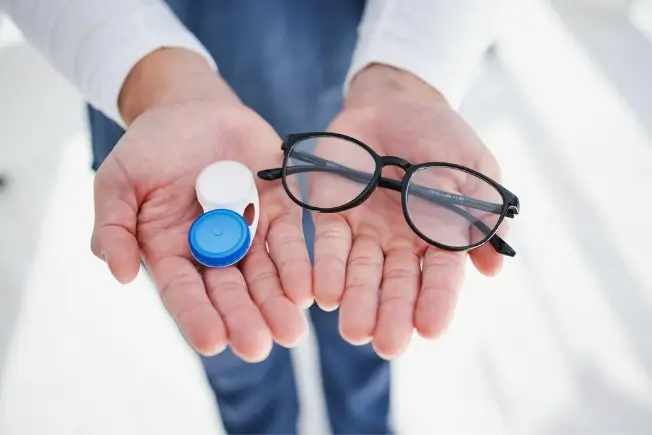
You need spectacles to correct refractive errors, like myopia, hyperopia, astigmatism, or presbyopia. Your correct vision should be more than just about seeing clear; it should also be about comfort, health, and matching your everyday life. The best decision is always the one that serves you the most, no matter if you choose the conventional type of glasses or the convenient contact lenses. We only have to work out together what factors matter to you the most.
The Very First Step: A Thorough Eye Exam
A visit to an ophthalmologist is necessary for a detailed eye check-up before you decide on your frames or lenses. This is definitely the most important step. Along with the prescription, the doctor carries out the tests to check the health of your eyes. Besides that, the doctor also evaluates various other things, like the cornea curvature (the front surface of the eye) and the tear film quality. All this data is very essential, especially if you are going to take the help of contact lenses.
Early warning of such problems is vital for the right treatment and keeping sight for a longer period. Moreover, the doctor will talk about your lifestyle as well, the time you spend on digital devices, your hobbies, and whether you do any sports. Such information helps to personalise the lens material along with any required coating, for instance, blue light filter or special tints, to give the best visual comfort for the whole day. They are certainly not just fulfilling the prescription when they make the final corrective eyewear; they are actually upgrading how you perceive the world by giving you solutions for all your specific visual needs. Later, the doctor will hand over to you an updated prescription, which will be the point of departure for everything else.
Working With Spectacles: Frames and Function
Spectacles are one of your personal styles; however, they are also a medical device that should function correctly.

1. Getting the frame that suits your face best
The frame you pick should be both comfortable and firm. It shall not be the one that slides down your nose or presses behind your ears. The most effective way of choosing is by trying on as many different styles as possible. Take into account your lens thickness, comfort, and other aspects.
2. Deciding on the Best Lenses
Here is where the magic takes place; materials and coatings are very important for the performance. Contact lenses give you freedom from frames, but at the same time, they require discipline and a pledge to hygiene.
Contact Lens Types Based on Material
For contact lenses, try to visit a Contact Lens Clinic where they will guide you the best suitable lenses. However, the type of lenses are as follows:
- Soft Lenses: They are the most common as they are comfortable and flexible. These lenses are the most convenient for first-time users.
- Disposable: Daily disposable lenses are the most comfortable and safe type of lenses because each morning, a new sterile pair is used, and no cleaning is required.
- Multifocal: A product that corrects the vision of people who have to see both nearby and far (like bifocals in glasses).
- Rigid Gas Permeable (RGP) Lenses: There are quite a few, but they provide very sharp, clear vision, especially if you have a heavy astigmatism or a certain eye condition. The comfort period is longer, but they can be more resistant and have a longer lifespan.
Matching Lenses to Your Lifestyle
Be honest with yourself about the way you live and what your habits are:
- Sports and Activity: Daily disposables are just right since there is no chance of contamination by sweat or dirt getting on cleaned lenses.
- Desk Work/Screen Time: In case you heavily use a screen and wear contact lenses, your lenses may dry up very frequently. Your doctor may recommend a different lens material that keeps moisture better or some special drops for you.
- Travel: Single-use lenses are great for travel, and it is unnecessary to bring bottles of solution or cases.
- Hygiene Commitment: In case you are a person who is prone to forgetting lens cleaning, then never pick weekly or monthly lenses. Following a daily routine is a must when it comes to the health of your contacts.

 English
 French
 Spanish
 Portuguese
 Deutsch
 Turkish
 Dutch
Dutch
 Italiano
 Russian
 Romaian
 Portuguese (Brazil)
 Greek
Greek