



Every time you see a dashboard update, a sales report, or a recommendation on an app, there is a quiet system working behind it. That system often depends on a process called ETL (Extract, Transform, Load).
For people working with large information systems, especially Data Engineers, ETL is not just helpful—it is part of daily work. Without it, most data systems would break or become unusable.
Let’s understand why ETL is so important for them, in a simple and clear way.
What Is ETL in Simple Terms?
The ETL Process is a method used to move information from different sources into one place where it can be used.
It has three steps:
- Extract – Collect information from different systems
- Transform – Clean and fix the information
- Load – Store it in a system for use
Simple idea:
ETL takes messy information and turns it into something useful and structured.
Why Data Engineers Use ETL Every Day
Data engineers are responsible for building systems that move and prepare information. Their job is not just to collect data but to make sure it is usable.
ETL helps them do exactly that.
Without ETL:
- Information stays scattered
- Systems become slow
- Reports show wrong results
With ETL:
- Everything becomes organized
- Data flows smoothly
- Systems stay reliable
ETL Helps Bring Data Together
Modern systems collect information from many places:
- Apps
- Websites
- Payment systems
- Cloud storage
- Customer tools
This information is not stored in one format.
ETL helps data engineers:
- Collect everything in one place
- Combine different formats
- Build a single view of all data
This is very important for companies that operate globally.
ETL Keeps Data Clean and Reliable
Raw information is never perfect. It often includes:
- Missing values
- Duplicate entries
- Incorrect formats
- Unwanted records
ETL helps fix all of this.
Example:
| Raw Data | After ETL |
| “india”, “IN” | India |
| blank value | 0 or NULL |
| repeated record | removed |
This cleaning step is important because bad data leads to wrong results.
ETL Makes Data Ready for Reports
Business teams rely on reports to make decisions. These reports come from clean and structured data.
ETL helps by:
- Organizing information
- Grouping related data
- Preparing summaries
Without ETL, reports would take too long or show incorrect information.
ETL Supports Large-Scale Systems
Companies deal with millions or even billions of records.
ETL helps data engineers:
- Handle large volumes of data
- Process information step by step
- Avoid system overload
Modern systems use cloud platforms to make this even easier.
ETL Helps in Fast Decision Making
When data is processed through ETL:
- Reports are updated quickly
- Dashboards stay current
- Teams can react faster
For example:
- Sales teams can see daily performance
- Marketing teams can track campaigns
- Finance teams can monitor expenses
ETL Helps Build Data Pipelines
A data pipeline is a system that moves data automatically from one place to another.
ETL is the base of these pipelines.
Data engineers use ETL to:
- Automate data movement
- Reduce manual work
- Keep systems updated continuously
This makes operations smooth and consistent.
ETL Works with Cloud Systems
Most companies now use cloud platforms.
ETL works very well with cloud tools like:
- AWS systems
- Google Cloud tools
- Azure platforms
In cloud systems:
- Data is stored online
- ETL processes run automatically
- Results are delivered faster
ETL Helps in Machine Learning and AI
Machine learning models need clean information.
ETL ensures:
- Data is structured
- Errors are removed
- Features are prepared properly
Without ETL, models would give poor predictions.
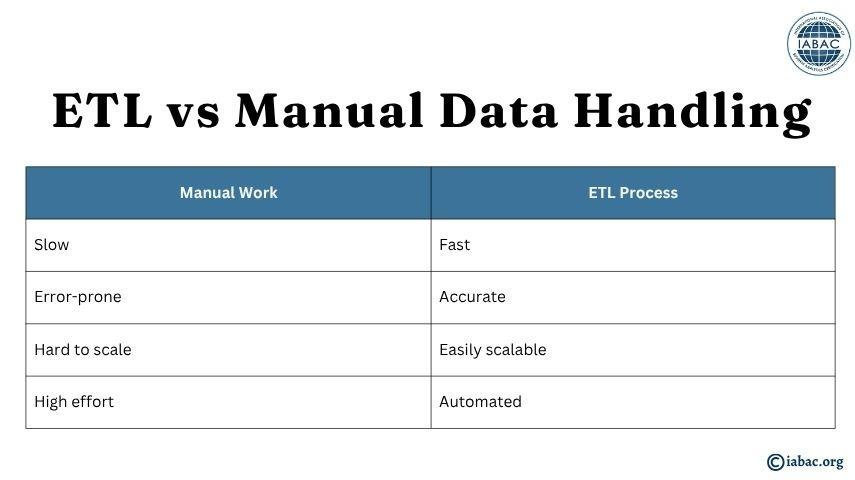
ETL Saves Time and Reduces Manual Work
Before ETL systems:
- Engineers had to clean data manually
- Reports took days or weeks
Now:
- ETL automates most steps
- Systems run continuously
- Human effort is reduced
This is one of the biggest reasons ETL is widely used.
ETL Helps Maintain System Quality
Data engineers must ensure systems are stable.
ETL helps by:
- Checking data quality
- Removing errors early
- Preventing system failures
It acts like a filter that protects the system from bad data.
ETL vs Manual Data Handling
Real Example of ETL Use
Imagine an online store:
It collects:
- Orders from website
- Payments from bank system
- Customer reviews
- Shipping updates
ETL:
- Collects all this information
- Removes errors
- Combines everything
- Stores it in a central system
Now the company can:
- Track sales
- Understand customer behavior
- Improve delivery systems
ETL Tools Used by Data Engineers
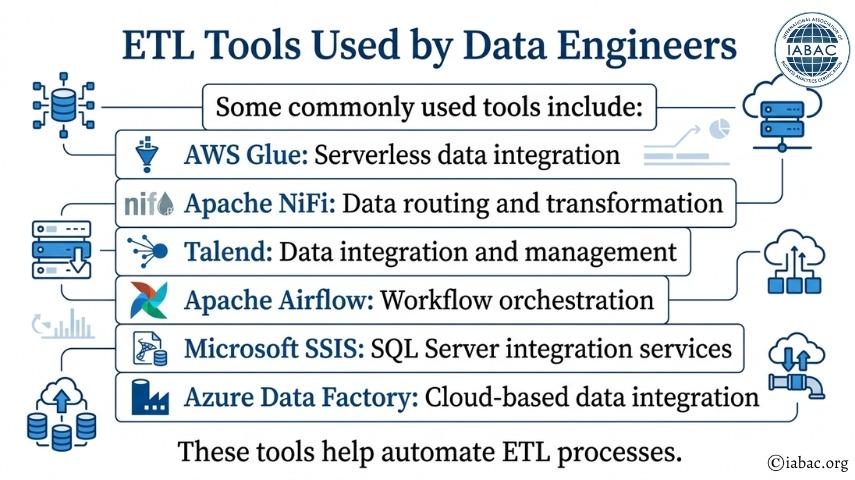
Some commonly used tools include:
- AWS Glue
- Apache NiFi
- Talend
- Apache Airflow
- Microsoft SSIS
- Azure Data Factory
These tools help automate ETL processes.
ETL and Career Growth
ETL is a key part of many roles like:
- Data Engineer
- Data Analyst
- Data Architect
Skills often needed:
- SQL
- Python
- Cloud platforms
- Data pipeline design
This is why ETL is included in many data science certifications and training programs such as those offered under IABAC certifications.
Simple View of ETL Importance
ETL is like a kitchen system:
- Raw ingredients = raw data
- Washing and cutting = transformation
- Cooking = processing
- Final dish = usable information
Without preparation, the output is not useful.
Common Challenges Data Engineers Face Without ETL
- Messy information
- Slow systems
- Incorrect reports
- Hard to manage large data
ETL solves these problems step by step.
Future of ETL in Data Systems
ETL systems are becoming:
- Faster
- More automated
- Cloud-based
- Real-time
More companies now expect instant updates instead of waiting for batch processing.
Data engineers rely heavily on ETL because it is the foundation of how modern data systems work. It helps collect, clean, and organize information so that it becomes useful for analysis, reporting, and advanced systems. Without ETL, data would stay scattered and confusing. With ETL, it becomes structured, reliable, and ready for use.
This is why ETL remains one of the most important skills in data engineering careers and is a core topic in professional learning programs like IABAC certifications.

 English
 Arabic
 French
 Spanish
 Portuguese
 Deutsch
 Turkish
 Dutch
Dutch
 Russian
 Romaian
 Portuguese (Brazil)
 Greek
Greek