


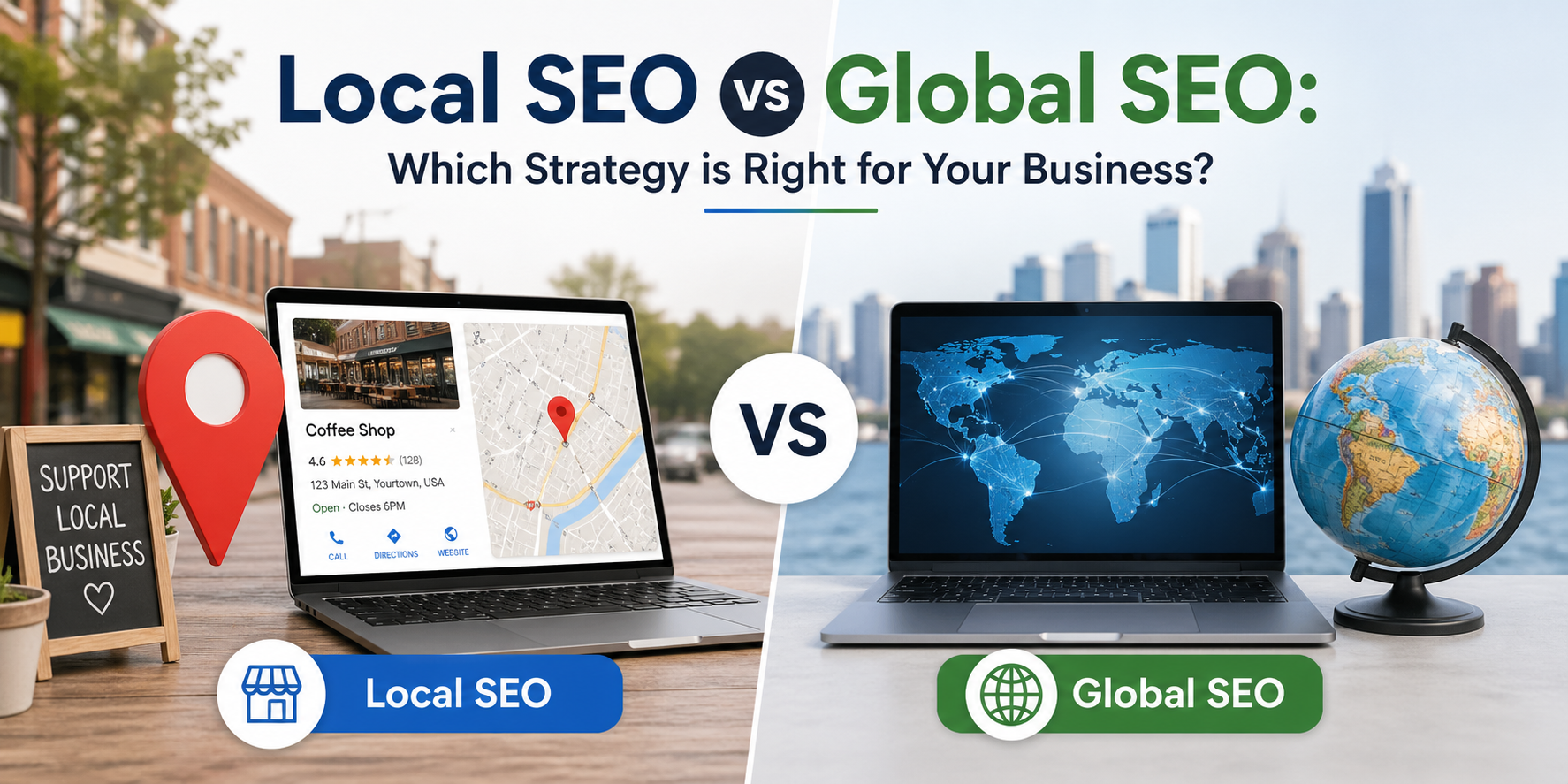
You have a business to grow, a website that exists, and a vague mandate to 'do SEO' — but nobody told you which kind. Local SEO and global SEO are not the same game, and investing in the wrong one is one of the most expensive mistakes a business can make in digital marketing. If your strategy does not match your actual customer geography, you are paying for traffic that was never yours to win.
The confusion is understandable. Most articles on SEO treat the topic as one-size-fits-all, glossing over the fundamental difference in how Google evaluates local versus global relevance. A restaurant in Salt Lake City, Kolkata, and a SaaS platform serving clients across three continents need completely different SEO architectures — different keyword strategies, different content structures, different technical setups, and different success metrics. Getting this wrong from the start means months of effort pointed in the wrong direction.
In this guide, you will understand exactly how local and global SEO differ, what the right choice looks like for different business types, and how a professional local SEO service in Kolkata can help you build a strategy calibrated to your actual market — not just a generic checklist pulled from a global playbook.
What Is Local SEO and How Does It Actually Work?
Local SEO is the practice of optimising your online presence so that your business appears prominently when people in a specific geographic area search for your products or services. The goal is geographic relevance — making Google understand not just what you do, but where you do it and for whom.
When someone in Kolkata searches for 'accountant near me' or 'best digital agency in Park Street,' Google does not serve the same results it would to someone in Mumbai or London. It pulls from a localised index that factors in proximity, relevance, and prominence — the three core pillars of local search ranking. This is an entirely separate algorithm layer from the standard organic search system, and it requires a specifically different optimisation approach.
The Signals That Drive Local Rankings
• Google Business Profile — completeness, accuracy, and activity level
• Local citations — consistent NAP (Name, Address, Phone) across directories
• Location-specific landing pages with geo-targeted content
• Localised backlinks from relevant regional websites
• Customer reviews — volume, recency, and business response rate
• On-page signals: city names, landmarks, and local context woven into content
What Is Global SEO and When Does It Apply?
Global SEO focuses on ranking for keywords without geographic restriction — targeting audiences across multiple cities, countries, or languages. The competition is broader, the keyword volumes are typically higher, and the timeline to meaningful results is generally longer. But for the right business, the potential reach is enormous.
Global SEO is not just local SEO at a larger scale. It involves a fundamentally different architecture. At the international level, you are dealing with hreflang tags for multi-language targeting, country-specific domain strategies (ccTLD, subdomain, or subfolder structures), content localisation that goes beyond translation, and backlink profiles that span multiple regional web ecosystems. A misstep in technical setup alone can cause your content to be indexed for the wrong country entirely.
Businesses That Benefit from Global SEO
• SaaS platforms with no geographic limitation on customer acquisition
• E-commerce stores shipping nationally or internationally
• Publishers and media brands targeting broad topic audiences
• Professional services firms with remote delivery capability
• EdTech, FinTech, and other digital-native product companies
The Core Differences: Local SEO vs Global SEO Side by Side
Understanding the strategic differences between these two approaches is essential before you commit budget and time to either. They diverge at almost every level — from keyword research to content creation to the metrics you use to evaluate performance.
In local SEO, keywords are geographic by nature: 'local SEO service in Kolkata,' 'CA firm Ballygunge,' 'interior designer Salt Lake.' The monthly search volumes are lower, but the commercial intent is much higher — someone adding a location to their search is almost always closer to a buying decision than someone searching a broad topic term. Global SEO targets head terms and informational keywords where volume is high but competition is fierce and conversion journeys are longer.
Key Differences at a Glance
• Keyword focus: geo-modified phrases (local) vs. broad topic terms (global)
• Primary ranking factor: Google Business Profile and proximity (local) vs. domain authority and backlink diversity (global)
• Content strategy: location-specific service pages (local) vs. topic clusters and pillar content (global)
• Timeline to results: 2 to 4 months for local (global) vs. 6 to 18 months for competitive global keywords
• Success metrics: calls, direction requests, and local pack visibility (local) vs. organic traffic, keyword rankings, and share of voice (global)
How to Decide Which Strategy Your Business Actually Needs
The right answer is not determined by which approach sounds more ambitious — it is determined entirely by where your customers are and how they find you. Start with one question: does your business serve customers in a specific city or region, or does it serve anyone with an internet connection regardless of location?
If your revenue depends on physical footfall, in-person service delivery, or customers within a defined geographic market, local SEO is not just the better option — it is the only one that makes business sense. A physiotherapy clinic in New Town, Kolkata, has nothing to gain from ranking for 'physiotherapy tips' to an audience in Chennai. Every rupee spent chasing global visibility is a rupee taken away from dominating the local market where customers actually exist.
Scenarios That Demand a Hybrid Approach
Some businesses operate at both levels simultaneously. A CA firm in Kolkata might want to rank locally for client acquisition while also ranking nationally for broad financial planning content to build authority. A manufacturer with a physical base in West Bengal might sell across India online. In these cases, the right strategy is a tiered one — prioritise local SEO for conversion-critical keywords while building global organic assets for awareness and authority. A skilled local SEO service in Kolkata will structure this precisely without diluting either effort.
Common Mistakes Businesses Make When Choosing Between the Two
The most expensive mistake is applying a global SEO template to a local business. This happens constantly — agencies pitch generic content calendars, high-volume keyword targets, and link-building campaigns that produce traffic from the wrong geography. The business sees growing organic sessions in Google Analytics and assumes the campaign is working, while their actual local customer base remains untouched.
The reverse also damages businesses. A company with genuine potential to capture national or international traffic limits itself to hyper-local keywords because a vendor positioned itself as a 'local SEO specialist' without assessing the broader opportunity. Both scenarios waste significant resources and delay real growth.
Red Flags in an SEO Proposal
• No mention of your specific customer geography in the strategy
• Keyword targets with high volume but no location intent for a local business
• Identical content templates regardless of your business model
• Reporting that shows only ranking improvements without revenue or lead data
• No Google Business Profile audit or optimisation plan for local businesses
What a Proper Local SEO Service in Kolkata Should Deliver
If your business is rooted in Kolkata — whether in Esplanade, Rajarhat, Howrah, or anywhere across the city and surrounding districts — your SEO strategy needs to be built around how Kolkata searches, not how the internet at large behaves. Search patterns, competitor landscapes, and user behaviour differ at the local level in ways that a generic national agency will simply not account for.
A serious local SEO service in Kolkata starts with a full audit of your current local presence: Google Business Profile health, citation consistency, review strategy, and local keyword gaps. From there, it builds location-specific landing pages for every service area you target, creates content that references local landmarks, events, and community context, and builds relationships with regional publishers and directories that carry genuine authority in your market.
• Fully optimised and actively managed Google Business Profile
• Location-specific service pages with locally relevant content
• Structured citation building across Bengali and national directories
• Review generation strategy tailored to Kolkata's business culture
• Local link acquisition from Kolkata-based media, blogs, and trade associations
• Monthly reporting on local pack rankings, calls, and direction requests
Conclusion : The Right Strategy Is the One That Matches Your Market
Local SEO and global SEO are not competing philosophies — they are different tools for different jobs. The businesses that get SEO right are the ones that begin with absolute clarity about who their customer is and where that customer lives. Every strategic decision flows from that single anchor point.
If you are a business in Kolkata serving customers in Kolkata, the most valuable investment you can make right now is in a local SEO service in Kolkata that understands your market at ground level — not one that applies a universal template and measures success in keywords rather than clients. Get the strategy right first. The rankings will follow.

 English
 Arabic
 French
 Spanish
 Portuguese
 Turkish
 Dutch
Dutch
 Italiano
 Russian
 Romaian
 Portuguese (Brazil)
 Greek
Greek