


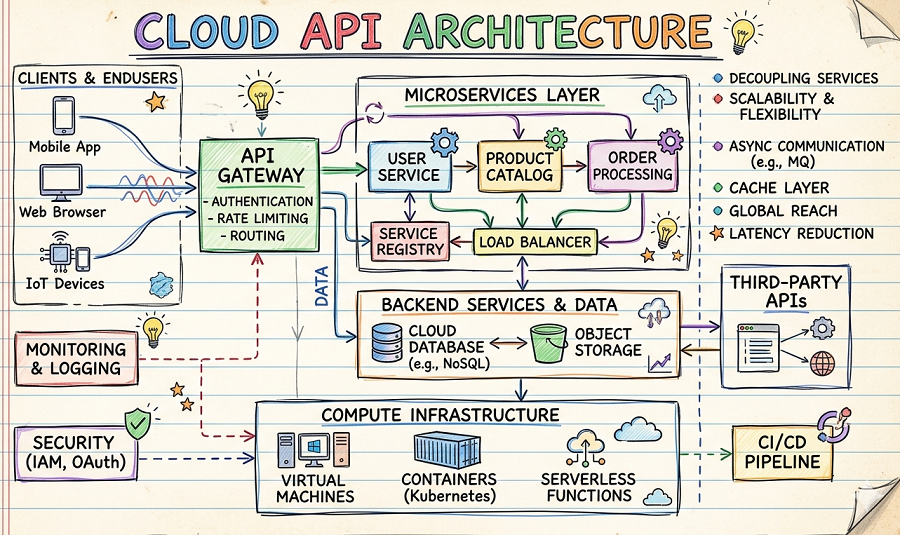
In the modern digital economy, applications and services are no longer monolithic entities but are intricate ecosystems of interconnected components. The invisible yet indispensable force enabling this new reality is the global Cloud Api industry, a sector built around the creation, management, and delivery of Application Programming Interfaces (APIs) in a cloud-native environment. A Cloud API acts as a standardized contract or messenger, allowing disparate software applications to communicate and share data with each other over the internet, without needing to know the complex inner workings of the systems they are interacting with. This industry provides the fundamental "glue" that holds the modern internet together, enabling a developer to seamlessly integrate a mapping service from Google, a payment processing function from Stripe, and a messaging service from Twilio into their own application. It represents a radical shift from building every component from scratch to a model of assembling best-in-class services. This move towards a composable enterprise, powered by cloud APIs, has unleashed a torrent of innovation, dramatically accelerating the pace of software development and enabling the creation of the rich, interconnected digital experiences that consumers and businesses now expect as standard.
The rise of the Cloud API industry is inextricably linked to the architectural shift away from monolithic applications towards microservices. In the past, applications were built as a single, large, tightly-coupled unit, making them difficult to update, scale, and maintain. The microservices architecture, by contrast, breaks down an application into a collection of small, independent services, each responsible for a specific business function. Cloud APIs are the essential communication backbone that allows these microservices to talk to each other. Each microservice exposes its functionality through a well-defined API, allowing other services to consume its data or trigger its actions. This API-driven approach enables teams to develop, deploy, and scale their services independently, leading to much greater agility and faster development cycles. For example, an e-commerce platform's "shopping cart" service can be updated without affecting the "product catalog" or "payment processing" services, as long as the API contract remains stable. This modularity, facilitated entirely by cloud APIs, is a cornerstone of modern, agile software development and a primary reason for the industry's explosive growth and strategic importance in building resilient, scalable, and adaptable digital products.
The ecosystem supporting the Cloud API industry is a complex and multi-layered landscape composed of providers, consumers, and a crucial middle layer of management platforms. The providers are a diverse group. At the foundational level are the Infrastructure-as-a-Service (IaaS) and Platform-as-a-Service (PaaS) providers like AWS, Microsoft Azure, and Google Cloud, who offer APIs to control their underlying compute, storage, and networking resources. Above them are the Software-as-a-Service (SaaS) providers, from Salesforce to Slack, who expose their application's core functionality through APIs, allowing for deep integration into other business workflows. The consumers of these APIs are the developers and businesses building new applications and services. Bridging the gap between them are the API management platforms, such as Google's Apigee, Salesforce's MuleSoft, and open-source solutions like Kong. These platforms provide the essential tools for securing, documenting, monitoring, and monetizing APIs, transforming them from simple technical interfaces into managed, productized assets. This intricate interplay of providers, consumers, and management tools forms a vibrant marketplace that is continuously expanding the possibilities of digital integration.
Looking forward, the future of the Cloud API industry is pointed towards an "API-first" design philosophy and the rise of the API economy. In an API-first approach, the development of the API is no longer an afterthought but the primary focus of the product development process. The API is treated as a first-class product in its own right, with its own lifecycle, documentation, and user experience (often called "Developer Experience" or DX). This shift is giving rise to a new wave of companies whose entire business model is the provision of a specific, high-value service through a simple, well-documented API. This has created the "API economy," where businesses can generate direct revenue from the consumption of their APIs. This trend is further accelerated by the increasing need for standardization and the adoption of specifications like OpenAPI (formerly Swagger) to ensure interoperability. As this API-first mindset becomes the norm, the industry will evolve from simply connecting applications to becoming the fundamental transaction layer for the entire digital economy, where value and data are exchanged as fluidly as information on the web.
Top Trending Reports:

 English
 Arabic
 French
 Spanish
 Portuguese
 Turkish
 Dutch
Dutch
 Italiano
 Russian
 Romaian
 Portuguese (Brazil)
 Greek
Greek