


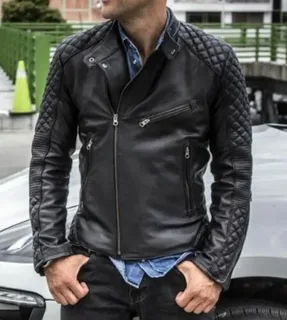
Introduction: Why This Jacket Never Disappears
The Leather Biker Jacket is one of the few fashion items that has never truly left circulation. Trends shift constantly, but this jacket continues to reappear in different decades, subcultures, and style movements.
That persistence is not accidental. Unlike garments designed primarily for seasonal aesthetics, the biker jacket was originally built around function under real-world conditions—movement, friction, and protection. Fashion adopted it later, but the structure itself comes from utility.
Origin: Built for Riders, Not Runways
The earliest versions of the leather biker jacket were designed for motorcycle riders who needed protection against wind, debris, and impact-related abrasion. Unlike standard coats, this jacket was engineered for:
-
High-speed airflow resistance
-
Durability against road friction
-
Flexibility for riding posture
-
Minimal interference during movement
This explains its asymmetrical zipper, tight fit, and reinforced panels. Every visible design feature started as a practical solution, not decoration.
Core Structural Elements That Define It
A real leather biker jacket is not defined by style alone. It has specific structural traits that separate it from generic leather outerwear.
1. Asymmetrical Front Zipper
This design allows better wind blocking when leaning forward on a motorcycle, reducing direct air pressure on the chest.
2. Reinforced Shoulder and Elbow Zones
These areas experience the highest friction during movement or falls, so they are often padded or double-stitched.
3. Close-Body Fit
A loose jacket would flap at high speeds. The biker jacket stays close to the body to reduce drag.
4. Thick Leather Shell
Leather is used not for fashion but for abrasion resistance. It creates a protective barrier between the body and external surfaces.
Why Leather Is Still the Material of Choice
Even with modern synthetic alternatives, leather remains dominant in biker jacket construction. The reason is performance consistency.
Leather provides:
-
Natural abrasion resistance
-
Wind-blocking capability
-
Structural durability over time
-
Ability to age into a stronger patina instead of degrading
Synthetic materials may be lighter, but they often fail under long-term friction and heat exposure.
The Shift From Utility to Cultural Symbol
Over time, the leather biker jacket moved beyond its functional origin and became a cultural signal. It was adopted by different groups—motorcyclists, musicians, and later fashion designers—each giving it a different meaning.
This shift turned it into a visual shorthand for:
-
Rebellion
-
Independence
-
Non-conformity
-
Urban edge
What’s important is that the jacket did not change structurally to gain this symbolism. The original design remained intact, which is why it still looks “authentic” compared to many fashion reinterpretations.
Performance in Real Use vs Fashion Use
There is a clear difference between how the jacket performs in real riding conditions and how it is used in everyday fashion.
In Functional Use:
-
Protects against wind chill
-
Reduces abrasion risk
-
Maintains body temperature stability during motion
In Fashion Use:
-
Acts as a visual statement piece
-
Complements layered outfits
-
Adds structure to otherwise simple clothing combinations
The key distinction is intent: one is protective, the other is expressive. But both rely on the same structure.
Common Mistakes When Choosing a Leather Biker Jacket
Many buyers evaluate biker jackets purely based on appearance, which often leads to poor long-term satisfaction.
Mistake 1: Choosing Thin Leather for Style Only
Thin leather may look sleek but lacks durability and protection.
Mistake 2: Ignoring Fit Mechanics
A biker jacket that is too loose loses its aerodynamic and structural purpose.
Mistake 3: Overlooking Stitch Quality
Weak stitching fails quickly under tension and movement.
Mistake 4: Confusing Fashion Jackets With Riding Jackets
Not all “biker-style” jackets are built for actual riding conditions.
How to Identify a High-Quality Jacket
A strong leather biker jacket can usually be identified through physical and construction cues:
-
Dense, natural leather texture (not overly uniform or plastic-like)
-
Reinforced stitching at stress points
-
Heavy, reliable metal zippers
-
Structured shoulders that hold shape
-
Comfortable but controlled tightness in fit
A good jacket should feel firm at first but gradually adapt to the wearer’s body over time.
Styling Without Losing Its Identity
One reason the biker jacket remains popular is its adaptability in styling. However, it works best when treated as the dominant piece.
Common effective combinations include:
-
Plain T-shirts with denim or slim trousers
-
Monochrome outfits that highlight jacket texture
-
Minimal layering to preserve silhouette clarity
-
Boots or simple sneakers depending on the look direction
Over-accessorizing often reduces its visual impact because the jacket already carries strong structure and presence.
Final Perspective
The Leather Biker Jacket s not just a fashion item that survived time—it is a functional design that transitioned into cultural identity without losing its engineering foundation.
Its continued relevance comes from a rare combination: it still performs its original protective role while also functioning as a visual symbol in modern style. That dual identity is why it remains unchanged in structure yet constantly reinterpreted in fashion.
In a clothing landscape driven by rapid trends, the biker jacket stands out because it was never designed to follow them in the first place.

 English
 Arabic
 French
 Portuguese
 Deutsch
 Turkish
 Dutch
Dutch
 Italiano
 Russian
 Romaian
 Portuguese (Brazil)
 Greek
Greek