


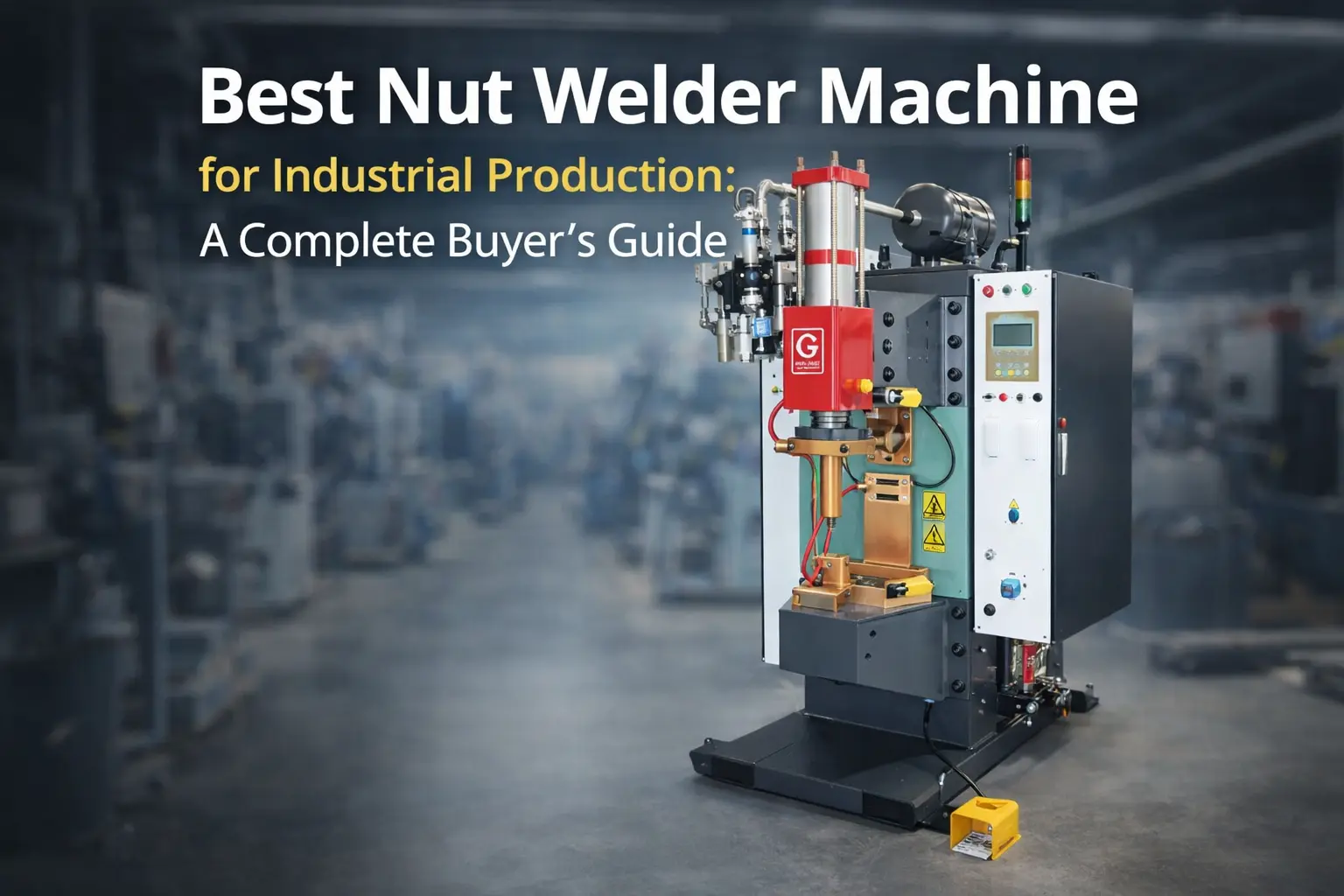
In today’s competitive manufacturing landscape, fastening reliability is just as important as structural integrity. A nut welder plays a critical role in ensuring strong, repeatable, and production-ready threaded joints in sheet metal and fabricated assemblies. From automotive bodies to HVAC enclosures and industrial machinery, nut welding has become a core process for high-speed, high-precision manufacturing.
For OEMs, automation integrators, and production engineers, selecting the right nut welding system directly impacts product durability, cycle time, and overall production efficiency.
At Heron Welder, advanced resistance welding technologies are engineered to meet these exact industrial demands, delivering scalable, automated, and quality-controlled nut welding solutions for global manufacturing environments.
What is a Nut Welder?
A nut welder is a specialized resistance welding machine designed to attach threaded nuts to metal sheets or components using controlled heat, pressure, and electrical current.
Unlike mechanical fastening or drilling-based methods, nut welding creates a permanent metallurgical bond between the nut and base material, ensuring higher strength and vibration resistance.
The process typically uses projection welding principles, where small raised points on the nut concentrate current and heat at specific contact zones, enabling precise fusion without damaging surrounding material.
How Nut Welding Works: Core Principle
The nut welding process is based on resistance heating + controlled pressure application:
- The nut is positioned accurately on the sheet metal surface
- Electrodes apply controlled force to hold the nut in place
- High electrical current passes through the contact points
- Heat is generated at projection points on the nut
- The metal fuses and forms a strong weld joint under pressure
This controlled energy delivery ensures consistent weld formation with minimal distortion and high repeatability essential for mass production environments.
Types of Nut Welder Systems in Industry
Modern manufacturing facilities use different nut welding technologies depending on material, production volume, and precision requirements.
1. AC Nut Welders
Traditional systems suitable for general fabrication work. They are cost-effective but less precise in energy control.
2. Capacitor Discharge (CD) Nut Welders
Ideal for thin sheet metals. They deliver a short, high-energy pulse, reducing heat-affected zones and preventing material deformation.
3. MFDC Nut Welders (Most Industrial Preferred)
Medium Frequency Direct Current (MFDC) systems provide:
- Stable current output
- High weld consistency
- Lower energy consumption
- Superior quality control
These are widely used in automotive and high-volume production lines.
4. Automated & Servo Nut Welding Systems
Designed for Industry 4.0 manufacturing, these systems integrate robotic positioning, nut feeding, and real-time monitoring for continuous production.
Industrial Applications of Nut Welders
Nut welders are widely used across industries where threaded fastening strength and speed are critical.
Automotive Manufacturing
Used for:
- Body-in-white assemblies
- Brackets and chassis components
- Interior and structural fastening points
Automotive production requires high-strength weld consistency at high speed, making MFDC nut welding essential.
HVAC & Sheet Metal Fabrication
Nut welders are used in:
- Air conditioning housings
- Ventilation systems
- Metal enclosures and cabinets
They eliminate loose fasteners and improve structural rigidity.
Electrical & Industrial Equipment
Applications include:
- Control panels
- Industrial enclosures
- Motor housings
These applications require vibration-resistant and long-lasting threaded joints.
Nut Welder vs Traditional Fastening Methods
| Factor | Nut Welding | Mechanical Fastening | Riveting |
|---|---|---|---|
| Strength | Very High | Medium | Medium |
| Speed | High (automation-ready) | Slow | Moderate |
| Cost Efficiency | High at scale | Low | Moderate |
| Automation | Fully compatible | Limited | Limited |
| Durability | Excellent vibration resistance | Can loosen over time | Good |
Nut welding clearly stands out for high-volume automated manufacturing environments where consistency and speed are critical.
Key Advantages of Using a Nut Welder Machine
1. High Production Efficiency
Nut welders reduce manual fastening steps, improving cycle time and throughput.
2. Strong & Reliable Joints
The metallurgical bond ensures resistance to vibration, torque, and long-term mechanical stress.
3. Automation Compatibility
Modern nut welders integrate easily with robotic arms and conveyor-based production lines.
4. Reduced Rework & Scrap
Precise current control minimizes defects such as weak welds or overheating.
5. Cost Optimization
Lower labor dependency and reduced material wastage lead to long-term cost savings.
Best Practices for Nut Welding in Production Lines
To achieve optimal performance, engineers should consider:
- Proper electrode force calibration
- Correct nut projection design
- Material compatibility (steel, stainless steel, coated sheets)
- Accurate current-time control settings
- Routine electrode maintenance
Advanced systems like those developed by Heron Welder include intelligent control systems that help maintain these parameters automatically for consistent output.
Why MFDC Nut Welding is Industry Standard
MFDC nut welding is now widely adopted because it provides:
- Stable energy output
- Reduced power consumption
- Lower heat distortion
- Better weld repeatability
This makes it ideal for automotive OEMs, appliance manufacturers, and industrial automation lines where quality control is non-negotiable.
Integration with Smart Manufacturing (Industry 4.0)
Modern nut welders are no longer standalone machines. They are integrated systems featuring:
- PLC-based control systems
- Real-time weld monitoring
- Data logging for quality assurance
- Robotic nut feeding systems
- Predictive maintenance alerts
This transformation allows manufacturers to achieve fully traceable and optimized production workflows.
Why Choose Heron Welder for Nut Welding Solutions?
Heron Welder is a global leader in resistance welding and metal joining technologies, offering advanced nut welding solutions tailored for industrial-scale production.
Key strengths include:
- MFDC and capacitor discharge welding expertise
- Custom automation integration
- High-performance production line solutions
- Reliable engineering for OEM manufacturing
- Industry-focused technical support
From standalone nut welding machines to fully automated production cells, Heron delivers solutions designed for efficiency, durability, and precision engineering.
FAQs About Nut Welder Machines
1. What is a nut welder used for?
A nut welder is used to permanently attach threaded nuts to metal sheets using resistance welding, commonly in automotive, HVAC, and industrial manufacturing.
2. What materials can be used in nut welding?
Nut welders typically work with low-carbon steel, stainless steel, and coated sheet metals depending on machine configuration.
3. Is nut welding stronger than screws or rivets?
Yes. Nut welding creates a metallurgical bond that is generally stronger and more vibration-resistant than mechanical fastening.
4. Which industries use nut welding the most?
Automotive manufacturing, appliance production, electrical enclosures, and sheet metal fabrication industries are the primary users.
5. Can nut welding be automated?
Yes. Modern nut welding systems can be fully automated and integrated into robotic production lines for high-volume manufacturing.
Final Thoughts
A nut welder machine is a critical investment for manufacturers aiming to improve production speed, fastening reliability, and automation capability. With evolving industrial requirements, choosing advanced MFDC or automated nut welding systems ensures long-term performance and manufacturing efficiency.
For companies seeking scalable and precision-driven welding solutions, partnering with an experienced manufacturer like Heron Welder can significantly enhance production quality and operational stability.
Request a Custom Solution
Looking to upgrade your production line with advanced nut welding technology?
Contact Heron Welder today to request a quotation or discuss a customized nut welding and automation solution tailored to your manufacturing needs.

 Arabic
 French
 Spanish
 Portuguese
 Deutsch
 Turkish
 Dutch
Dutch
 Italiano
 Russian
 Romaian
 Portuguese (Brazil)
 Greek
Greek