


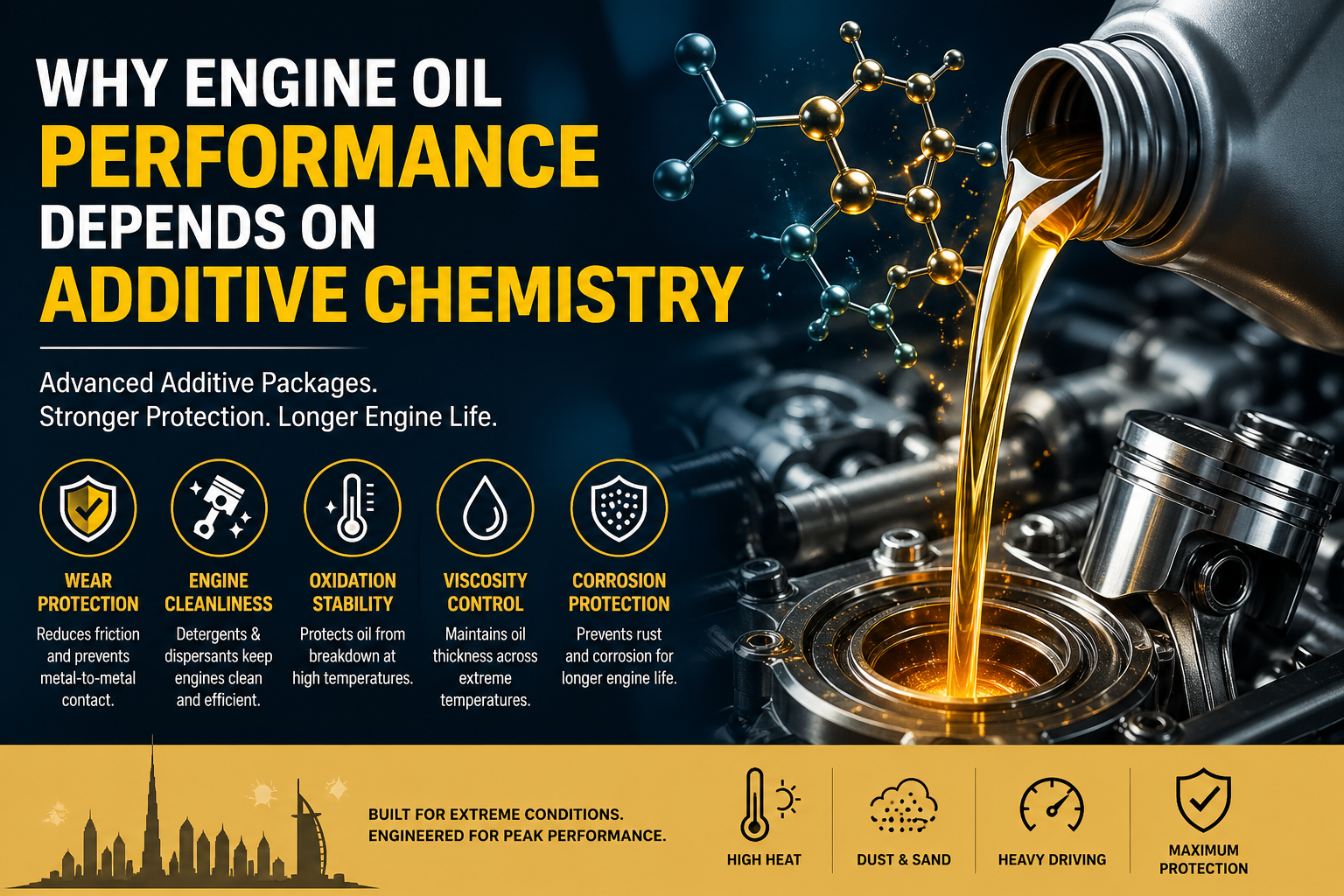
When most people think about engine oil, they focus on viscosity grades or brand names. But in reality, the true performance of any lubricant lies in its engine oil additive packages. These carefully engineered chemical blends are what enable oil to withstand extreme temperatures, reduce wear, and keep engines running efficiently—especially in demanding environments like the UAE, where heat, dust, and long driving hours are constant challenges.
This article breaks down why additive chemistry is the backbone of engine oil performance and how it directly impacts engine longevity, fuel efficiency, and maintenance costs.
What Are Engine Oil Additive Packages?
Base oil alone cannot meet the complex requirements of modern engines. That’s where engine oil additive packages come in. These are combinations of specialized chemicals added to base oils to enhance performance characteristics.
Typically, additives make up 15–30% of the total oil formulation, depending on the application. Without them, even the highest-quality base oil would fail under real-world operating conditions.
Key Functions of Additive Chemistry
1. Wear Protection and Friction Reduction
One of the most critical roles of additives is minimizing metal-to-metal contact. Anti-wear agents such as zinc dialkyldithiophosphate (ZDDP) form a protective film on engine components.
Why it matters in the UAE: High temperatures can thin oil films, increasing wear risk. Effective additive chemistry ensures continuous protection even under thermal stress.
2. Engine Cleanliness and Deposit Control
Detergents and dispersants prevent sludge and carbon deposits from accumulating inside the engine.
-
Detergents neutralize acidic by-products
-
Dispersants keep contaminants suspended in the oil
According to industry studies, engines using advanced additive formulations can reduce deposit formation by up to 40%, improving efficiency and extending oil life.
3. Oxidation Stability
Oxidation is a chemical reaction that degrades oil, especially at high temperatures. Antioxidants in additive packages slow this process, maintaining oil integrity over time.
In regions like the UAE, where engine temperatures often exceed normal operating ranges, oxidation resistance becomes a non-negotiable factor.
4. Viscosity Control Across Temperatures
Viscosity index improvers help oil maintain consistent thickness in both cold starts and high heat.
This ensures:
-
Smooth startup lubrication
-
Stable performance during long drives
Without these additives, oil would either become too thick or too thin, compromising engine protection.
5. Corrosion and Rust Prevention
Moisture and combustion by-products can lead to corrosion. Additives form a protective barrier that prevents rust formation on engine components.
This is particularly important for vehicles exposed to coastal environments or humidity variations common in parts of the UAE.
Why Additive Chemistry Matters More Than Ever
Modern Engines Are More Demanding
Today’s engines are designed for higher efficiency and lower emissions. This means tighter tolerances and higher operating pressures.
As a result, engine oil additive packages must evolve continuously to meet the following:
-
Emission standards
-
Fuel economy requirements
-
Extended oil drain intervals
Extreme Climate Conditions in the UAE
The UAE’s environment presents unique challenges:
-
Ambient temperatures often exceeding 45°C
-
Dust and sand contamination
-
Heavy traffic and long idle times
These factors accelerate oil degradation, making high-performance additive chemistry essential rather than optional.
Real-World Impact: Cost vs Performance
Using oil with inferior additive chemistry might seem cost-effective initially, but it often leads to the following:
-
Increased engine wear
-
Frequent oil changes
-
Higher maintenance costs
On the other hand, premium additive formulations can:
-
Extend engine life by 20–30%
-
Improve fuel efficiency
-
Reduce downtime
This makes them a smarter long-term investment for both individual drivers and fleet operators.
How to Choose the Right Engine Oil
When selecting engine oil, don’t just look at viscosity grades like 5W-30 or 10W-40. Instead, evaluate:
-
Additive technology used
-
OEM approvals and certifications
-
Performance standards (API, ACEA)
A well-balanced engine oil additive package ensures that the oil performs reliably under your specific driving conditions.
Conclusion: Chemistry Drives Performance
Engine oil is far more than just a lubricant—it’s a sophisticated chemical system designed to protect, clean, and optimize engine performance. The effectiveness of this system depends entirely on the quality of its additive chemistry.
For drivers and businesses in the UAE, investing in advanced engine oil additive packages isn’t just about better performance—it’s about durability, efficiency, and long-term savings.

 Arabic
 French
 Spanish
 Portuguese
 Deutsch
 Turkish
 Dutch
Dutch
 Italiano
 Russian
 Romaian
 Portuguese (Brazil)
 Greek
Greek