


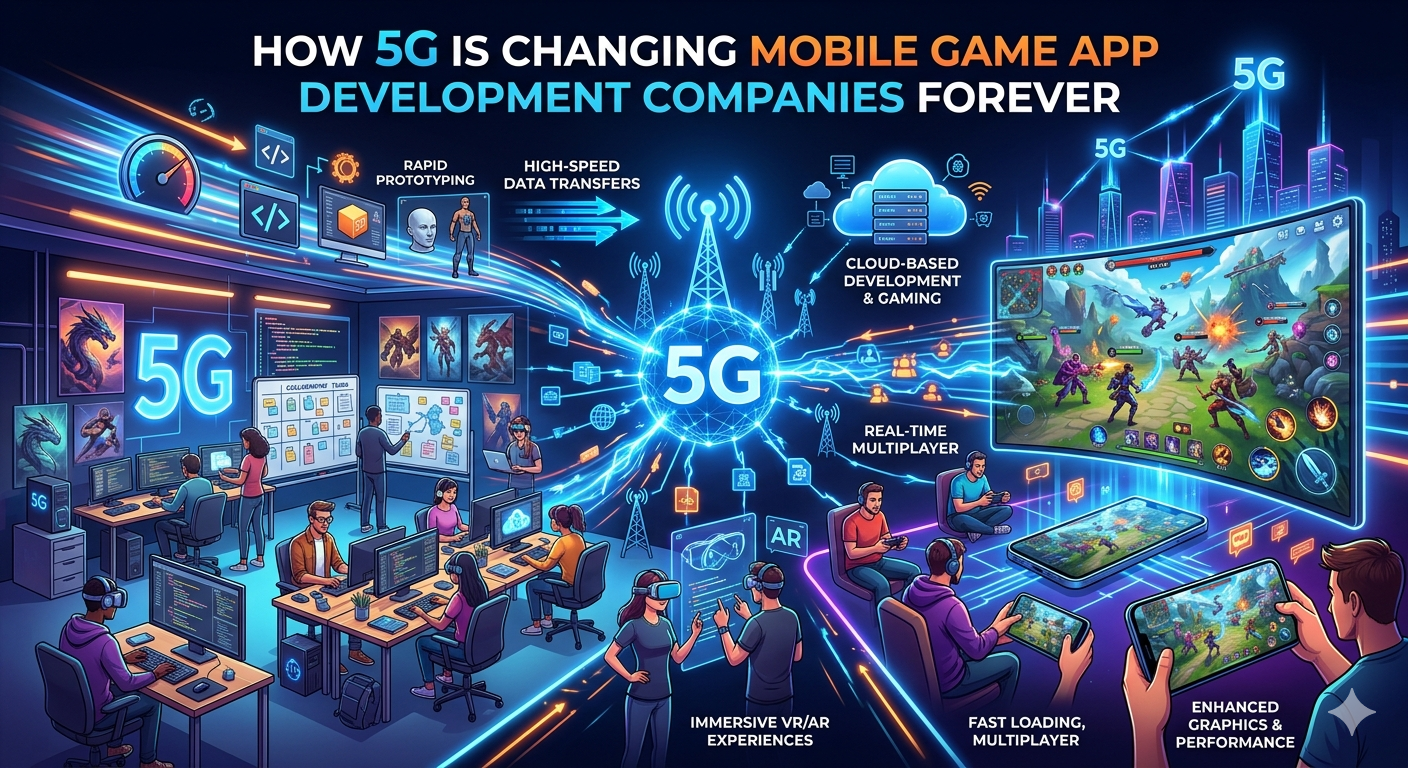
The rollout of 5G technology marks one of the most significant shifts in the mobile ecosystem since the advent of smartphones. With ultra-low latency, high bandwidth, and massive device connectivity, 5G is not just an incremental upgrade over 4G—it is a foundational change that is reshaping how mobile applications, especially games, are developed and experienced.
For mobile game app development companies, 5G opens the door to new possibilities: real-time multiplayer experiences, cloud gaming, AR/VR integration, and highly immersive gameplay environments. It is transforming not only the technical architecture of games but also business models, user expectations, and innovation cycles.
This blog explores how 5G is revolutionizing mobile game development, the opportunities it creates, the challenges it introduces, and how companies like JPLoft are adapting to this new era.
Understanding 5G Technology
5G is the fifth generation of wireless communication technology, designed to deliver faster speeds and more reliable connections.
Key Features of 5G
- Ultra-Low Latency: As low as 1 millisecond
- High Data Speeds: Up to 10 Gbps
- Massive Connectivity: Supports millions of devices per square kilometer
- Improved Reliability: Stable and consistent connections
Difference from 4G
| Feature | 4G | 5G |
|---|---|---|
| Latency | ~50 ms | ~1 ms |
| Speed | Up to 1 Gbps | Up to 10 Gbps |
| Connectivity | Limited | Massive |
These improvements directly impact mobile gaming capabilities.
Impact of 5G on Mobile Game Development
5G is changing how games are designed, developed, and delivered.
Real-Time Experiences
- Seamless multiplayer interactions
- Instant responsiveness
Enhanced Graphics
- Streaming high-quality assets
- Reduced device dependency
Larger Game Worlds
- Persistent environments
- Real-time updates
Reduced Load Times
- Faster downloads and updates
Developers can now create more complex and immersive games without compromising performance.
Enabling Cloud Gaming
Cloud gaming is one of the biggest beneficiaries of 5G.
How Cloud Gaming Works
- Games are processed on remote servers
- Video streams are delivered to devices
Benefits
- No need for high-end hardware
- Instant access to games
- Cross-device compatibility
Role of 5G
- Reduces latency
- Ensures smooth streaming
5G makes cloud gaming viable on mobile devices at scale.
Revolutionizing Multiplayer Gaming
Multiplayer gaming is significantly enhanced by 5G.
Low Latency Benefits
- Real-time synchronization
- Reduced lag
Massive Multiplayer Support
- Larger player counts
- More dynamic interactions
Competitive Gaming
- Improved fairness
- Better esports experiences
Developers can now build highly responsive multiplayer systems.
AR and VR Integration
5G accelerates the adoption of AR and VR in mobile gaming.
AR Gaming
- Real-time environment interaction
- Location-based experiences
VR Gaming
- Immersive virtual environments
- Reduced motion lag
5G Advantages
- High bandwidth for data-heavy content
- Low latency for real-time rendering
This enables next-level immersive experiences.
Edge Computing and Game Performance
Edge computing works closely with 5G to improve performance.
What is Edge Computing?
Processing data closer to the user rather than in centralized servers.
Benefits for Gaming
- Reduced latency
- Faster response times
- Improved performance
Use Cases
- Real-time analytics
- Dynamic content delivery
Edge computing enhances the capabilities of 5G-powered games.
Changes in Game Architecture
5G requires a shift in traditional game architecture.
Cloud-Based Architecture
- Offloading processing to servers
Microservices
- Modular and scalable systems
Real-Time Data Processing
- Continuous synchronization
Developers must redesign systems to fully leverage 5G capabilities.
Monetization Opportunities with 5G
5G enables new revenue models.
Subscription Services
- Cloud gaming platforms
In-Game Streaming Content
- Live events
- Interactive experiences
Advanced In-App Purchases
- High-quality digital assets
Esports and Live Competitions
- Real-time tournaments
These opportunities expand revenue potential.
Data Analytics and Personalization
5G enhances data collection and analysis.
Real-Time Analytics
- Immediate insights
- Dynamic gameplay adjustments
Personalization
- Tailored experiences
- Adaptive difficulty
Benefits
- Improved retention
- Higher engagement
Developers can deliver more personalized experiences.
Challenges of 5G Adoption
Despite its advantages, 5G presents challenges.
Infrastructure Limitations
- Not fully available worldwide
Development Complexity
- Requires new skills and tools
Cost Implications
- Higher initial investment
Device Compatibility
- Not all devices support 5G
Developers must navigate these challenges carefully.
Security Considerations in 5G Gaming
Increased connectivity introduces security risks.
Potential Threats
- Data breaches
- Network attacks
Security Measures
- Encryption
- Secure APIs
- Authentication protocols
Ensuring security is critical in a 5G-enabled ecosystem.
Role of AI in 5G-Powered Games
AI complements 5G capabilities.
Applications
- Smart NPCs
- Predictive analytics
- Personalized gameplay
Benefits
- Enhanced user experience
- Improved engagement
AI and 5G together create intelligent gaming systems.
Future Trends in 5G and Mobile Gaming
Hyper-Connected Ecosystems
- Seamless integration across devices
Metaverse Integration
- Persistent virtual worlds
Advanced Cloud Gaming
- Console-quality games on mobile
Real-Time Collaboration
- Social gaming experiences
The future of gaming will be deeply influenced by 5G.
Strategies Adopted by Mobile Game Development Companies
Investing in Infrastructure
- Cloud and edge computing
Adopting New Technologies
- AI, AR, VR
Enhancing User Experience
- Low latency gameplay
- High-quality visuals
Continuous Innovation
- Experimenting with new models
These strategies help companies stay competitive.
How JPLoft Is Leveraging 5G in Mobile Game Development
JPLoft has positioned itself as a cross-platform game app development company that is actively embracing the transformative power of 5G. They focus on integrating advanced technologies to deliver next-generation gaming experiences.
Advanced Game Architecture
They design systems that:
- Leverage cloud computing
- Utilize edge processing
- Support real-time interactions
This ensures high performance and scalability.
Focus on Multiplayer Excellence
They build multiplayer games that:
- Minimize latency
- Enhance synchronization
- Support large player bases
Integration of Emerging Technologies
They incorporate:
- AR/VR features
- AI-driven systems
- Cloud gaming capabilities
User-Centric Approach
They prioritize:
- Seamless gameplay
- Fast load times
- Personalized experiences
Continuous Innovation
They stay ahead by:
- Adapting to 5G advancements
- Exploring new gaming models
- Delivering future-ready solutions
Their approach ensures that clients can fully leverage the benefits of 5G.
Conclusion
5G is fundamentally transforming mobile game development, enabling faster, more immersive, and highly interactive experiences. From cloud gaming and real-time multiplayer to AR/VR integration and advanced analytics, the possibilities are vast.
Mobile game app development companies are adapting by redesigning architectures, adopting new technologies, and exploring innovative monetization strategies. While challenges remain, the benefits of 5G far outweigh the obstacles.
Companies like JPLoft demonstrate how embracing 5G can unlock new opportunities in mobile gaming. By focusing on performance, scalability, and user experience, they help businesses create games that are ready for the future of connectivity.

 English
 Arabic
 French
 Spanish
 Portuguese
 Deutsch
 Turkish
 Dutch
Dutch
 Italiano
 Russian
 Romaian
 Greek
Greek