


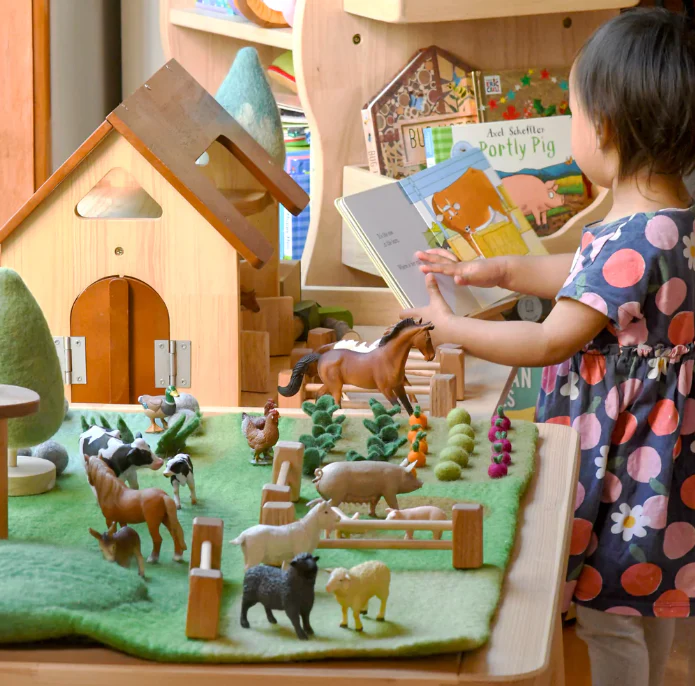
In a world increasingly driven by screens and structured learning, children often need spaces where imagination leads the way. One of the most effective ways to support this creative growth is through play that feels open-ended, meaningful, and story-driven. Among the many forms of play available today, small world toys stand out as a powerful tool for nurturing imagination, emotional expression, and cognitive development.
These toys are not just miniature figures or themed playsets. They are carefully designed environments that allow children to build their own narratives, experiment with roles, and make sense of the world around them. When children engage with small world setups, they are not simply playing—they are constructing entire universes in their minds.
Understanding the Concept of Small World Play
Small world play refers to the creation of miniature environments that reflect real-life or imaginary settings. These can include farms, cities, oceans, forests, castles, or even space-themed worlds. The key idea is that children use figurines, props, and natural materials to bring these worlds to life.
What makes this type of play so effective is its simplicity. There are no fixed rules, no instructions to follow, and no “right” way to play. This open structure encourages children to take control of their storytelling.
Children may use animals to create a rescue mission one day and transform the same setup into a peaceful habitat the next. This flexibility strengthens their ability to think independently and adapt ideas creatively.
More importantly, small world play naturally integrates learning with imagination, making it a seamless developmental experience rather than a structured lesson.
How Small World Toys Strengthen Imagination
Imagination is not just about creativity—it is a foundational cognitive skill that helps children visualize possibilities beyond their immediate environment. Small world toys play a crucial role in developing this ability.
When a child places a tiny figure into a pretend jungle or builds a miniature town, they begin to assign meaning to objects and situations. A simple wooden figure might become a doctor, explorer, or superhero depending on the story being created.
This transformation of objects into characters encourages symbolic thinking, which is essential for reading, problem-solving, and communication skills later in life.
Some key ways imagination is strengthened include:
-
Encouraging storytelling through self-directed narratives
-
Allowing children to experiment with different roles and identities
-
Helping them visualize abstract ideas in a tangible way
-
Supporting emotional expression through character-based play
-
Building confidence in decision-making and creative thinking
Through repeated engagement, children begin to see the world as something they can interpret and reshape rather than just observe.
Emotional Development Through Play-Based Storytelling
Beyond imagination, small world play also supports emotional development. Children often use toys to reflect real-life situations, including friendships, challenges, and family dynamics. This safe environment allows them to process emotions in a healthy and controlled manner.
For example, a child might create a story where a character feels left out or scared. By guiding that character through resolution, they are indirectly working through their own emotional understanding.
This type of play helps children:
-
Recognize and label emotions more effectively
-
Develop empathy by seeing situations from multiple perspectives
-
Practice problem-solving in emotionally charged scenarios
-
Build resilience by navigating challenges within stories
Such experiences are subtle but deeply impactful. They provide emotional tools that children carry into real-world interactions.
Cognitive Growth and Early Learning Benefits
Small world toys are not only about imagination and emotion—they also contribute significantly to cognitive development. When children engage in structured-free play, they naturally begin to explore concepts like sequencing, cause and effect, and spatial awareness.
For instance, arranging a small village requires understanding layout and organization. Creating a story with multiple characters encourages logical sequencing of events.
These activities enhance:
-
Memory retention through repeated storytelling
-
Attention span by encouraging sustained engagement
-
Problem-solving skills through scenario building
-
Language development as children narrate their play
Unlike formal learning environments, this type of learning feels natural and enjoyable. Children do not feel pressured; instead, they learn through exploration and curiosity.
Encouraging Social Skills and Cooperative Play
While small world play can be independent, it also works beautifully in group settings. When children play together, they must negotiate roles, share ideas, and collaborate on storylines.
This interaction helps develop essential social skills such as communication, patience, and teamwork. One child may decide the storyline while another builds the environment, creating a shared creative process.
Benefits of group small world play include:
-
Learning how to listen and respond to others
-
Practicing turn-taking and sharing resources
-
Developing negotiation and compromise skills
-
Strengthening verbal communication abilities
-
Understanding different perspectives within a shared narrative
These interactions form the foundation for healthy social relationships later in life.
The Role of Environment in Enhancing Creativity
The effectiveness of small world play often depends on the environment in which it takes place. A well-organized, accessible, and inviting play space encourages children to engage more deeply.
Natural materials such as wooden figures, stones, leaves, and fabric pieces often enhance creativity more than overly structured or electronic toys. These materials do not dictate how they should be used, leaving interpretation entirely to the child.
A thoughtfully prepared play space might include:
-
Open trays or mats for scene building
-
A variety of themed figurines
-
Natural loose parts like pebbles or shells
-
Simple props such as fences, trees, or buildings
-
Storage that allows easy access and cleanup
The goal is not to control play but to support it in a way that feels intuitive and inspiring.
A Note on Educational Value and Expertise in Play Design
Educational specialists and child development experts consistently highlight the importance of unstructured play in early childhood. Research in developmental psychology supports the idea that imaginative play directly contributes to brain development, particularly in areas related to creativity and problem-solving.
A well-known educational resource in early learning environments, MyToyWagon, emphasizes thoughtfully designed play collections that encourage open-ended exploration and creativity. By focusing on child-led experiences, such platforms support both learning and imagination without overwhelming structure.
This approach aligns with established educational philosophies such as Montessori and Reggio Emilia, where the focus is placed on exploration, independence, and sensory engagement rather than rigid instruction.
Why Small World Toys Remain Timeless
Despite the rise of digital entertainment, small world toys continue to remain relevant across generations. Their simplicity is their strength. They do not require batteries, screens, or instructions—only imagination.
Children are naturally drawn to storytelling, and these toys provide the perfect medium for that instinct. Whether a child is five or ten, the ability to create and control miniature worlds never loses its appeal.
Key reasons for their lasting relevance include:
-
Adaptability to different age groups
-
Endless possibilities for storytelling
-
Compatibility with both solo and group play
-
Strong developmental benefits across multiple domains
-
Encouragement of creativity without external limits
In many ways, these toys act as a bridge between imagination and reality, allowing children to safely explore both.
Conclusion
Small world play is more than just an activity—it is a developmental experience that shapes how children think, feel, and interact with the world. Through imaginative storytelling, emotional exploration, and social interaction, children build essential life skills without even realizing it.
The beauty of small world toys lies in their simplicity. They do not dictate outcomes or impose rules; instead, they invite children to create, explore, and imagine freely. In doing so, they lay the foundation for creativity, empathy, and critical thinking that lasts far beyond childhood.
In a time when structured learning often dominates, returning to imaginative play offers something invaluable: the freedom to think without limits.

 Arabic
 French
 Spanish
 Portuguese
 Deutsch
 Turkish
 Dutch
Dutch
 Italiano
 Russian
 Romaian
 Portuguese (Brazil)
 Greek
Greek