


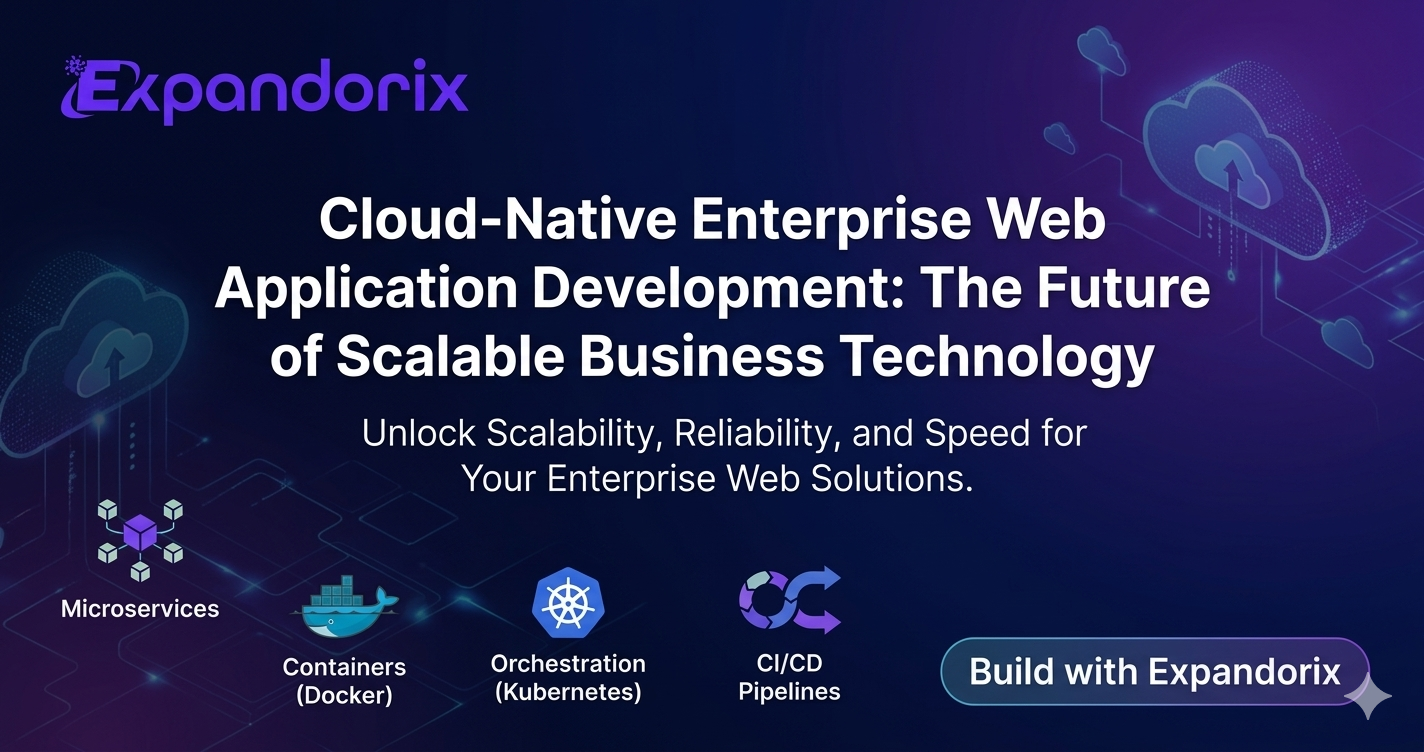
The cloud has fundamentally changed what is possible in enterprise web application development. Organizations that once spent months provisioning servers, configuring networking, and managing physical infrastructure can now deploy globally distributed, infinitely scalable enterprise web applications in weeks. Cloud-native development has become the default approach for any enterprise web application that needs to scale, adapt, and evolve with the pace of modern business.
This guide explores cloud-native enterprise web application development in depth, covering what it means, why it matters, the technologies involved, and how Expandorix helps organizations build and deploy cloud-native enterprise web solutions that deliver exceptional scalability, reliability, and cost efficiency.
What Does Cloud-Native Mean for Enterprise Web Applications?
Cloud-native is more than just hosting an application on a cloud server. A truly cloud-native enterprise web application is designed from the ground up to take full advantage of the capabilities that cloud platforms offer. This means building applications as collections of loosely coupled microservices, using containers for consistent deployment, leveraging managed cloud services to offload infrastructure management, and building for elastic scalability and resilience from day one.
Cloud-native applications embrace automation. Infrastructure is defined as code and provisioned automatically. Deployment pipelines build, test, and deploy code changes continuously without manual intervention. Monitoring systems automatically detect and respond to issues. Scaling rules automatically adjust capacity based on demand. This level of automation enables enterprise organizations to move faster, with less operational overhead, than was ever possible with traditional on-premises or infrastructure-as-a-service approaches.
Core Cloud-Native Technologies for Enterprise Web Development
Microservices Architecture
Microservices architecture decomposes an enterprise web application into a collection of small, independently deployable services, each responsible for a specific business capability. A large enterprise application might comprise dozens or hundreds of microservices handling functions like user authentication, payment processing, notification delivery, reporting, and data analytics.
Each microservice can be developed, deployed, scaled, and maintained independently. This independence dramatically reduces the risk associated with changes, since updating one service does not require redeploying the entire application. It also enables teams to work in parallel on different parts of the application without stepping on each other's changes.
Containerization with Docker
Containers package an application and all its dependencies into a single, portable unit that runs consistently across different environments. Docker has become the industry standard for containerization. By containerizing enterprise web application services, development teams ensure that the application runs identically in development, testing, and production environments, eliminating the classic 'it works on my machine' problem.
Containers also provide process isolation, resource efficiency, and fast startup times that make them ideal for cloud-native enterprise applications. A single cloud server can run dozens of containers simultaneously, each isolated from the others, making containers far more efficient than traditional virtual machines for many enterprise workloads.
Container Orchestration with Kubernetes
When an enterprise application is composed of many containers, managing them manually becomes impossible. Kubernetes is the leading container orchestration platform, automating the deployment, scaling, networking, and management of containerized applications. Kubernetes manages the lifecycle of containers, automatically restarting failed containers, distributing load across healthy instances, and scaling capacity up or down based on demand.
All major cloud platforms offer managed Kubernetes services: Amazon Elastic Kubernetes Service (EKS) on AWS, Azure Kubernetes Service (AKS) on Microsoft Azure, and Google Kubernetes Engine (GKE) on Google Cloud. These managed services handle the operational complexity of running Kubernetes, allowing development teams to focus on building application functionality.
Serverless Computing
Serverless computing takes cloud-native development even further by abstracting away server management entirely. With serverless platforms like AWS Lambda, Azure Functions, and Google Cloud Functions, developers write and deploy individual functions that execute in response to events, without provisioning or managing any servers at all. Billing is per execution, making serverless extremely cost-efficient for workloads with variable or unpredictable demand.
Serverless is particularly well-suited for event-driven enterprise use cases like processing incoming webhooks, transforming data streams, sending notifications, and handling background jobs. Many modern enterprise web applications combine serverless functions with container-based services to optimize cost and performance across different types of workloads.
Continuous Integration and Continuous Deployment (CI/CD)
CI/CD pipelines automate the process of building, testing, and deploying code changes from the development team's workstations to production. A robust CI/CD pipeline automatically runs unit tests, integration tests, security scans, and code quality checks on every code change. If all checks pass, the change can be automatically deployed to production with zero manual intervention.
CI/CD enables enterprise development teams to ship new features, improvements, and bug fixes to production multiple times per day, with high confidence and minimal risk. Tools like GitHub Actions, GitLab CI, Jenkins, and Azure DevOps Pipelines are commonly used to implement enterprise CI/CD workflows.
Cloud Platform Options for Enterprise Web Applications
Amazon Web Services (AWS)
AWS is the world's largest cloud platform, offering the broadest selection of cloud services for enterprise web application development. Key services include EC2 for compute, RDS and DynamoDB for databases, S3 for storage, CloudFront for content delivery, API Gateway for API management, and a vast ecosystem of AI, analytics, and security services. AWS's global infrastructure spans dozens of regions, enabling low-latency delivery to users anywhere in the world.
Microsoft Azure
Azure is the second-largest cloud platform and the preferred choice for organizations heavily invested in the Microsoft ecosystem. Azure integrates deeply with Microsoft products like Active Directory, Office 365, and Dynamics 365, making it an excellent choice for enterprises that rely on these tools. Azure's enterprise agreements, compliance certifications, and hybrid cloud capabilities make it particularly attractive for large enterprises and government organizations.
Google Cloud Platform (GCP)
GCP is known for its exceptional data analytics, machine learning, and Kubernetes capabilities. Google Kubernetes Engine is widely considered the gold standard for managed Kubernetes, and Google BigQuery is a leading platform for enterprise data analytics. GCP is often chosen by data-intensive enterprises and organizations looking to leverage cutting-edge AI and machine learning capabilities in their enterprise web applications.
Benefits of Cloud-Native Enterprise Web Development
-
Unlimited scalability: Cloud-native applications can scale automatically from handling ten users to ten million users without architectural changes
-
High availability: Redundant, geographically distributed infrastructure ensures 99.9% or higher uptime for mission-critical applications
-
Cost efficiency: Pay-per-use pricing and elastic scaling mean you only pay for the resources you actually consume
-
Faster time to market: Automated CI/CD pipelines and managed infrastructure services dramatically accelerate development and deployment
-
Global reach: Cloud platforms provide globally distributed infrastructure for low-latency delivery to users anywhere in the world
-
Enhanced security: Cloud platforms provide security services, compliance certifications, and infrastructure security that would be prohibitively expensive to replicate on-premises
-
Business continuity: Automated backups, multi-region failover, and disaster recovery capabilities ensure business continuity even in the face of major outages
How Expandorix Delivers Cloud-Native Enterprise Web Applications
Expandorix has built deep expertise in cloud-native enterprise web application development across AWS, Azure, and GCP. Their cloud architecture team designs cloud-native solutions that maximize scalability, reliability, and cost efficiency while minimizing operational complexity. Every enterprise web application they build is cloud-native by default, leveraging microservices architecture, containerization, managed services, and CI/CD automation.
Expandorix's DevOps engineers implement comprehensive CI/CD pipelines that enable rapid, reliable delivery of new features and improvements. Their infrastructure-as-code approach using Terraform and CloudFormation ensures that infrastructure is consistent, reproducible, and version-controlled. Automated monitoring and alerting systems give clients real-time visibility into application performance and health.
For organizations migrating from on-premises or legacy infrastructure to the cloud, Expandorix offers cloud migration services that assess your current environment, design the target cloud architecture, execute the migration with minimal disruption to operations, and optimize the cloud environment for performance and cost after migration.
Conclusion
Cloud-native enterprise web application development is not just a technical trend; it is the definitive approach for building enterprise web applications that can meet the demands of modern business. The scalability, reliability, cost efficiency, and speed advantages of cloud-native development are too significant to ignore. Organizations that embrace cloud-native approaches gain a foundational technology advantage that compounds over time.
Expandorix is the partner organizations need to navigate the complexity of cloud-native enterprise web development. With deep expertise across all major cloud platforms and a proven track record of delivering scalable, reliable enterprise web solutions, Expandorix makes cloud-native development accessible and achievable for organizations of all sizes. Contact Expandorix today to start building your cloud-native enterprise future.

 Arabic
 French
 Spanish
 Portuguese
 Deutsch
 Turkish
 Dutch
Dutch
 Italiano
 Russian
 Romaian
 Portuguese (Brazil)
 Greek
Greek