


Do recruiters value Online business analytics certification? Understand hiring trends, skill expectations, and what impacts your chances of getting hired.
When thinking about certifications, one common doubt keeps coming up:
Do recruiters really value online business analytics certifications, or do they still prefer traditional offline programs?
This question matters because the learning format you choose can influence how confident you feel while applying for roles.
The truth is that recruiters don't care if you got your certification online or in person. Their attention is on what you can actually do with the skills you have learned. The format has become secondary, while practical capability has taken the front seat.
Do Recruiters Prefer Online or Offline Business Analytics Certification
Recruiters do not have a fixed preference for online or offline certifications. What matters more is how effectively the certification prepares you for real business challenges.
Here is how recruiters usually think about it:
-
Recruiters prioritize skill application over the mode of learning delivery
-
They focus on whether candidates can solve business problems using data
-
Certifications are evaluated based on relevance to current industry tools
-
Practical exposure during learning matters more than classroom presence
-
Recruiters are open to both formats if outcomes are clearly visible
In most hiring scenarios, the format itself does not become a deciding factor.
Why Online Business Analytics Certification Is Widely Accepted
Online learning has become a standard way to build skills, especially in fields like analytics where tools and technologies evolve quickly. Recruiters are aware of this shift and have adapted their expectations.
There are several reasons why online certifications are accepted:
-
Online certifications provide flexibility for continuous skill development alongside work
-
Many programs include hands-on assignments aligned with real business use cases
-
An updated curriculum helps candidates stay aligned with industry requirements
-
Candidates show initiative by choosing to upgrade skills independently
-
Online learning platforms often emphasize tool-based training and application
Because of these factors, online certifications are seen as relevant and practical.
When Offline Certifications May Still Have an Edge
Although online certifications are widely accepted, there are certain situations where offline learning can offer additional benefits. This does not mean recruiters always prefer offline programs, but the experience can add value in specific ways.
Offline certifications may offer advantages such as:
-
Structured classroom environments that support consistent learning discipline
-
Immediate access to instructors for doubt clarification and deeper discussions
-
Opportunities for peer interaction and collaborative problem-solving
-
Networking with professionals who are part of the same learning cohort
-
Exposure to guided projects and in-person mentoring sessions
These aspects can strengthen understanding, but they are not mandatory for success.
What Recruiters Actually Look for Beyond Certification Format
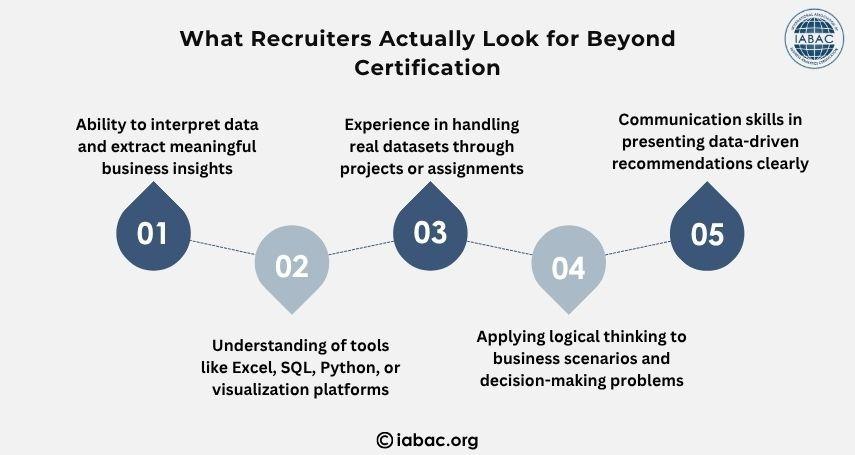
Instead of focusing on how the certification was completed, recruiters evaluate whether candidates are ready to contribute in a business environment. This shifts the conversation away from online versus offline.
Recruiters typically assess the following:
-
Ability to interpret data and extract meaningful business insights
-
Understanding of tools like Excel, SQL, Python, or visualization platforms like powerBI
-
Experience in handling real datasets through projects or assignments
-
Logical thinking applied to business scenarios and decision-making problems
-
Communication skills in presenting data-driven recommendations clearly
These factors carry significantly more weight than the learning format.
How Certification Format Impacts Freshers vs Experienced Professionals
The importance of certification format can vary slightly depending on your experience level. However, even in these cases, skills remain the central focus.
For freshers:
-
Certifications help demonstrate commitment to learning and skill building
-
Online certifications can provide quick access to industry-relevant knowledge
-
Projects become essential to prove practical understanding
-
Recruiters look for potential rather than format of learning
-
Certification acts as a starting point for entering analytics roles
For experienced professionals:
-
Certifications support upskilling or transitioning into analytics roles
-
Online formats are often preferred due to flexibility with work schedules
-
Recruiters focus on how new skills are applied in current job roles
-
Real-world application matters more than where the certification was completed
-
Experience combined with certification strengthens overall profile
In both cases, the format plays a minimal role compared to outcomes.
Common Mistakes Candidates Make While Choosing Certification Format
Many candidates spend too much time deciding between online and offline formats without focusing on what actually matters. This can lead to missed opportunities in building relevant skills.
Some common mistakes include:
-
Choosing a certification based only on format instead of curriculum quality
-
Assuming offline certifications automatically carry more credibility
-
Ignoring practical project work while focusing only on course completion
-
Not evaluating whether the program includes industry-relevant tools
-
Overlooking the importance of building a strong portfolio alongside certification
Avoiding these mistakes helps in making a more effective decision.
How to Make Any Certification Valuable for Recruiters
Whether you choose online or offline certification, the way you use it determines its impact. Recruiters respond more to demonstrated capability than the format itself.
You can strengthen the value of your certification by:
-
Building projects that reflect real business challenges and solutions
-
Showcasing your work through a structured portfolio or case studies
-
Highlighting measurable outcomes achieved during project execution
-
Aligning your skills with the requirements mentioned in job descriptions
-
Preparing to confidently explain your approach during interviews
These actions help convert certification into a strong career asset.
Why the Industry Is Moving Beyond Format-Based Judgement
The increasing reliance on data across industries has changed how talent is evaluated. Organizations need professionals who can work with data effectively, regardless of how they learned.
This shift is visible in hiring patterns:
-
Companies are focusing on skill-based hiring rather than traditional credentials
-
Remote work culture has normalized online learning and collaboration
-
Rapid technological changes require continuous upskilling through flexible formats
-
Employers value adaptability and learning mindset in candidates
-
Certifications are seen as proof of effort, but skills prove capability
This evolution has reduced the importance of format in hiring decisions.
Recruiters do value online business analytics certification, and they do not treat it as less important than offline certification. The difference lies in how well you can apply what you have learned. Certification format may influence your learning experience, but it does not define your chances of getting hired.
What truly matters is your ability to work with data, solve business problems, and communicate insights effectively. When these elements are strong, both online and offline certifications can support your career growth. Strengthen your analytics skills with an IABAC certification and build a profile that stands out to recruiters.

 Arabic
 French
 Spanish
 Portuguese
 Deutsch
 Turkish
 Dutch
Dutch
 Italiano
 Russian
 Romaian
 Portuguese (Brazil)
 Greek
Greek