


AI in finance is transforming fraud detection, risk assessment, and customer experience, helping firms improve decisions, reduce costs, and drive growth.
Finance has always been about making smart decisions, but today, AI in finance is making those decisions faster, smarter, and more accurate than ever before.
From detecting fraud in milliseconds to managing investments automatically, artificial intelligence is no longer a buzzword in financial services; it's the backbone of modern finance.
In this guide, we'll walk you through the top real-world uses of AI in finance, covering everything from credit scoring and risk assessment to personalized banking and cybersecurity.
Whether you're a finance professional or just getting started, understanding these applications will help you stay ahead in a rapidly evolving industry.
Fraud Detection and Prevention
Detecting fraud is still one of the most important ways that AI is used in finance. It's hard to find suspicious activity, because banks and other financial institutions handle millions of transactions every day. AI fixes this by looking at patterns in real time.
Machine learning models can find strange transaction patterns, mark them as suspicious, and keep learning from new types of fraud. AI changes over time, which makes it more accurate at finding things and less likely to give false positives than rule-based systems.
Key benefits include the following:
-
Real-time monitoring of transactions
-
Faster identification of fraudulent activities
-
Reduced financial losses and improved customer trust
-
Continuous improvement through adaptive learning
AI-powered fraud systems are now considered essential, especially as cyber threats grow more sophisticated.
Algorithmic Trading and Investment Strategies
AI is a big part of how people trade these days. Algorithmic trading uses machine learning models to look at market data, find patterns, and make trades very quickly.
These systems can make decisions faster than human traders by looking at historical data, market signals, and even news sentiment. This makes things work better and gives better returns when you take risks.
Key capabilities include:
-
High-frequency trading execution
-
Predictive market analysis
-
Sentiment analysis using financial news and reports
-
Reduced emotional bias in trading decisions
AI-driven trading platforms are widely used in capital markets, enabling institutions to respond quickly to market changes and optimize portfolio performance.
Credit Scoring and Risk Assessment
Old-fashioned credit scoring systems use a small amount of financial history and rules that don't change. AI improves this process by looking at more types of data, such as transactional and behavioral data.
Machine learning models evaluate creditworthiness with greater precision by detecting concealed patterns that conventional systems might miss. This helps banks and other financial institutions make better choices about who to lend money to.
Advantages include:
-
Improved accuracy in credit scoring
-
Faster loan approval processes
-
Inclusion of underserved or thin-credit populations
-
Better risk management strategies
AI-driven risk assessment is helping financial institutions balance growth with risk control, making lending more efficient and inclusive.
Personalized Banking and Customer Experience
People's expectations in finance have changed a lot. People want services that are tailored to them, quick answers, and digital experiences that are easy to use. AI makes this change possible by personalizing based on data.
AI systems can give personalized recommendations, financial advice, and product suggestions by looking at a customer's behavior, preferences, and transaction history.
Common applications include:
-
Personalized product recommendations
-
AI-powered chatbots and virtual assistants
-
24/7 customer support
-
Behavioral insights for targeted financial services
AI improves engagement by delivering relevant experiences, which strengthens customer relationships and increases retention.
Robo-Advisors and Wealth Management
Robo-advisors are AI-powered platforms that give you automated financial advice and help you manage your portfolio. They use algorithms to figure out users' goals, how much risk they can handle, and how much money they have to make investment plans.
By lowering costs and removing barriers to entry, these platforms make wealth management available to more people.
Key features include the following:
-
Automated portfolio management
-
Real-time rebalancing of investments
-
Data-driven financial planning
-
Lower fees compared to traditional advisors
AI-driven advisory services are transforming how individuals approach investments, offering scalable and efficient solutions.
Process Automation and Operational Efficiency
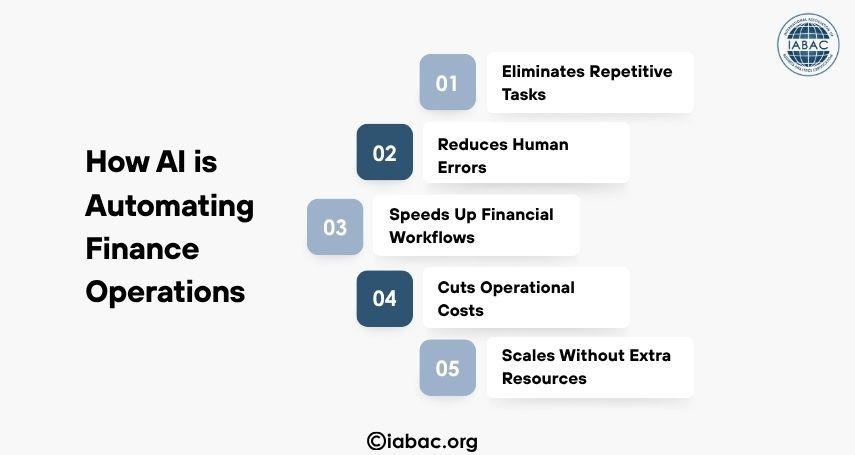
Finance includes a lot of repetitive and time-consuming tasks like entering data, reconciling accounts, and making reports. AI and robotic process automation (RPA) work together to make these tasks easier.
Automation cuts down on mistakes made by hand, speeds up workflows, and lets professionals focus on important tasks instead of everyday ones.
Major use cases include:
-
Invoice processing and reconciliation
-
Financial reporting automation
-
Data extraction and validation
-
Workflow optimization
Organizations adopting AI for automation report improved productivity and cost savings, making operations more efficient and scalable.
Anti-Money Laundering (AML) and Compliance
Regulatory compliance is a very important part of finance, and AI is helping to make AML processes stronger. Traditional compliance systems often have trouble with a lot of data and rules that change all the time.
AI helps by looking at transactions, finding patterns that look suspicious, and making compliance reports automatically.
Benefits include:
-
Faster detection of money laundering activities
-
Reduced false alerts
-
Automated regulatory reporting
-
Improved compliance accuracy
AI-driven compliance tools enable financial institutions to meet regulatory requirements more effectively while minimizing operational complexity.
Predictive Analytics and Financial Forecasting
AI enhances forecasting by analyzing historical data and identifying trends that influence future outcomes. Financial teams use predictive analytics for budgeting, cash flow management, and strategic planning.
AI models can simulate different scenarios, helping organizations prepare for uncertainties and make informed decisions.
Applications include:
-
Cash flow forecasting
-
Revenue prediction
-
Risk scenario modeling
-
Investment planning
AI improves the reliability of forecasts, enabling businesses to respond proactively to market changes.
Conversational AI and Virtual Assistants
Conversational AI is transforming how customers interact with financial institutions. Chatbots and virtual assistants provide instant responses, handle queries, and guide users through financial processes.
These systems use natural language processing (NLP) to understand and respond to customer needs effectively.
Key advantages:
-
Instant query resolution
-
Reduced customer service costs
-
Consistent support across channels
-
Improved user experience
AI-powered assistants are becoming a standard feature in digital banking, enhancing accessibility and convenience.
Sentiment Analysis and Market Intelligence
Financial markets are influenced by news, social media, and global events. AI uses NLP to analyze unstructured data sources and extract insights that impact market behavior.
Sentiment analysis helps investors and institutions understand market trends and make data-driven decisions.
Use cases include:
-
Analyzing financial news and reports
-
Monitoring social media sentiment
-
Identifying market trends
-
Supporting investment decisions
This capability provides a competitive advantage by enabling faster and more informed responses to market developments.
Cybersecurity and Risk Monitoring
As financial systems become more digital, cybersecurity threats are increasing. AI strengthens security by detecting anomalies, identifying vulnerabilities, and preventing attacks.
AI systems monitor network activity in real time and respond to potential threats before they escalate.
Key capabilities:
-
Behavioral biometrics for user verification
-
Real-time threat detection
-
Risk scoring and anomaly detection
-
Automated incident response
AI-driven cybersecurity is becoming essential for protecting financial data and maintaining customer trust.
The Growing Impact of AI in Finance
AI is not limited to one area of finance; it is integrated across the entire ecosystem. From customer-facing applications to backend operations, its influence continues to grow.
Financial institutions are investing heavily in AI to improve efficiency, reduce risks, and stay competitive. The ability to process large datasets, generate insights, and automate complex tasks is driving this adoption.
Some broader impacts include the following:
-
Faster and more accurate decision-making
-
Improved operational efficiency
-
Enhanced customer experiences
-
Greater financial inclusion
-
Reduced costs and increased scalability
As AI adoption increases, professionals in finance must adapt to new tools and technologies, and getting certified in certifications like Certified AI Professional in Finance is the smartest career move.
Challenges in Adopting AI in Finance
Despite its advantages, AI adoption comes with challenges that organizations must address.
Key challenges include the following:
-
Data privacy and security concerns
-
Regulatory compliance complexities
-
Bias in AI models
-
Integration with legacy systems
-
Need for skilled professionals
Addressing these challenges requires a balanced approach that combines technology, governance, and human oversight.
AI is redefining how finance operates, from detecting fraud to managing investments and improving customer experiences. Its ability to analyze data, automate processes, and generate insights is transforming every aspect of the financial ecosystem.
As organizations continue to adopt AI, the demand for professionals who understand both finance and technology is increasing. Building expertise in AI-driven financial systems, along with certifications from IABAC, can open up strong career opportunities in a rapidly evolving industry.
Those who adapt to these changes will be better positioned to contribute to data-driven decision-making and innovation in finance.

 English
 Arabic
 French
 Spanish
 Portuguese
 Deutsch
 Turkish
 Italiano
 Russian
 Romaian
 Portuguese (Brazil)
 Greek
Greek