


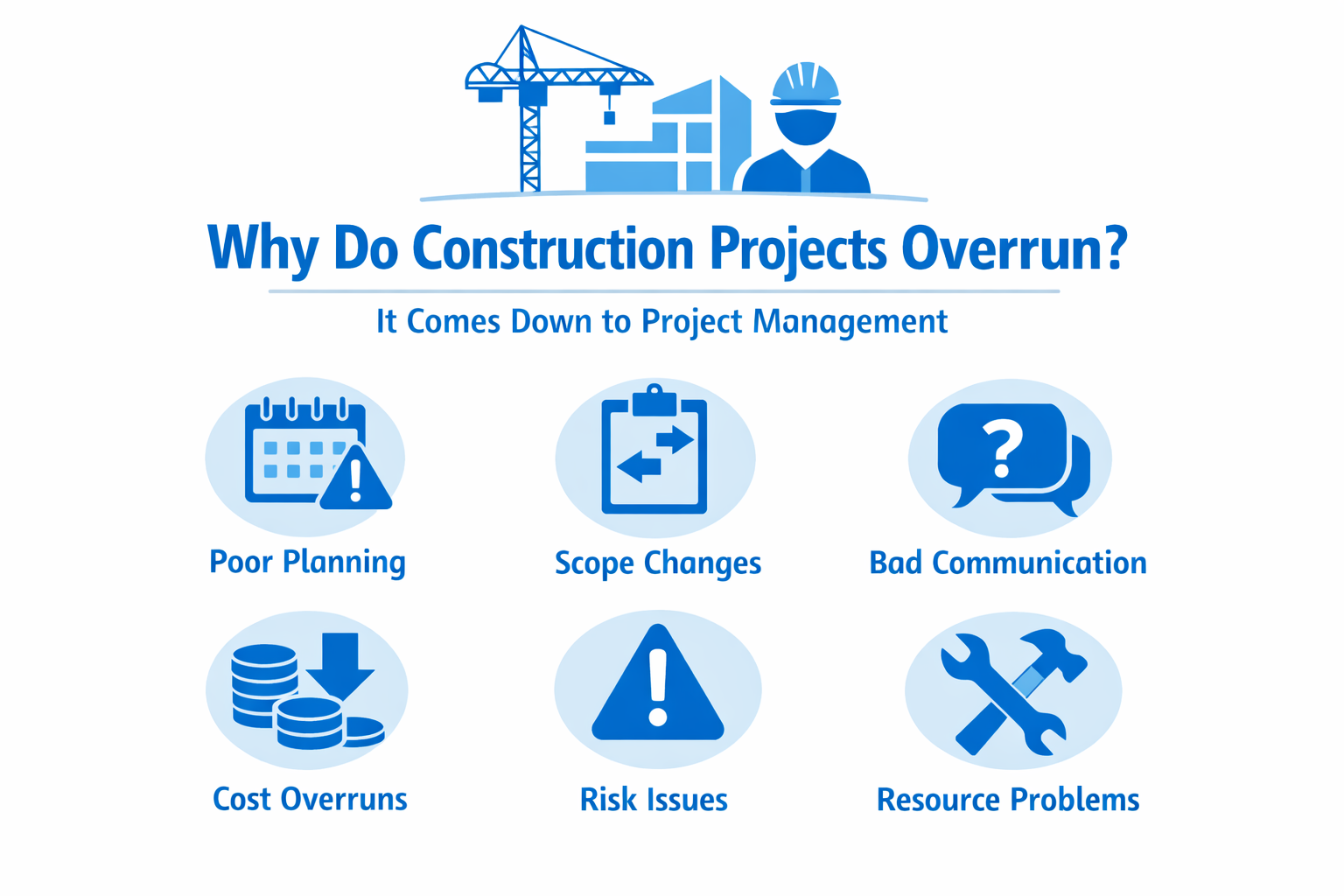
Construction projects are notorious for going over budget and missing deadlines. From small residential builds to large-scale infrastructure developments, cost overruns and delays seem almost inevitable. While external factors like weather, regulatory changes, and market fluctuations do play a role, the core reason behind most overruns is far more controllable: ineffective project management.
At its heart, construction is a complex coordination of people, materials, timelines, and budgets. When project management falls short, even the most well-funded and well-planned projects can spiral out of control.
1. Poor Planning and Unrealistic Timelines
One of the most common causes of overruns is inadequate planning at the initial stage. Many projects begin with overly optimistic timelines and budgets, often driven by pressure to win bids or satisfy stakeholders. However, failing to account for real-world complexities — such as site conditions, labor availability, or permit approvals — sets the project up for delays from day one.
Effective project management ensures that planning is grounded in realistic assumptions, backed by data, and includes contingency buffers. Without this, even minor disruptions can lead to significant setbacks.
2. Scope Creep and Changing Requirements
Scope creep — when project requirements continuously change after work has begun — is another major contributor to overruns. Clients may request design changes, add new features, or alter specifications mid-project. While some changes are unavoidable, poor management of these changes leads to confusion, rework, and increased costs.
Strong project management involves clear documentation, change control processes, and stakeholder alignment. Every change should be evaluated for its impact on time and cost before implementation.
3. Ineffective Communication
Construction projects involve multiple stakeholders — clients, architects, engineers, contractors, and suppliers. When communication between these parties breaks down, misunderstandings occur, leading to errors and delays.
For example, unclear instructions or delayed approvals can halt progress on-site. Similarly, lack of coordination between teams can result in tasks being completed out of sequence or duplicated efforts.
A competent project manager ensures seamless communication through regular updates, structured reporting, and collaboration tools, reducing the risk of misalignment.
4. Weak Cost Control and Budget Monitoring
Many projects fail not because the budget was insufficient, but because it wasn’t properly tracked and controlled. Without real-time monitoring, expenses can quickly exceed projections without immediate visibility.
This is where specialized expertise becomes critical. Many organizations today rely on project controls services to strengthen cost tracking, forecasting, and reporting processes. Al Qarar is project controls service provider in Oman that provides structured frameworks and advanced tools that help project managers maintain financial discipline and identify potential overruns early.
Project managers play a crucial role in tracking costs, forecasting future expenses, and identifying potential overruns before they escalate. Implementing cost control mechanisms — such as regular financial reviews and variance analysis — helps keep the project within budget.
5. Inadequate Risk Management
Every construction project carries risks, from supply chain disruptions to labor shortages and unforeseen site conditions. However, many projects fail to identify and plan for these risks proactively.
Poor project management often means reacting to problems as they arise rather than anticipating them. This reactive approach leads to delays and increased costs.
Effective project management includes risk identification, assessment, and mitigation planning from the outset. By preparing for potential challenges, teams can respond quickly and minimize impact.
6. Resource Mismanagement
Efficient use of resources — labor, equipment, and materials — is critical for project success. Mismanagement can lead to idle labor, equipment downtime, or material shortages, all of which contribute to delays and increased costs.
For instance, if materials are not delivered on time or labor is not scheduled effectively, work can come to a standstill. Similarly, over-allocation or under-utilization of resources affects productivity and efficiency.
A strong project management framework ensures proper scheduling, procurement planning, and resource allocation to maintain workflow continuity.
7. Lack of Accountability and Leadership
Projects often overrun when there is no clear ownership or accountability. Without strong leadership, decision-making becomes slow, issues remain unresolved, and teams lack direction.
An effective project manager acts as the central point of accountability, ensuring that tasks are completed on time, responsibilities are clearly defined, and issues are addressed promptly.
Leadership also involves motivating teams, resolving conflicts, and maintaining focus on project goals — factors that significantly influence project outcomes.
8. Insufficient Use of Technology and Tools
In today’s digital age, relying solely on manual processes and outdated systems can hinder project efficiency. Lack of proper tools for scheduling, cost tracking, and communication often leads to errors and delays.
Modern project management tools provide real-time insights, improve collaboration, and enhance decision-making. Projects that fail to leverage these tools are more likely to experience overruns.
Conclusion
While construction projects are inherently complex, overruns are not inevitable. The majority of delays and cost escalations can be traced back to gaps in project management rather than uncontrollable external factors.
From planning and communication to risk management and cost control, effective project management serves as the backbone of successful construction projects. Organizations that invest in skilled project managers, robust processes, and modern tools are far better equipped to deliver projects on time and within budget.
In the end, it’s not just about building structures — it’s about building them efficiently, predictably, and successfully.

 English
 Arabic
 French
 Spanish
 Portuguese
 Deutsch
 Turkish
 Dutch
Dutch
 Italiano
 Romaian
 Portuguese (Brazil)
 Greek
Greek