


According to TechSci Research report, “Automotive Axial Flux Motor Market – Global Industry Size, Share, Trends, Competition, Opportunity, and Forecast, 2031F,” the Global Automotive Axial Flux Motor Market is projected to grow significantly, expanding from USD 1.45 billion in 2025 to USD 4.25 billion by 2031, registering a compound annual growth rate (CAGR) of 19.63% during the forecast period.
The rapid transformation of the automotive sector toward electrification is creating unprecedented opportunities for innovative motor technologies. Among these, axial flux motors are gaining increasing attention from automakers, technology firms, and investors due to their compact design, high torque density, and improved efficiency compared to traditional motor architectures. As electric mobility continues to reshape global transportation, axial flux motors are emerging as a promising technology capable of addressing several limitations associated with conventional radial flux motors.
The growing demand for electric vehicles (EVs), combined with continuous technological advancements in motor engineering, power electronics, and battery systems, is driving the expansion of the automotive axial flux motor market. With the automotive industry aiming to achieve higher performance, longer driving ranges, and improved energy efficiency, axial flux motors are becoming a preferred solution for next-generation electric powertrains.
Understanding Axial Flux Motor Technology
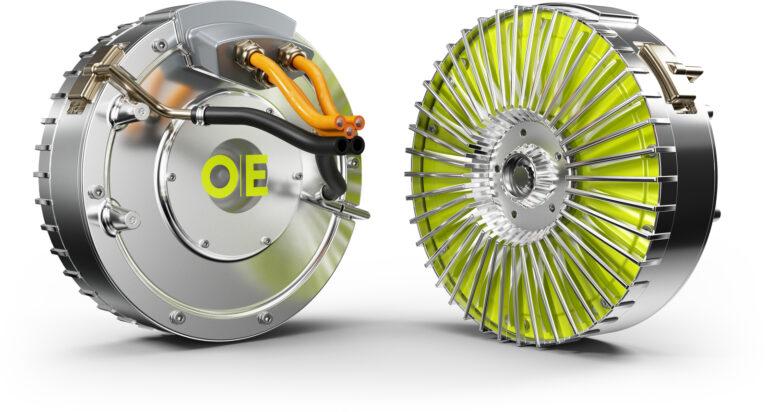
Axial flux motors differ significantly from traditional radial flux motors in terms of structural geometry and magnetic flux orientation. In a radial flux motor, the magnetic flux travels radially from the rotor to the stator. However, in an axial flux motor, the magnetic flux travels parallel to the motor’s rotational axis, creating a flat and disc-shaped structure.
This distinctive design provides several performance advantages, including:
- Higher torque density
- Improved power-to-weight ratio
- Reduced size and weight
- Better cooling efficiency
- Greater design flexibility for integration into vehicle architectures
Due to their flat geometry, axial flux motors are often referred to as “pancake motors” or flat motors. Their axial length is significantly smaller compared to their diameter, allowing them to fit into compact spaces within vehicle platforms.
Another notable characteristic of axial flux motors is that they can utilize similar electrical operating principles as other motor technologies. Various types of motors—including brushed DC motors, induction motors, and stepper motors—can be configured within axial flux geometries. This flexibility enables manufacturers to tailor the design according to vehicle performance requirements.
In comparison with radial motors of similar size, axial flux motors can deliver 30% to 40% greater torque, making them particularly attractive for electric vehicles where maximizing efficiency and performance is essential.
Download Free Sample Report: https://www.techsciresearch.com/sample-report.aspx?cid=8273
Growing Role of Electric Vehicles in Market Expansion
One of the primary forces behind the rising demand for axial flux motors is the global shift toward electric mobility. Governments, automotive manufacturers, and consumers are increasingly prioritizing cleaner transportation solutions to reduce greenhouse gas emissions and combat climate change.
Electric vehicles are widely recognized as a sustainable alternative to conventional internal combustion engine (ICE) vehicles. As environmental regulations become stricter worldwide, automakers are accelerating investments in EV development.
Global electric vehicle adoption has increased rapidly over the past decade. Rising environmental awareness, government incentives, expanding charging infrastructure, and declining battery costs have all contributed to strong EV demand.
Axial flux motors are particularly well suited for electric vehicles due to their:
- Compact size
- Lightweight design
- High torque output
- High efficiency
- Enhanced power density
These characteristics allow EV manufacturers to improve vehicle acceleration, efficiency, and driving range, while also reducing vehicle weight.
Furthermore, axial flux motors can be integrated into various electric vehicle configurations such as:
- Wheel-hub motors
- Central drivetrain motors
- Hybrid propulsion systems
This flexibility provides automakers with multiple design possibilities when developing next-generation EV platforms.
Industry Key Highlights
The global automotive axial flux motor market is witnessing strong momentum as technological advancements and rising EV adoption reshape the automotive landscape. Several key highlights define the current state of the industry:
1. Rapid Market Growth
The market is expected to expand at a CAGR of nearly 20%, reflecting strong adoption across electric vehicle segments.
2. Rising EV Production Worldwide
Increasing global production of battery electric vehicles (BEVs) and plug-in hybrid vehicles (PHEVs) is creating strong demand for efficient motor technologies.
3. Strategic Investments by Automotive Companies
Major automotive manufacturers and technology companies are investing heavily in axial flux motor research and development.
4. Increasing Partnerships and Acquisitions
Industry collaborations, joint ventures, and acquisitions are accelerating the commercialization of axial flux motor technology.
5. Technological Innovation in Motor Design
Advancements in magnetic materials, power electronics, and cooling systems are enhancing motor performance.
6. Expansion of EV Supply Chains
The development of global EV supply chains is supporting large-scale manufacturing of advanced motor technologies.
7. Strong Demand from Passenger Vehicles
Passenger cars currently dominate the market due to the rapid rise in electric passenger vehicle sales worldwide.
8. Growing Adoption in Commercial Applications
Commercial vehicles, industrial equipment, and robotics are also adopting axial flux motor technologies.
Emerging Trends in the Automotive Axial Flux Motor Market
1. Increasing Adoption of High-Performance Electric Powertrains
Modern electric vehicles require motors capable of delivering both high power and efficiency. Axial flux motors offer superior torque density, making them ideal for performance-oriented EVs such as electric sports cars and luxury vehicles.
Automakers are exploring these motors to enhance acceleration capabilities and overall driving performance.
2. Integration of Motors within Vehicle Wheels
One of the emerging trends in the industry is the development of in-wheel motor systems. Due to their compact design, axial flux motors can be integrated directly into vehicle wheels.
This integration eliminates the need for traditional drivetrain components such as transmissions and drive shafts, resulting in:
- Reduced mechanical complexity
- Improved energy efficiency
- Increased cabin space
3. Advancements in Magnetic Materials
Technological advancements in permanent magnet materials are improving the performance of axial flux motors. The use of high-strength rare-earth magnets enables manufacturers to achieve higher efficiency and power output.
Research is also being conducted to reduce reliance on rare-earth materials, ensuring cost efficiency and supply chain stability.
4. Increasing Investments in Motor Manufacturing
Automotive companies are expanding their electric motor production capabilities. Several manufacturers are investing in large-scale production facilities to meet the growing demand for EV components.
These investments are expected to accelerate the commercialization of axial flux motor technologies in the coming years.
5. Growth in Electric Commercial Vehicles
Electric buses, trucks, and delivery vehicles are emerging as important applications for axial flux motors. The high torque output of these motors makes them suitable for heavy-duty vehicles that require strong propulsion capabilities.
As urban logistics and public transportation systems electrify, demand for advanced motor technologies will continue to rise.
Key Market Drivers
Rising Global Demand for Electric Vehicles
One of the most significant drivers of the automotive axial flux motor market is the growing adoption of electric vehicles worldwide. Governments across major economies are introducing policies to encourage EV adoption, including:
- Tax incentives
- Emission regulations
- EV subsidies
- Infrastructure investments
These initiatives are accelerating the transition toward electric mobility and increasing demand for efficient motor technologies.
Need for Higher Efficiency and Performance
Automotive manufacturers are constantly striving to improve vehicle performance while minimizing energy consumption. Axial flux motors provide higher efficiency compared to conventional motors, making them attractive for EV powertrain systems.
Higher efficiency directly translates to longer driving range, which is a critical factor for EV adoption.
Technological Advancements in Electric Motor Design
Continuous research and development in electric motor technology is enabling the development of more efficient and compact motors. Innovations in areas such as electromagnetic design, cooling techniques, and manufacturing processes are enhancing the performance of axial flux motors.
Growing Investments from Automotive Companies
Several leading automotive manufacturers and technology firms are investing in axial flux motor development. These investments aim to accelerate innovation and establish competitive advantages in the EV market.
For example, automotive companies have acquired or partnered with axial flux motor manufacturers to integrate the technology into future electric vehicles.
Market Segmentation Analysis
The global automotive axial flux motor market can be segmented based on vehicle type, propulsion type, demand category, and region.
By Vehicle Type
- Passenger Cars
- Light Commercial Vehicles
- Medium & Heavy Commercial Vehicles
- Two Wheelers
Among these segments, passenger cars dominate the market due to the rapid adoption of electric passenger vehicles globally.
By Propulsion Type
- Battery Electric Vehicles (BEV)
- Hybrid Electric Vehicles (HEV)
- Plug-in Hybrid Electric Vehicles (PHEV)
Battery electric vehicles represent the largest share of the market due to their growing popularity and increasing global production.
By Demand Category
- Original Equipment Manufacturer (OEM)
- Aftermarket
The OEM segment holds the largest market share as automotive manufacturers integrate axial flux motors into new vehicle designs.
By Region
- Asia-Pacific
- Europe & CIS
- North America
- South America
- Middle East & Africa
Europe currently dominates the global market due to strong EV adoption and the presence of major automotive manufacturers. However, Asia-Pacific is expected to register the fastest growth during the forecast period.
Regional Market Insights
Europe
Europe represents one of the most mature markets for electric vehicles. Strict emission regulations and strong government support for EV adoption have encouraged automotive companies to invest in advanced electric powertrain technologies.
Several European companies are leading the development of axial flux motors, strengthening the region’s market position.
Asia-Pacific
Asia-Pacific is expected to witness the fastest growth in the automotive axial flux motor market. Countries such as China, Japan, and South Korea are investing heavily in electric vehicle production and battery manufacturing.
China, in particular, has emerged as a global leader in EV manufacturing and adoption.
North America
North America is also experiencing rapid growth in EV adoption. Major automakers are expanding electric vehicle production and investing in advanced motor technologies.
The presence of innovative technology companies is further driving the development of axial flux motor systems in the region.
Competitive Analysis
The global automotive axial flux motor market is characterized by intense competition among technology developers, automotive suppliers, and electric motor manufacturers.
Companies are focusing on strategies such as:
- Research and development investments
- Strategic partnerships
- Product innovation
- Mergers and acquisitions
Some of the major companies operating in the market include:
- YASA Limited
- Magnax BV
- Saietta Group Plc
- Whylot Electromechanical Solutions
- Emrax d.o.o
- Lucchi R. E Motor Solution
- Agni Motors Ltd.
- Turntide Technologies
- Magtec Propulsion Ltd.
These companies are continuously developing advanced motor technologies to improve efficiency, reduce manufacturing costs, and expand their presence in the rapidly growing electric vehicle market.
For example, leading automotive companies have acquired stakes in axial flux motor manufacturers to integrate the technology into their electric vehicle platforms. Such strategic collaborations are expected to accelerate technological innovation and market growth.
Future Outlook
The future of the automotive axial flux motor market appears highly promising. As electric vehicles continue to gain popularity worldwide, the demand for high-performance electric motors will increase significantly.
Axial flux motors are expected to play an increasingly important role in next-generation electric vehicle architectures due to their superior efficiency and compact design.
Several factors will shape the future growth of the market:
- Increasing EV adoption worldwide
- Technological advancements in motor design
- Expansion of EV charging infrastructure
- Government initiatives supporting clean transportation
- Rising investments in EV manufacturing
With continuous innovation and increasing industry collaboration, axial flux motor technology is expected to become a key component of future electric mobility solutions.
10 Benefits of the Automotive Axial Flux Motor Market Research Report
- Provides comprehensive analysis of market size and growth trends.
- Offers detailed insights into emerging technologies and innovations.
- Identifies key market drivers, challenges, and opportunities.
- Analyzes regional market dynamics and growth potential.
- Evaluates competitive landscape and company strategies.
- Provides segmentation analysis across vehicle types and propulsion technologies.
- Helps businesses identify new investment opportunities.
- Supports strategic decision-making for automotive manufacturers and suppliers.
- Offers long-term market forecasts up to 2031.
- Delivers valuable insights for stakeholders involved in the electric vehicle ecosystem.
Conclusion
The global automotive axial flux motor market is entering a period of rapid expansion as the automotive industry transitions toward electrification. With advantages such as high torque density, compact size, and improved efficiency, axial flux motors are becoming a key technology for next-generation electric vehicles.
Growing investments, technological innovation, and increasing EV adoption are expected to drive strong market growth over the coming years. As automakers continue to explore advanced propulsion technologies, axial flux motors are likely to play a crucial role in shaping the future of sustainable mobility.
Overall, the market presents significant opportunities for technology developers, automotive manufacturers, and investors seeking to capitalize on the evolving electric vehicle ecosystem.
Contact Us-
Mr. Ken Mathews
708 Third Avenue,
Manhattan, NY,
New York – 10017
Tel: +1-646-360-1656
Email: sales@techsciresearch.com
Website: www.techsciresearch.com

 English
 Arabic
 French
 Spanish
 Portuguese
 Deutsch
 Turkish
 Dutch
Dutch
 Italiano
 Romaian
 Portuguese (Brazil)
 Greek
Greek