


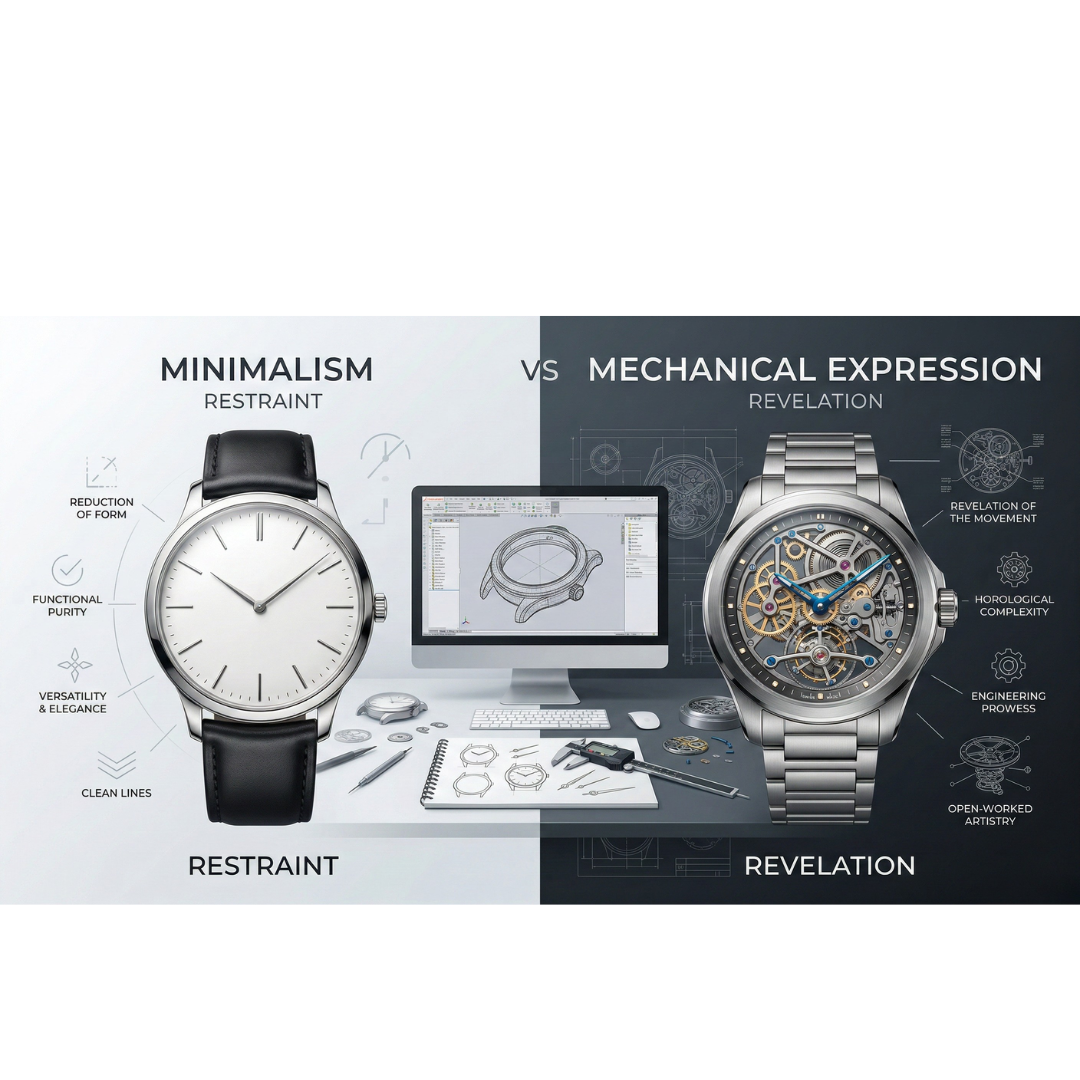
Two dominant design philosophies are shaping the modern watchmaking landscape. On one side, minimalism strips the watch down to its most essential elements: clean dials, restrained proportions, and quiet sophistication. On the other hand, mechanical expression puts the movement, construction, and engineering of the timepiece on full display through skeletonization, open-worked dials, and visible complications.
Both approaches have strong followings. Both have commercial viability. And both reflect something deeper about what watch buyers are looking for in their timepieces. Understanding where each philosophy works best, where it struggles, and how the two sometimes overlap is useful for anyone involved in designing, selling, or buying modern watches.
The choice between minimalism and mechanical expression is not purely aesthetic. It affects pricing, target audience, brand positioning, wearability, and long-term collectibility. It is a strategic design decision as much as a creative one.
The Case for Minimalism in Watch Design
Minimalist watch design is built on the principle of reduction. Every element on the dial, case, and bracelet must justify its presence. If it does not serve a functional or compositional purpose, it is removed. The result is a watch that communicates clarity, restraint, and confidence.
This approach has historical roots. Mid-century watch design, particularly from the 1950s and 1960s, produced many of the most admired dress watches in history. Thin cases, simple dial layouts, dauphine or baton hands, and subtle applied indices defined an era of quiet elegance that continues to influence design today.
The appeal of minimalism is broad. A clean, restrained watch fits a wide range of social and professional contexts. It pairs equally well with a suit and with casual clothing. It does not demand attention but rewards close inspection with quality finishing and proportional refinement.
From a commercial perspective, minimalist watches often appeal to:
-
Buyers entering the watch market for the first time
-
Professionals looking for a versatile daily wear piece
-
Collectors who value subtlety and finishing over visual complexity
-
Customers in markets where overt displays of luxury are culturally inappropriate
The challenge with minimalism is differentiation. When every element is reduced, the differences between brands become very subtle. A minimalist watch from one brand may look nearly identical to one from another at a glance. This puts more pressure on finishing quality, proportional precision, and brand storytelling to create distinction.
The Case for Mechanical Expression
Mechanical expression takes the opposite approach. Instead of hiding the movement behind a solid dial, it reveals it. Skeletonized dials, open case backs, visible escapements, and exposed gear trains are the defining features of this philosophy. The movement is not just the engine of the watch. It is the design itself.
This approach celebrates the engineering and craftsmanship of watchmaking directly. It appeals to buyers who see the movement as the most important part of the watch and want to experience it visually, not just functionally.
Mechanical expression also allows brands to showcase technical capabilities that are not visible in a minimalist watch. A tourbillon, a minute repeater, or a perpetual calendar is more impressive when the customer can see its components in motion. For brands that invest heavily in movement development, this visibility is a competitive advantage.
The audience for mechanically expressive watches tends to be different from the minimalist audience:
-
Experienced collectors who appreciate movement architecture
-
Buyers who view watches as wearable art or engineering showcases
-
Customers seeking statement pieces for specific occasions
-
Enthusiasts interested in the technical side of horology
The risk with mechanical expression is visual complexity. A poorly executed skeleton dial can look busy, chaotic, or difficult to read. The most successful examples maintain legibility and visual balance while revealing the movement. This requires significant design skill and a deep understanding of both aesthetics and movement construction.
How Each Philosophy Affects Wearability
Wearability is a practical consideration that design philosophy directly influences. Minimalist watches tend to be thinner, lighter, and more comfortable for extended daily wear. Their visual restraint also means they attract less attention, which many wearers prefer in professional or social settings.
Mechanically expressive watches tend to be thicker and visually busier. This is partly due to the movement architectures required for visible complications and partly due to the design decision to make the watch a visual focal point. While many enthusiasts enjoy wearing a bold, complex timepiece, others find that it limits versatility.
Case thickness is often a direct reflection of this tension. A simple time only movement can be housed in a case under 10mm thick. A tourbillon with an exposed mechanism may require 12mm to 15mm or more. For buyers who spend most of their time at a desk, slipping their wrist into and out of shirt cuffs, thickness is a genuine concern.
Some brands have addressed this by developing ultra thin skeleton movements that maintain visual openness in a slim profile. These represent a technical achievement that bridges both philosophies, though they typically come at a significant price premium.
Dial Design: Restraint vs Revelation
The dial is where the difference between minimalism and mechanical expression is most immediately visible. A minimalist dial may feature nothing more than hour markers, hands, and a brand logo. Color, texture, and surface finishing carry the visual interest rather than additional elements.
A mechanically expressive dial, by contrast, may not have a conventional dial at all. The movement itself serves as the visual surface, with bridges, wheels, and springs creating the visual composition. In some cases, a partial dial covers certain sections while leaving others open, creating a hybrid approach.
Dial finishing standards differ between the two approaches as well. In a minimalist watch, the dial itself must be flawless because it is the primary visual element. Any imperfection in lacquer application, printing, or surface treatment is immediately visible. In a mechanically expressive watch, the movement finishing is under the same scrutiny. Beveling, polishing, and engraving of bridges and plates must be executed at a high level because they are fully visible.
A watch design studio working on either philosophy must invest heavily in finishing quality, but the focus of that investment falls on different components.
Market Trends and Buyer Preferences
Current market data suggests that both philosophies are commercially viable, but buyer demographics differ. Minimalist watches are performing well in Asia, among younger professionals, and among first-time buyers. These segments value versatility, restraint, and ease of wear.
Mechanically expressive watches are performing well among established collectors, at higher price points, and in Western markets where visible craftsmanship is valued as a form of personal expression. Limited edition skeleton and open-worked pieces generate strong demand and often trade above retail on secondary markets.
There is also a growing middle ground. Watches with mostly clean dials but a single open-worked element such as a visible balance wheel at six o'clock, appeal to buyers who want a hint of mechanical interest without full visual complexity. This approach has been adopted by brands at multiple price points and represents a commercially pragmatic compromise.
The Role of Material and Color in Both Philosophies
Material and color choices interact differently with each philosophy. In minimalist design, material and color carry more weight because fewer elements are competing for attention. A blue sunray dial in a steel case creates a very different impression than a matte black dial in a titanium case, even though the design structure is identical.
In mechanically expressive design, materials like blackened steel, rose gold plated bridges, or blued screws become part of the visual composition. The color palette is determined by the movement architecture as much as by the case and dial, giving designers a different set of variables to work with.
Advances in surface treatments and coatings have expanded the palette available to both philosophies. DLC-coated cases, ceramic inserts, gradient dials, and multi-layer lacquer techniques give designers more tools to create distinctive pieces within either framework.
How a Watch Design Studio Approaches Each Philosophy
The design process differs depending on which philosophy guides the project. A minimalist watch design begins with proportions, dial layout, and hand selection. The goal is to achieve visual harmony with the fewest possible elements. Every millimeter of the dial is planned for spatial balance.
A mechanically expressive design begins with the movement. The bridge layout, wheel placement, and complication visibility drive the visual composition. The case and any partial dial elements are then designed around the movement to frame it appropriately.
Both approaches require close collaboration between designers and watchmakers. In the minimalist approach, the case maker's skill in achieving thin profiles and tight tolerances is critical. In the mechanically expressive approach, the movement finisher's skill in preparing visible surfaces is critical.
The tools and software used may be similar, but the priorities and workflows differ substantially. Understanding these differences is important for anyone commissioning, evaluating, or selling watches in either category.
Investment and Collectibility Considerations
From a collectibility standpoint, both philosophies produce pieces that appreciate, but for different reasons. Minimalist watches from established brands tend to hold value through scarcity, brand reputation, and timeless design. A clean dress watch from a respected manufacturer will look as appropriate in 30 years as it does today.
Mechanically expressive pieces tend to appreciate based on technical rarity and movement innovation. A unique skeleton movement or a visible complication produced in limited numbers can command significant premiums as collectors compete for scarce supply.
Buyers making purchase decisions with long-term value in mind should consider both the design philosophy and the brand's track record in that category. A brand with a long history of minimalist design is likely a safer investment in that segment than one attempting it for the first time.
Conclusion
Minimalism and mechanical expression represent two valid, commercially successful approaches to modern watch design. Neither is inherently superior. Each serves a different buyer, a different context, and a different set of priorities.
Minimalism offers versatility, wearability, and quiet sophistication. Mechanical expression offers visual drama, a technical showcase, and emotional engagement with the craft of watchmaking. The most interesting developments in current watch design often occur in the overlap between the two, where designers find ways to suggest mechanical depth within restrained visual frameworks.
For buyers, the choice comes down to personal preference, intended use, and what they want their watch to communicate. For designers and brands, the choice is a strategic one that affects everything from target audience to manufacturing processes to pricing and positioning.
FAQs
Is minimalist watch design less valuable than complicated watches?
Not necessarily. Value is determined by brand reputation, movement quality, finishing, and scarcity. Some of the most valuable watches ever sold are relatively simple in design.
What makes a skeleton watch successful from a design perspective?
Legibility and visual balance. The best skeleton watches maintain clear time reading while showcasing the movement in a composed, intentional way rather than simply removing material.
Can a watch combine minimalist and mechanical design elements?
Yes. Many modern watches feature clean dials with a single open worked element, such as a visible balance wheel or a small aperture showing the movement. This hybrid approach is increasingly popular.
Are minimalist watches easier to manufacture than mechanically complex ones?
The case and dial may be simpler, but achieving the finishing quality required for a minimalist piece is highly demanding. Any imperfection is immediately visible because there are fewer elements to distract the eye.
Which style holds resale value better?
Both can hold value well, depending on the brand and specific model. Minimalist watches from established brands tend to hold steady value. Limited edition mechanically expressive pieces can appreciate significantly if demand exceeds supply.
What should a first time buyer consider when choosing between these styles?
Versatility, comfort, and personal taste. A minimalist watch is generally more versatile for daily wear. A mechanically expressive watch is better suited as a statement piece or second watch in a collection.

 English
 Arabic
 French
 Portuguese
 Deutsch
 Turkish
 Dutch
Dutch
 Italiano
 Russian
 Romaian
 Portuguese (Brazil)
 Greek
Greek