


Food Hydrocolloids Market Outlook
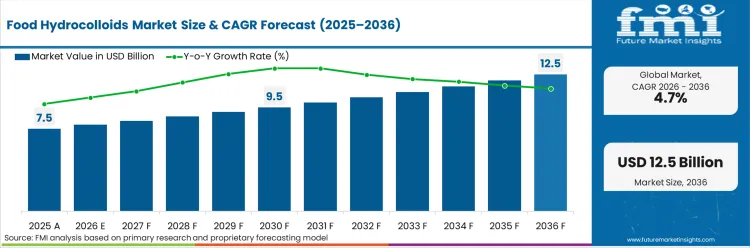
The global Food Hydrocolloids Market, valued at USD 7.6 billion in 2025, is projected to reach USD 7.9 billion in 2026 and expand to USD 12.5 billion by 2036, reflecting a CAGR of 4.7% over the forecast period, according to the latest analysis by Future Market Insights (FMI). Absolute dollar growth of USD 4.6 billion underscores a structural transformation in food formulation, procurement strategies, and ingredient sourcing worldwide.
Food hydrocolloids—water-soluble polymers that modify viscosity, stabilize emulsions, and enhance texture—have evolved from auxiliary additives to strategic cost-control and product innovation tools. As food inflation pressures margins and agricultural volatility disrupts raw material supplies, manufacturers are increasingly adopting blended hydrocolloid systems to secure formulation stability and protect profitability.
The market’s expansion is driven by three converging forces: inflation-driven recipe reformulation, rising foodservice traffic requiring heat-stable ingredients, and accelerating clean-label mandates favoring natural plant-based extracts over synthetic additives.
Botanical sources remain dominant, accounting for approximately 62% of market share in 2026. Thickener functionality represents the largest application segment with a 38% share, reflecting growing demand for viscosity control in dairy alternatives, sauces, beverages, and ready-to-eat meals. Manufacturers increasingly rely on hydrocolloid networks to replicate fat textures in low-calorie and plant-based formulations without altering flavor profiles.
According to Nandini Roy Choudhury, Principal Consultant – Food & Beverage at FMI, volatile agricultural yields are tightening availability of pure extracts, compelling producers to diversify supply chains and incorporate multi-ingredient systems to ensure consistent performance. This shift is fundamentally altering procurement playbooks, as long-term botanical contracts replace spot-market purchases vulnerable to harvest fluctuations.
Macroeconomic conditions further reinforce this transition. OECD data indicates food inflation reached 3.9% in late 2024, intensifying pressure on processors to engineer lower-cost texture solutions. Blended gum systems now allow manufacturers to achieve equivalent sensory outcomes at reduced dosage rates, mitigating input volatility.
Regionally, Asia Pacific remains the fastest-growing hub for hydrocolloid demand. India is projected to expand at a CAGR of 5.4% between 2026 and 2036, supported by rapid urbanization and rising packaged food consumption. China follows at 5.0%, driven by domestic production scale and localized bio-gum capacity additions. Japan, expanding at 4.8%, emphasizes texture innovation tailored to aging demographics and dysphagia-friendly food solutions.
In contrast, mature markets such as Germany (4.5%), the United Kingdom (4.2%), and the United States (3.3%) exhibit reformulation-led growth rather than structural volume surges. Clean-label compliance costs and private-label price sensitivity define European expansion, while North America benefits from robust foodservice spending, which recently captured 58.9% of total U.S. food expenditures.
Industrial capacity localization is emerging as a decisive competitive strategy. In September 2024, Jungbunzlauer announced a USD 200 million investment to establish Canada’s first xanthan gum facility, reducing freight exposure and enhancing regional supply security. Similarly, in November 2024, Tate & Lyle completed its acquisition of CP Kelco, creating a consolidated specialty solutions platform with expanded texture and fortification capabilities.
Ingredient innovation continues to reshape competitive positioning. Ingredion launched NOVATION® Indulge 2940 functional native starch to enhance plant-based performance, while Cargill introduced a cost-effective pectin replacer targeting confectionery applications in emerging markets. At IFF, scientists emphasize precision tailoring of hydrocolloid functionalities to meet stringent quality benchmarks across global food systems.
From a sourcing perspective, global seaweed exports totaling over 819,000 tons highlight dependence on fragile marine ecosystems for carrageenan production. Climate variability and regulatory scrutiny surrounding sustainable harvesting practices add complexity to long-term supply planning. As a result, procurement departments increasingly approve dual-sourcing strategies and diversified extract portfolios to prevent production interruptions.
The report defines food hydrocolloids strictly within edible applications, excluding pharmaceutical, cosmetic, and industrial polymer markets. Coverage spans botanical, microbial, seaweed, and synthetic sources across bakery, confectionery, dairy alternatives, beverages, and meat processing sectors. Forecast modeling is constructed using hybrid top-down and bottom-up methodologies validated through primary interviews with procurement heads and ingredient scientists, alongside corporate capacity disclosures and agricultural output statistics.
Strategically, FMI highlights several executive priorities shaping the decade ahead:
- Secure long-term botanical supply contracts to mitigate harvest volatility.
• Expand blending capabilities to deliver customized functional systems.
• Align formulation innovation with regional clean-label and vegan certification standards.
• Invest in localized extraction infrastructure to reduce geopolitical shipping risks.
As global food manufacturers navigate persistent inflation, regulatory tightening, and evolving consumer expectations, hydrocolloids are transitioning from commodity additives to essential engineering components within modern food architecture.
With USD 12.5 billion in projected market value by 2036, the Food Hydrocolloids Market stands at the intersection of cost optimization, supply chain resilience, and clean-label innovation—positioning ingredient processors and strategic suppliers at the core of next-generation food system design.
👉 Unlock In-Depth Market Intelligence — Access the Full Report Now: https://www.futuremarketinsights.com/reports/food-hydrocolloids-market
Frequently Asked Questions
How large will the global food hydrocolloids market be in 2026?
The global food hydrocolloids market is projected to reach approximately USD 7.9 billion in 2026, reflecting steady demand from processed food, dairy alternatives, bakery, and ready-to-eat meal applications.
What is the projected market size of food hydrocolloids by 2036?
By 2036, the market is forecast to expand to USD 12.5 billion, supported by rising clean-label reformulation, cost-optimization strategies, and growing foodservice consumption worldwide.
What is the anticipated growth rate between 2026 and 2036?
Demand for food hydrocolloids is expected to grow at a compound annual growth rate (CAGR) of 4.7% during the 2026 to 2036 forecast period.
Which source segment will dominate global sales by 2026?
Botanical-based hydrocolloids are set to lead the market, accounting for nearly 62% of total share in 2026, driven by strong consumer preference for plant-derived, clean-label ingredients.
Why FMI: https://www.futuremarketinsights.com/why-fmi
About Future Market Insights (FMI)
Future Market Insights (FMI) is a leading provider of market intelligence and consulting services, serving clients in over 150 countries. Headquartered in Delaware, USA, with a global delivery center in India and offices in the UK and UAE, FMI delivers actionable insights to businesses across industries including automotive, technology, consumer products, manufacturing, energy, and chemicals.
An ESOMAR-certified research organization, FMI provides custom and syndicated market reports and consulting services, supporting both Fortune 1,000 companies and SMEs. Its team of 300+ experienced analysts ensures credible, data-driven insights to help clients navigate global markets and identify growth opportunities.
Contact Us:
Future Market Insights Inc.
Christiana Corporate, 200 Continental Drive,
Suite 401, Newark, Delaware - 19713, USA
T: +1-347-918-3531
For Sales Enquiries: sales@futuremarketinsights.com

 English
 Arabic
 Spanish
 Portuguese
 Deutsch
 Turkish
 Dutch
Dutch
 Italiano
 Russian
 Romaian
 Portuguese (Brazil)
 Greek
Greek