


Savory Flavor Blend Market Outlook
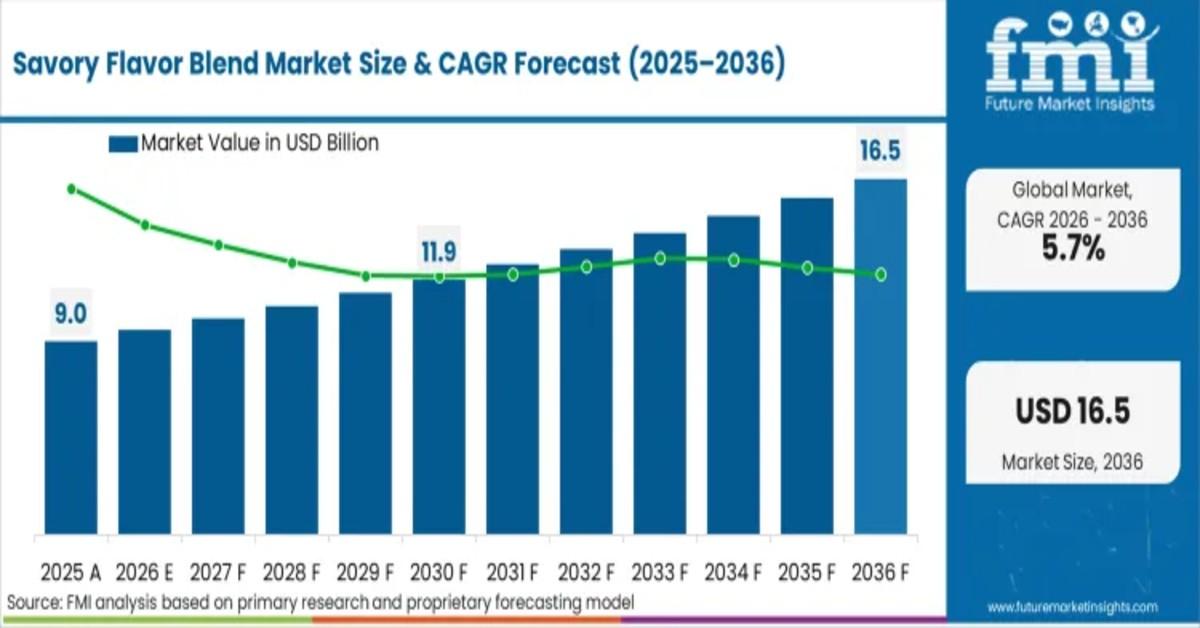
The global savory flavor blend market has crossed USD 8.9 billion in 2025 and is projected to reach USD 9.5 billion in 2026, advancing to USD 16.5 billion by 2036, according to the latest analysis by Future Market Insights (FMI). The projected 5.7% CAGR between 2026 and 2036 reflects not incremental demand, but structural transformation across industrial food manufacturing.
Growth is being driven by a decisive shift away from sodium-heavy legacy recipes toward precision-engineered aromatic systems powered by umami enhancers, spice oleoresins, and encapsulated volatile compounds. Regulatory pressure is intensifying this transition. Sodium reduction mandates—such as the U.S. policy goal targeting average intake of 2,750 mg/day referenced in the Federal Register—are forcing manufacturers to reformulate at scale without compromising sensory performance.
FMI estimates an absolute dollar opportunity of USD 7.0 billion over the forecast period, underscoring how savory blends have evolved into margin-protection tools rather than optional taste enhancers.
Market Definition and Structural Scope
The savory flavor blend sector encompasses complex aromatic mixtures—including extracts, essential oils, oleoresins, and functional carriers—designed to standardize product quality in commercial food production. These blends are widely used in snacks, meat products, soups, sauces, and bakery applications to enhance taste, optimize machinability, and improve shelf stability.
Retail spice packets and standalone salt products are excluded from valuation. The study focuses strictly on business-to-business distribution into industrial processing environments.
Growth Drivers Reshaping Industrial Formulation
Stringent clinical nutrition guidelines are compelling packaged food manufacturers to aggressively reduce sodium. Simultaneously, busy consumer lifestyles are expanding ready-to-eat and convenience food demand, increasing reliance on standardized aromatic systems. Supermarket supply chains, under pressure to cut food waste, require extended anti-staling performance—another area where advanced savory blends provide measurable ROI.
According to Nandini Roy Choudhury, Principal Consultant for Food & Beverage at FMI, “Aromatic systems are no longer discretionary add-ons. They are strategic enablers that protect margins, stabilize yields, and help manufacturers navigate agricultural volatility.”
Segmental Performance: Powder Formats Lead
Powder-based savory blends command 60% of global volume in 2026. Processors prefer powders because they eliminate complex liquid mixing steps, reduce labor intensity, and ensure uniform dispersion across high-speed automated lines. Encapsulation technologies protect volatile compounds during extreme heat exposure, preserving flavor intensity through baking and frying cycles.
Spices and herbs account for 41% of total flavor consumption demand in 2026. High-speed mixing environments create mechanical stress on botanical ingredients, pushing manufacturers to adopt stabilized extracts and fortified aromatic matrices.
Procurement volatility in agricultural inputs is another catalyst. Data from the World Integrated Trade Solution highlights heavy cross-border spice trade flows, reinforcing the need for centralized, quality-controlled blending systems.
Regional Growth Divergence
Growth trajectories vary significantly by geography. East Asia leads global expansion, with South Korea projected at 6.2% CAGR and China at 6.0% through 2036. Rapid industrial automation and expanding convenience food exports are reinforcing demand for standardized blends.
In South Asia, India is forecast to grow at 5.8% CAGR, supported by rising packaged food penetration and strong agricultural integration. Government-reported spice export volumes exceeding USD 4.45 billion illustrate upstream supply depth.
North America remains a reformulation-driven market. U.S. food spending away from home has reached 58.9%, according to the Economic Research Service, compelling foodservice operators to seek efficient, scalable flavor systems. The United States is projected to expand at 5.5% CAGR.
Europe presents a dual dynamic: Germany advances at 5.0% CAGR driven by clean-label premiumization, while the United Kingdom grows at 2.3% as retailers tighten compliance and waste-reduction mandates.
Competitive and Strategic Landscape
The competitive field is anchored by multinational ingredient innovators including:
- Kerry Group
- Symrise
- Givaudan
- Ajinomoto
- McCormick & Company
Recent developments highlight aggressive capacity expansion. In October 2025, Kerry Group launched its Smart Taste platform to help manufacturers reduce sugar and regulatory risk while maintaining sensory performance. Meanwhile, Symrise announced new spray-drying tower operations to expand powder blend capacity.
Localized technical support models are also expanding, with Givaudan investing CHF 50 million in new application facilities in Asia to accelerate on-site reformulation services.
👉 Get Access to the Report Sample: https://www.futuremarketinsights.com/reports/sample/rep-gb-723
Strategic Implications
Manufacturers must prioritize blends that demonstrate measurable yield stabilization, moisture control, and anti-staling performance. Commercial strategies increasingly center on margin savings and waste reduction metrics rather than taste claims alone. As regulatory mandates tighten and supply chains consolidate, savory flavor blends are becoming foundational to industrial resilience.
Why FMI: https://www.futuremarketinsights.com/why-fmi
Frequently Asked Questions (FAQs)
How large is the global Savory Flavor Blend market in 2026?
Global demand for savory flavor blends is projected to reach USD 9.5 billion in 2026, reflecting strong reformulation momentum across processed food and foodservice manufacturing.
What is the projected market size by 2036?
The market is forecast to expand to USD 16.5 billion by 2036, supported by sustained industrial adoption and clean-label transitions.
What is the expected growth rate between 2026 and 2036?
Worldwide consumption is anticipated to grow at a CAGR of 5.7% during the 2026–2036 forecast period, driven by automation, sodium reduction initiatives, and demand for shelf-life optimization.
Which form will dominate global sales by 2026?
Powder-based blends are expected to lead the market, accounting for 60% of global share in 2026. Their dominance stems from superior anti-staling performance, ease of handling in high-speed production lines, and improved dispersion consistency.
How important are Spices and Herbs within the flavor category?
Spices and herbs represent the largest flavor segment, contributing 41% of total consumption demand in 2026. Their prominence is linked to the need for strong aromatic stability in continuous industrial mixing environments.
What factors are driving demand in China?
China’s growth is fueled by rapid factory automation, expanding retail franchise networks, and the need for standardized, high-volume production systems capable of delivering consistent sensory profiles.
About Future Market Insights (FMI)
Future Market Insights (FMI) is a leading provider of market intelligence and consulting services, serving clients in over 150 countries. Headquartered in Delaware, USA, with a global delivery center in India and offices in the UK and UAE, FMI delivers actionable insights to businesses across industries including automotive, technology, consumer products, manufacturing, energy, and chemicals.
An ESOMAR-certified research organization, FMI provides custom and syndicated market reports and consulting services, supporting both Fortune 1,000 companies and SMEs. Its team of 300+ experienced analysts ensures credible, data-driven insights to help clients navigate global markets and identify growth opportunities.
Contact Us:
Future Market Insights Inc.
Christiana Corporate, 200 Continental Drive,
Suite 401, Newark, Delaware - 19713, USA
T: +1-347-918-3531
For Sales Enquiries: sales@futuremarketinsights.com

 English
 Arabic
 Spanish
 Portuguese
 Deutsch
 Turkish
 Dutch
Dutch
 Italiano
 Russian
 Romaian
 Portuguese (Brazil)
 Greek
Greek