


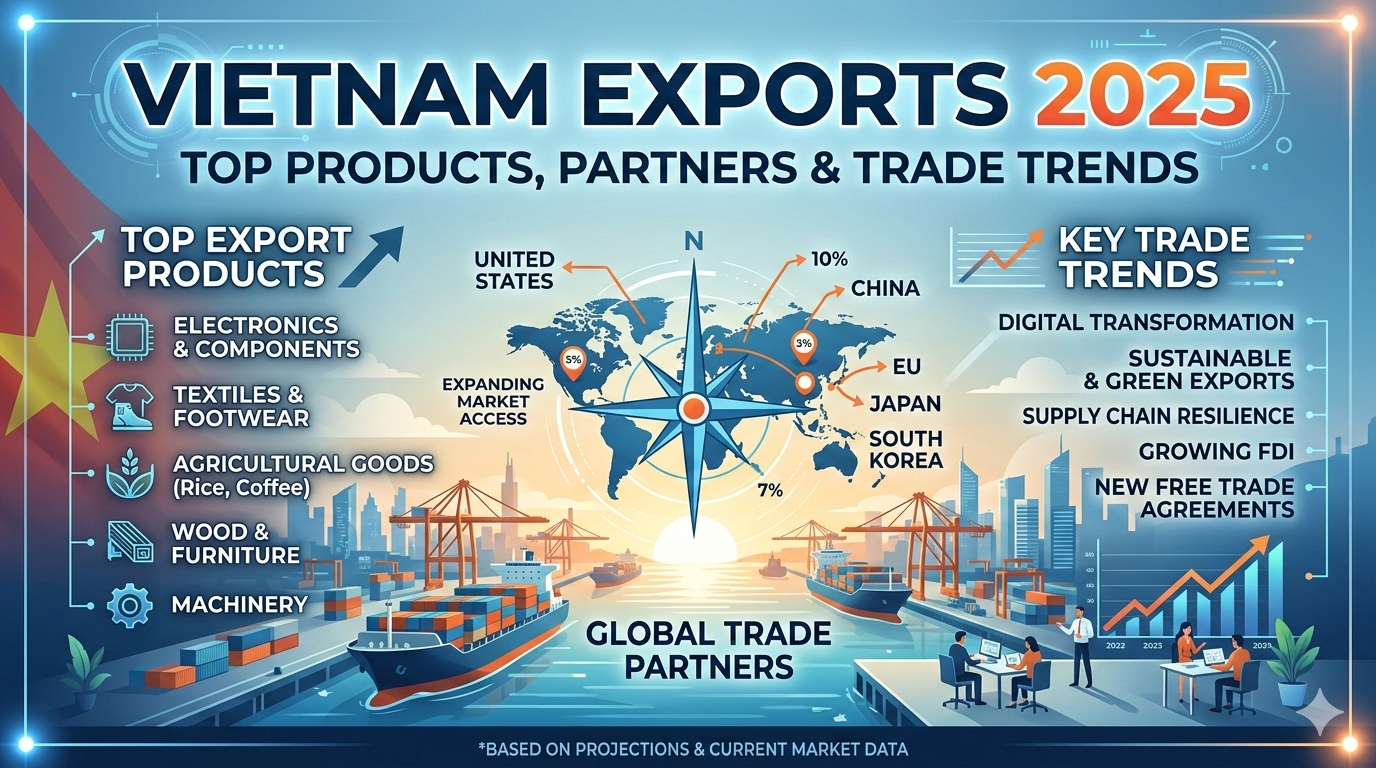
In recent years, Vietnam has solidified its position as one of Asia’s fastest-growing export-driven economies. Strategically located in Southeast Asia, backed by competitive labor costs and strong foreign direct investment (FDI), the country has transformed into a global manufacturing powerhouse. According to the latest vietnam export data and vietnam customs data, the total export value reached $403.2 billion in 2024, marking a 6.4% increase compared to the previous year.
As per global trade statistics, Vietnam now ranks among the top 25 exporting nations worldwide, standing 21st globally. The strong performance of vietnam exports continues into 2025, with first-quarter exports totaling $102.8 billion, reflecting a 10.6% year-over-year increase. Total trade turnover in Q1 2025 reached $202.5 billion, up 13.7% YoY, while the country posted a trade surplus of $4.67 billion in the first five months of 2025.
This article explores vietnam exports in depth—covering vietnam main exports by HS code, vietnam exports by country, top exporters, historical growth, and the forward outlook for 2025.
Overview of Vietnam’s Export Performance
Vietnam’s export model is heavily manufacturing-driven. In 2024:
-
Manufacturing & processing accounted for 88.7% of exports
-
FDI enterprises contributed 72.1% of total exports
-
Domestic firms accounted for 27.9%
Electronics remain the dominant sector, followed by textiles, footwear, machinery, agriculture, and wood products. Strong integration into global supply chains, along with free trade agreements such as CPTPP, EVFTA, and RCEP, has significantly enhanced vietnam exports competitiveness.
Vietnam Main Exports: Top 10 by HS Code
Based on vietnam export data and vietnam trade data for 2024–25, the following are the top product categories driving vietnam exports:
1. Electrical Machinery & Equipment (HS 85) – $121.7 Billion
Electrical machinery leads all categories, accounting for 29.5% of total exports. Smartphones, displays, semiconductors, and electronic components dominate this segment. Major multinational corporations such as Samsung, Intel, and LG operate large-scale production facilities in Vietnam.
2. Footwear (HS 64) – $25.4 Billion
Vietnam is one of the world’s largest footwear producers. The sector represents 6.1% of total exports, supplying major global brands across the US, EU, and Asia.
3. Machinery & Mechanical Appliances (HS 84) – $23.5 Billion
Industrial machinery, engines, pumps, and manufacturing equipment form a critical part of vietnam main exports, contributing 5.7% of total export value.
4. Apparel (Knit) (HS 61) – $21.2 Billion
Knit garments such as t-shirts and sweaters remain highly competitive in global markets.
5. Apparel (Non-Knit) (HS 62) – $19.7 Billion
Formalwear, jackets, and woven garments support Vietnam’s status as a global textile leader.
6. Furniture & Bedding (HS 94) – $14.2 Billion
Vietnam has emerged as a leading furniture exporter, especially to the US and EU markets.
7. Fish & Seafood (HS 03) – $9.8 Billion
Shrimp, pangasius, squid, and other seafood products play a crucial role in agricultural exports.
8. Wood & Wood Articles (HS 44) – $6.5 Billion
Plywood, particleboard, and wooden furniture support supply chains across Europe and North America.
9. Coffee, Tea & Spices (HS 09) – $5.6 Billion
Vietnam is the world’s second-largest coffee exporter, making agriculture a vital contributor to vietnam exports.
10. Rubber & Articles (HS 40) – $4.3 Billion
Rubber tires, gloves, and industrial rubber products complete the top 10 vietnam main exports list.
Vietnam Exports by Country: Top Trade Partners
A critical aspect of analyzing vietnam exports is understanding vietnam exports by country. Export diversification has strengthened Vietnam’s resilience amid global trade volatility.
Here are the top export destinations based on vietnam customs data for 2024–25:
1. United States – $113.9 Billion (27.5%)
The United States remains Vietnam’s largest export market. Electronics, textiles, footwear, and furniture dominate shipments. The trade surplus with the US surged to $12.2 billion in May 2025 alone.
2. China – $60.7 Billion (14.7%)
China imports agricultural goods, electronics components, and machinery from Vietnam. Bilateral trade remains dynamic due to regional supply chain integration.
3. South Korea – $28.2 Billion (6.8%)
Electronics and textiles drive exports to South Korea, reflecting deep investment linkages.
4. Japan – $26.8 Billion (6.5%)
Japan imports seafood, automotive parts, and machinery components.
5. Hong Kong – $20.1 Billion (4.9%)
Acts as a re-export hub for electronics and consumer goods.
6. Germany – $14.7 Billion (3.6%)
7. Netherlands – $10.3 Billion (2.5%)
8. United Kingdom – $9.2 Billion (2.2%)
9. Thailand – $8.8 Billion (2.1%)
10. India – $7.5 Billion (1.8%)
These figures highlight how vietnam exports by country are geographically diversified across North America, Asia, and Europe.
Top Exporters Driving Vietnam Exports
Several multinational and domestic firms contribute significantly to vietnam exports.
-
Samsung Group (Vietnam): $65 billion
-
Intel Products Vietnam: $12.9 billion
-
LG Group: $8.2 billion
-
NatSteelVina: $8 billion
-
Foxconn Vietnam: $4.5 billion
-
Hanyang Digitech Vina: $5.8 billion
-
VNG/VinaCapital: $2.1 billion
-
VINATEX: $800 million
-
Intimex Group: $320 million
-
Vinamilk: $180 million
FDI enterprises dominate high-tech exports, while domestic players are strong in agriculture, dairy, and textiles.
Historical Growth of Vietnam Exports
Vietnam’s export growth over the past decade has been remarkable:
-
2014: $150.21 billion
-
2018: $243.69 billion
-
2021: $335.79 billion
-
2022: $370.90 billion
-
2023: $353.07 billion
-
2024: $403.20 billion
From 2014 to 2024, vietnam exports nearly tripled in value. This growth trajectory underscores the country’s successful integration into global supply chains.
Tariff Risks & Policy Impacts
Despite strong performance, vietnam exports face tariff uncertainties, particularly in the US market:
-
Steel tariffs under Section 232: 25%
-
Aluminum tariffs increased to 25% (Feb 2025)
-
Proposed 46% reciprocal tariffs (currently paused)
These developments triggered an export surge of 17% in May 2025 as companies accelerated shipments before potential tariff implementation.
At the same time, Vietnam benefits from multiple free trade agreements. Leveraging FTAs remains critical for exporters navigating global trade tensions.
Insights for Buyers and Suppliers
For Buyers
-
Expect price volatility in steel, aluminum, coffee, and pepper.
-
Consider long-term procurement contracts.
-
Ensure compliance with FTA origin requirements.
For Suppliers
-
Diversify markets beyond the US.
-
Strengthen documentation amid scrutiny over origin abuse.
-
Increase localization of raw materials.
-
Focus on value-added manufacturing rather than labor-intensive production alone.
Understanding vietnam trade data allows importers and exporters to make informed sourcing decisions.
2025 Outlook for Vietnam Exports
Forecasts suggest vietnam exports could surpass $450 billion in 2025, assuming stable tariff conditions. Growth is expected in:
-
Electronics & semiconductors
-
Textile upgrades toward sustainable production
-
Machinery and industrial components
-
Agricultural value-added products
However, risks include global tariff volatility, EU environmental regulations, and supply chain disruptions.
Vietnam’s strategic position amid U.S.–China supply chain decoupling continues to attract investment. The country is increasingly viewed as a preferred alternative manufacturing hub.
Conclusion
Vietnam’s export engine remains one of the strongest in Asia. From electronics and textiles to agriculture and furniture, vietnam main exports showcase the country’s diversified industrial base. Strong performance in vietnam exports by country demonstrates successful global market penetration, especially in the United States, China, and the European Union.
Backed by consistent growth in vietnam export data and rising trade turnover reflected in vietnam customs data, Vietnam continues to strengthen its role in global commerce. While tariff uncertainties and regulatory challenges persist, strategic diversification, FTA optimization, and supply chain resilience position Vietnam for sustained export expansion.
For businesses, analysts, and trade professionals, closely tracking vietnam exports and vietnam trade data will be essential to capitalize on opportunities in 2025 and beyond.

 English
 Arabic
 French
 Spanish
 Portuguese
 Deutsch
 Turkish
 Dutch
Dutch
 Russian
 Romaian
 Portuguese (Brazil)
 Greek
Greek