


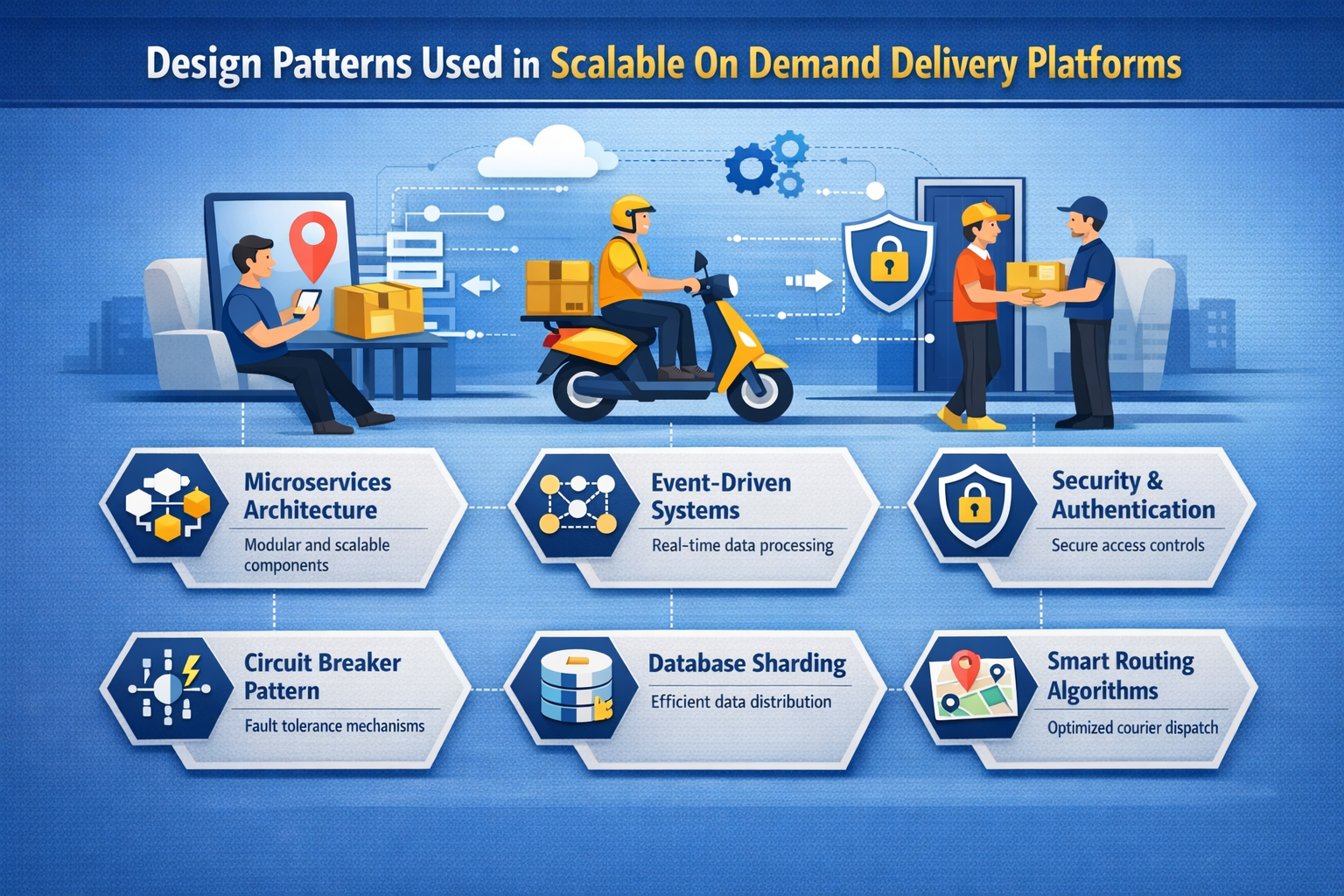
On demand delivery platforms have transformed logistics by enabling real time coordination between customers, couriers, and merchants. Behind their seamless user experience lies a sophisticated architectural foundation built to manage scale, reliability, and rapid feature deployment. Businesses investing in courier delivery app development must understand the design patterns that ensure high availability, fault tolerance, and operational efficiency. These patterns allow platforms to handle fluctuating demand, integrate with multiple services, and deliver consistent performance across diverse geographic regions.
Architectural Foundations for Scalable Delivery Apps
Scalable delivery systems are typically built on distributed architectures that separate concerns and reduce coupling. The foundation often combines cloud infrastructure, containerization, and service isolation to support horizontal scaling.
A typical architecture includes:
-
Client applications for customers, drivers, and administrators
-
API gateways for request routing and authentication
-
Backend services for order management, dispatch, payments, and notifications
-
Real time communication channels using WebSockets or streaming protocols
-
Cloud based storage and distributed databases
The transition from monolithic systems to modular architectures allows delivery platforms to scale components independently. For example, dispatch services may require aggressive scaling during peak hours, while reporting services may not. By isolating workloads, organizations improve system resilience and cost efficiency.
Moreover, robust logging, observability, and monitoring frameworks are embedded at the foundational level to maintain performance benchmarks and detect anomalies before they escalate.
Microservices Pattern in Logistics Platforms
The microservices pattern is one of the most widely adopted approaches in courier delivery app development. Instead of building a single, tightly coupled application, the system is divided into independently deployable services.
Each microservice is responsible for a distinct business capability, such as:
-
Order creation and validation
-
Courier allocation and tracking
-
Payment processing
-
Customer notifications
-
Analytics and reporting
This decomposition offers several advantages:
-
Independent deployment cycles
-
Technology stack flexibility
-
Improved fault isolation
-
Enhanced scalability per service
In high growth scenarios, microservices enable teams to iterate quickly without affecting unrelated components. For example, improving route optimization logic does not require redeploying the payment service.
However, microservices introduce operational complexity. Service discovery, distributed tracing, API versioning, and network latency management become critical considerations. Proper orchestration tools and container management platforms are essential to sustain reliability.
Event Driven Architecture for Real Time Operations
Delivery platforms operate in an event rich environment. Orders are placed, drivers accept assignments, payments are processed, and deliveries are completed. An event driven architecture ensures that these actions trigger automated responses across the system.
In this pattern, services communicate via events rather than direct synchronous calls. When a user places an order, an event is published to a message broker. Other services subscribe and react accordingly.
Core components include:
-
Message brokers or streaming platforms
-
Event producers and consumers
-
Event schemas and version control
-
Retry and dead letter mechanisms
This approach provides several benefits:
-
Loose coupling between services
-
Improved responsiveness
-
Enhanced scalability under high load
-
Greater system resilience
For example, once an order confirmation event is published, the notification service, dispatch engine, and billing service can process it simultaneously without blocking each other.
Event driven systems are particularly useful in pickup and delivery app development, where real time tracking, route adjustments, and instant notifications are essential for operational accuracy.
API Gateway and Backend for Frontend Pattern
Delivery ecosystems often support multiple client applications, including Android, iOS, web dashboards, and partner portals. Each interface may require different data formats and performance optimizations.
The API Gateway pattern centralizes request handling. It manages authentication, rate limiting, caching, and routing. This reduces redundancy across services and improves security.
Complementing the gateway is the Backend for Frontend pattern. Instead of one generic backend serving all clients, separate backend layers are tailored for specific frontends. For example:
-
A lightweight backend for driver applications
-
A feature rich backend for admin dashboards
-
A simplified backend for customer mobile apps
This segmentation ensures:
-
Optimized payload sizes
-
Reduced latency
-
Platform specific business logic handling
By implementing these patterns, organizations streamline mobile app development solutions that must support diverse user personas without compromising performance or maintainability.
Circuit Breaker and Resilience Design Pattern
In distributed systems, failures are inevitable. Network interruptions, third party API downtime, and database latency can disrupt service continuity. The circuit breaker pattern prevents cascading failures by monitoring service calls and halting requests when a failure threshold is exceeded.
The mechanism operates in three states:
-
Closed, where requests pass normally
-
Open, where calls are blocked due to repeated failures
-
Half open, where limited test calls determine recovery
This pattern improves reliability by:
-
Preventing resource exhaustion
-
Allowing fallback responses
-
Protecting dependent services
For instance, if a payment provider becomes unavailable, the system can temporarily queue transactions or switch to an alternative provider instead of overwhelming the failing endpoint.
Combined with retry policies, bulkhead isolation, and timeout strategies, circuit breakers form the backbone of fault tolerant architecture in high volume delivery platforms.
Database Sharding and Caching Strategies
Scalable delivery platforms generate large volumes of transactional and geospatial data. Efficient data management is essential to maintain performance.
Database sharding distributes data across multiple database instances. Instead of storing all orders in a single database, records are partitioned by region, customer ID, or time interval. This approach:
-
Reduces query latency
-
Prevents bottlenecks
-
Improves write throughput
Caching further enhances performance. Frequently accessed data such as courier availability or pricing rules can be stored in in memory caches. This minimizes repeated database queries and accelerates response times.
Common caching techniques include:
-
Read through caching
-
Write through caching
-
Time based cache invalidation
-
Distributed caching clusters
When estimating the cost to build delivery app infrastructure, organizations must consider database replication, failover mechanisms, and cache management systems, as these directly impact scalability and long term operational expenditure.
Strategy Pattern in Dispatch and Routing Logic
Dynamic dispatching is a critical component of delivery systems. Different business scenarios require different allocation algorithms. The Strategy pattern enables flexible selection of routing or assignment logic at runtime.
For example, dispatch strategies may include:
-
Nearest courier assignment
-
Zone based distribution
-
Priority based allocation
Batch delivery optimization
Instead of embedding all algorithms in a single conditional block, the Strategy pattern encapsulates each approach into separate classes or modules. The system selects the appropriate strategy based on predefined rules.
Benefits include:
-
Cleaner code structure
-
Simplified algorithm updates
-
Easier experimentation and optimization
-
Reduced risk of regression
This pattern is especially relevant for white label delivery app deployments, where clients may require customized dispatch workflows without altering the core architecture.
Security and Authentication Design Patterns
Security is fundamental in on demand delivery platforms, which handle payment information, personal data, and location tracking. Several design patterns and architectural practices strengthen system protection.
Key mechanisms include:
-
Token based authentication
-
Role based access control
-
API throttling and rate limiting
-
End to end encryption
The use of centralized authentication services simplifies identity management across microservices. Access tokens validate user sessions, while granular permission models restrict sensitive operations.
Data encryption ensures confidentiality during transmission and storage. Additionally, audit logging and anomaly detection systems help monitor suspicious behavior.
In courier delivery app development, secure architecture must also address device level risks. Secure storage of tokens, certificate pinning, and protection against reverse engineering are essential to prevent unauthorized access.
By integrating security patterns at every layer, organizations mitigate operational risks and comply with regulatory requirements across jurisdictions.
Conclusion
Scalable on demand delivery platforms rely on carefully selected design patterns to manage complexity, performance, and resilience. From microservices and event driven systems to circuit breakers and sharding strategies, each pattern addresses specific architectural challenges. When implemented cohesively, these approaches create flexible, fault tolerant systems capable of handling rapid growth and fluctuating demand. A deep understanding of these patterns enables technical teams to design delivery ecosystems that remain stable, secure, and adaptable in an increasingly competitive logistics landscape.

 English
 Arabic
 French
 Spanish
 Portuguese
 Deutsch
 Turkish
 Italiano
 Russian
 Romaian
 Portuguese (Brazil)
 Greek
Greek