


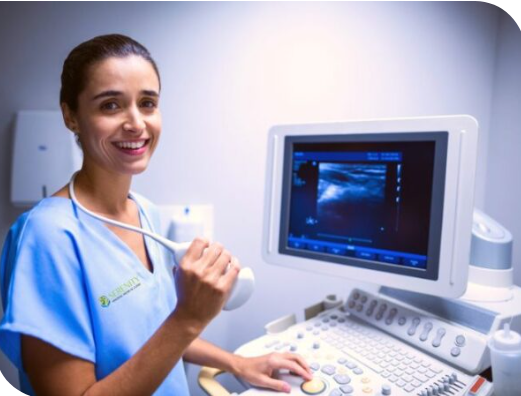
Ultrasound technology has come a long way since its early beginnings. What started as a basic diagnostic tool for obstetrics has now evolved into a sophisticated technology used across numerous medical specialties. Today’s ultrasound services offer real-time imaging, advanced tissue characterization, AI-enabled analysis, and interventional guidance — transforming patient care in ways that once seemed impossible.
In this article, we’ll take you through the evolution of ultrasound, how its applications expanded beyond traditional diagnostic imaging, and where the technology is headed next.
Origins and Growth of Ultrasound in Medicine
Medical use of ultrasound began in the mid-20th century, sparked by early research into how sound waves interact with tissue. The first clinical applications focused on obstetric imaging, allowing physicians to observe a developing fetus without invasive procedures. This quickly proved invaluable and laid the foundation for broader use in diagnostic imaging.
Advancements in the 1960s and 1970s expanded ultrasound’s role to abdominal, cardiac, and vascular imaging. The introduction of real-time B-mode imaging allowed clinicians to view moving structures like the beating heart — a breakthrough that expanded clinical applications significantly.
By the 1980s, innovations such as Doppler ultrasound, which analyzes blood flow, and color imaging brought new dimensions to ultrasound diagnostics. These developments enhanced the ability of physicians to evaluate circulatory conditions and tissue function noninvasively — a major milestone in the evolution of ultrasound services.
Ultrasound Today: A Cornerstone of Modern Diagnostic Imaging
In modern clinical practice, ultrasound remains one of the most widely used imaging modalities — and for good reasons. Unlike CT or MRI, ultrasound doesn’t use ionizing radiation, making it a safer option for repeated use, especially in obstetrics and pediatric medicine. It’s also relatively fast, cost-effective, and capable of providing dynamic, real-time images during examinations.
Ultrasound services today encompass a broad range of studies, including:
-
Abdominal and pelvic imaging
-
Obstetric and gynecologic scans
-
Cardiac echocardiography
-
Musculoskeletal evaluation
-
Vascular and blood flow analysis
-
Guided interventional procedures
-
Breast and thyroid imaging
Clinics offering ultrasound services, such as those listed on Why Wait Imaging Inc.’s services page, use high-frequency sound waves to generate images that help diagnose conditions ranging from gallbladder disease to soft tissue abnormalities.
Advancements That Transformed Ultrasound Services
Ultrasound technology has advanced well beyond basic 2D imaging. Several innovations have reshaped how clinicians diagnose and treat patients:
3D and 4D Ultrasound Imaging
While traditional ultrasound produces 2D cross-sectional images, 3D ultrasound reconstructs structures in three dimensions, offering more detailed visualization. 4D ultrasound adds the element of real-time movement, making it especially useful in obstetrics, cardiology, and complex anatomical assessments.
These technologies enhance diagnostic confidence and patient communication by enabling clinicians and patients to see more clearly than ever before.
Elastography
Elastography measures tissue stiffness, which can be an important marker for diseases such as liver fibrosis, breast cancer, and thyroid nodules. This technique expands the diagnostic power of traditional ultrasound by adding quantitative data that helps differentiate between benign and malignant conditions.
Contrast-Enhanced Ultrasound (CEUS)
Contrast-enhanced ultrasound uses microbubble agents to improve the visualization of blood flow and tissue perfusion. CEUS is especially valuable for characterizing liver masses and vascular conditions, providing a radiation-free alternative to contrast imaging used with CT and MRI.
Artificial Intelligence and Machine Learning
AI-assisted ultrasound services are rapidly emerging to enhance image interpretation and reduce operator dependency. Algorithms trained on large datasets can help identify anomalies, automate measurements, and assist clinicians in spotting subtle patterns that might otherwise go unnoticed.
AI is particularly promising for point-of-care settings where non-specialist clinicians can benefit from decision support tools to improve accuracy and consistency.
Clinical and Interventional Applications
The expanded capabilities of ultrasound have led to its use in diverse clinical settings:
Cardiology
Echocardiography remains a pillar of ultrasound services, providing detailed assessments of heart structure and function. Real-time imaging guides treatment decisions in heart disease, valve disorders, and congenital abnormalities.
Obstetrics and Gynecology
Ultrasound is synonymous with prenatal care. Its ability to visualize the developing fetus, monitor growth, detect anomalies, and guide procedures makes it indispensable in maternal health. The improved clarity of 3D/4D imaging also enhances bonding between parents and babies.
Emergency and Critical Care
Point-of-care ultrasound (POCUS) has revolutionized emergency medicine. Clinicians can rapidly assess trauma patients, monitor fluid status, or evaluate cardiac function at the bedside — without waiting for formal imaging. This has made ultrasound services an essential tool in critical care environments.
Intervention Guidance
Ultrasound serves as a guide in procedures like biopsies, drainages, and injections, offering real-time visualization that improves precision and safety. These interventional uses reduce procedure times and minimize patient discomfort compared with blind techniques.
Portable and Point-of-Care Ultrasound
Miniaturization has introduced handheld ultrasound devices that bring imaging to the bedside, rural clinics, and global health settings where traditional imaging equipment may not be available. These portable tools extend the reach of ultrasound services to underserved populations and emergency scenes.
The portability and accessibility of these devices reflect a broader trend toward democratizing healthcare — making sophisticated imaging more widely available and reducing barriers to early diagnosis.
Future Directions in Ultrasound Services
Looking forward, ultrasound continues to evolve with new technologies on the horizon:
Super-Resolution Imaging
Technologies such as Ultrasound Localization Microscopy (ULM) aim to achieve ultra-high resolution, enabling imaging at scales previously only possible with MRI or CT, particularly valuable in vascular disease assessment.
AI-Augmented Diagnostics
Emerging AI platforms may soon interpret complex scans autonomously or in real time, helping clinicians detect conditions such as early cancers, cardiovascular disease, or subtle musculoskeletal injuries.
Therapeutic Ultrasound
Beyond diagnostics, ultrasound is increasingly used therapeutically — for example in high-intensity focused ultrasound (HIFU), which targets and ablates tumors without surgery.
These advancements promise to make ultrasound services even more effective, accessible, and integrated into everyday clinical workflows.
The Role of Ultrasound Providers Today
Clinics such as Why Wait Imaging Inc. offer a range of ultrasound services — including abdominal, pelvic, obstetrical, breast, and musculoskeletal imaging — using the latest technology and expert interpretation.
For patients seeking timely, reliable imaging results, access to providers who offer up-to-date ultrasound services is critical to effective diagnosis and care planning — especially when combined with other diagnostic modalities like MRI or CT.
Conclusion: More Than Sound Waves
Ultrasound has evolved from a basic pregnancy scan into a powerful, multi-faceted tool in modern medicine. It remains a cornerstone of medical imaging — fast, safe, non-invasive, and increasingly capable across diagnostic and interventional applications. As technology continues to advance, ultrasound services will only grow in clinical significance, shaping the future of patient-centered care.
Whether you’re seeking routine imaging or advanced clinical evaluation, understanding how ultrasound has evolved helps you appreciate its value in modern healthcare — today and tomorrow.

 English
 Arabic
 French
 Spanish
 Portuguese
 Deutsch
 Dutch
Dutch
 Italiano
 Russian
 Romaian
 Portuguese (Brazil)
 Greek
Greek