


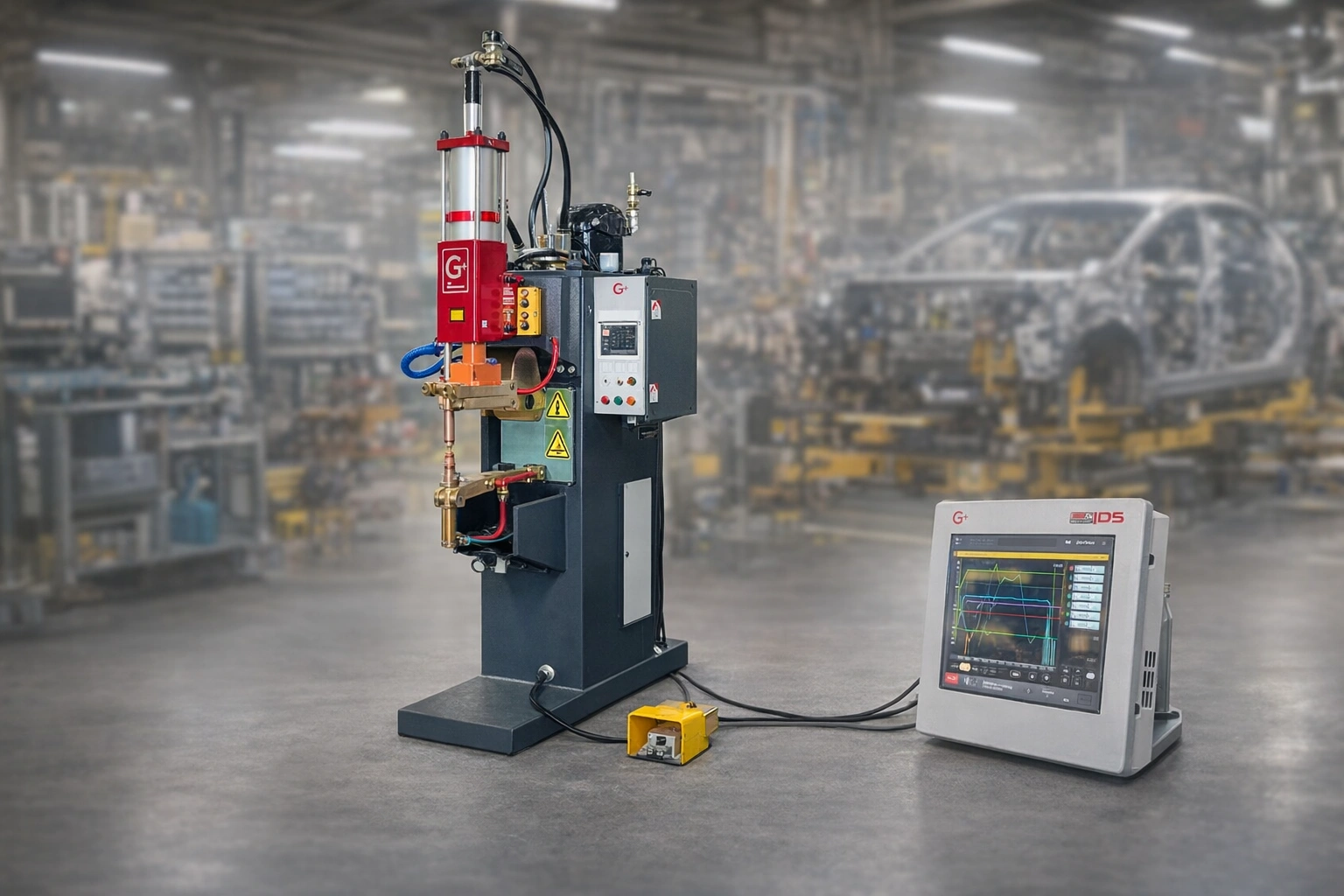
In today’s fast-paced industrial landscape, manufacturers are increasingly turning to advanced welding technologies to improve efficiency, consistency, and product quality. Among these technologies, the aluminum spot welder stands out as a critical tool for joining aluminum and lightweight alloys in automotive, aerospace, electronics, and industrial applications.
Heron Welder, a global leader in industrial welding solutions, offers a comprehensive range of resistance welding machines, including spot, projection, seam, MFDC, and capacitor discharge welders, as well as automation-ready welding guns and controllers. With decades of expertise, Heron provides manufacturers with reliable, high-performance aluminum spot welding solutions tailored to complex production demands.
What is an Aluminum Spot Welder?
An aluminum spot welder is a specialized resistance welding machine designed to join aluminum sheets and components through localized heat generated by electric current. Unlike steel, aluminum has high thermal and electrical conductivity, which requires precise current control, electrode pressure, and welding time to achieve strong, defect-free welds.
Key components of an aluminum spot welder include:
-
Electrodes: Copper alloy electrodes designed for high conductivity and durability.
-
Power supply: MFDC (Medium Frequency Direct Current) or AC/DC transformer-based units to deliver controlled welding currents.
-
Control systems: Microprocessor or PLC-based controllers to manage welding parameters, timing, and quality monitoring.
Heron’s aluminum spot welders are engineered to ensure repeatable, high-quality welds with minimal maintenance, making them ideal for both manual and fully automated production lines.
Principles of Aluminum Spot Welding
The process of aluminum spot welding relies on resistance heating:
-
Current Flow: An electric current passes through the overlapping aluminum sheets at the contact point.
-
Heat Generation: Resistance at the metal interface generates heat, melting the metal locally.
-
Pressure Application: Electrodes apply pressure to fuse the molten aluminum, forming a robust spot weld.
-
Cooling: Once the current is stopped, the weld solidifies under pressure, creating a strong joint.
Because aluminum dissipates heat faster than steel, modern aluminum spot welders, like those from Heron, often use MFDC technology. This allows precise control over current and pulse duration, reducing the risk of electrode sticking, expulsion, or weak welds.
Applications of Aluminum Spot Welding
Aluminum spot welding is widely used across industries where lightweight, high-strength assemblies are required:
-
Automotive Manufacturing: Body panels, battery packs for electric vehicles, and chassis components.
-
Aerospace: Aircraft panels, frames, and fuselage assemblies.
-
Electronics: Heat sinks, housings, and enclosures for electrical components.
-
Industrial Fabrication: Lightweight frames, enclosures, and sheet-metal assemblies.
Heron Welder’s solutions are designed to integrate seamlessly into automated production lines, providing high throughput, consistent quality, and minimal downtime, which is critical for OEMs and contract manufacturers.
Aluminum Spot Welding vs. Steel Spot Welding
Aluminum and steel spot welding differ in key ways due to the material properties:
| Feature | Aluminum Spot Welding | Steel Spot Welding |
|---|---|---|
| Electrical Conductivity | High – requires higher current and precise control | Moderate – standard AC/DC welding sufficient |
| Thermal Conductivity | High – rapid heat dissipation | Lower – heat concentrated at weld |
| Electrode Wear | Faster – requires copper alloy electrodes | Slower – standard electrodes suffice |
| Welding Challenges | Risk of burn-through, sticking, and porosity | Less risk, more forgiving process |
| Process Control | MFDC or advanced AC control recommended | AC transformer-based machines often sufficient |
By understanding these differences, manufacturers can optimize production parameters and achieve consistent, high-strength aluminum welds.
Best Practices for Aluminum Spot Welding
To maximize weld quality and minimize downtime, consider the following best practices:
-
Electrode Maintenance: Regularly dress and clean electrodes to prevent sticking and maintain weld consistency.
-
Optimal Welding Parameters: Use Heron’s advanced controllers to fine-tune current, pressure, and time for each aluminum thickness.
-
Surface Preparation: Remove oxide layers and contaminants to ensure strong welds.
-
Cooling Management: Implement appropriate cooling cycles to prevent overheating and warping.
-
Automation Integration: Utilize Heron’s automated welding guns and production lines for high-volume, repeatable welds.
Following these practices helps extend electrode life, reduce rejects, and maintain high production efficiency.
Why Choose Heron for Aluminum Spot Welding?
Heron Welder has established itself as a trusted partner for industrial manufacturers worldwide. The company offers:
-
Comprehensive Product Range: Spot welders, seam welders, capacitor discharge systems, and FSPR solutions.
-
Automation Expertise: Fully integrated production lines for high-volume, precision welding.
-
Customized Solutions: Tailored machines and controllers to meet unique material and assembly requirements.
-
Global Support Network: Technical assistance, training, and maintenance services to ensure smooth operations.
By choosing Heron, manufacturers gain access to innovative technology and expert guidance, reducing production risk and improving overall weld quality.
FAQs About Aluminum Spot Welders
Q1: Can aluminum spot welders handle different thicknesses of aluminum sheets?
A1: Yes. Modern MFDC welders from Heron allow precise control of welding parameters, accommodating a wide range of thicknesses.
Q2: How often should electrodes be maintained?
A2: Electrode maintenance depends on production volume and material type. For aluminum, regular cleaning and dressing are recommended to prevent sticking and ensure consistent welds.
Q3: Are aluminum spot welders compatible with automation?
A3: Absolutely. Heron designs welders and welding guns for integration into robotic and conveyor-based production lines.
Q4: What industries benefit most from aluminum spot welding?
A4: Automotive, aerospace, electronics, and industrial fabrication industries rely heavily on aluminum spot welding for lightweight, strong assemblies.
Q5: How does Heron ensure weld quality?
A5: Heron welders feature advanced controllers, real-time monitoring, and optional integration with production data systems to ensure consistent, defect-free welds.
Conclusion
An aluminum spot welder is essential for manufacturers aiming to optimize production, reduce material waste, and achieve high-strength, lightweight assemblies. By leveraging Heron Welder’s advanced resistance welding technology, precision controllers, and automation-ready systems, factories can maintain peak efficiency and superior quality.
For manufacturers, OEMs, and automation integrators seeking tailored aluminum spot welding solutions, contact Heron today to request a quote or consult on customized welding and automation systems that elevate your production line performance.

 Arabic
 French
 Spanish
 Portuguese
 Deutsch
 Turkish
 Dutch
Dutch
 Italiano
 Russian
 Romaian
 Portuguese (Brazil)
 Greek
Greek