


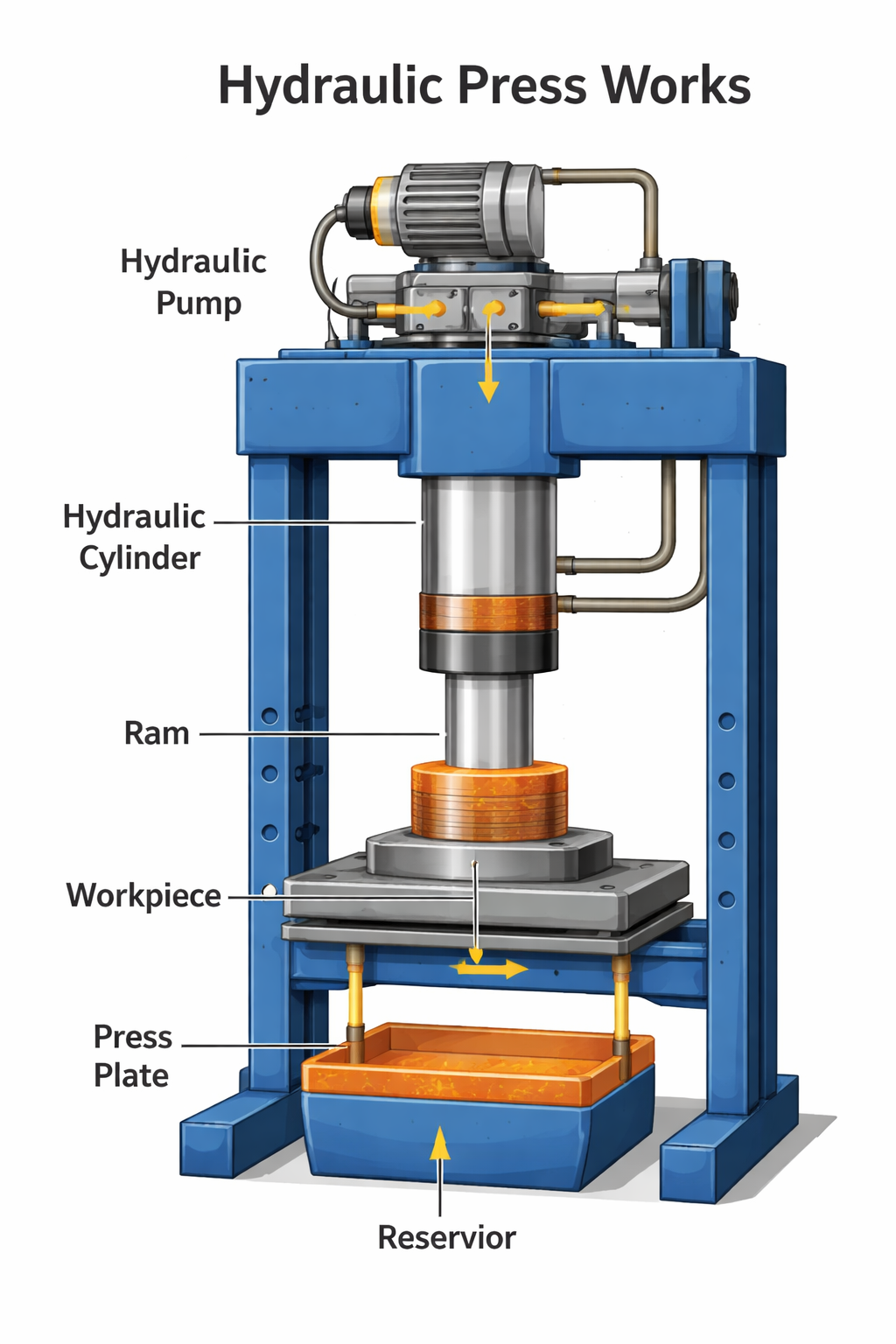
A hydraulic press is one of the most powerful and widely used machines in modern industry. From metal forming and automotive manufacturing to recycling and heavy equipment repair, the hydraulic press machine plays a critical role across the United States. But how exactly does it work?
This beginner-friendly guide explains the working principle, components, and applications of a heavy duty hydraulic press machine in simple terms.
What Is a Hydraulic Press?
A hydraulic press is a machine that uses hydraulic pressure to generate compressive force. It is designed to shape, bend, mold, stamp, or compress materials like metal, plastic, rubber, and composite materials.
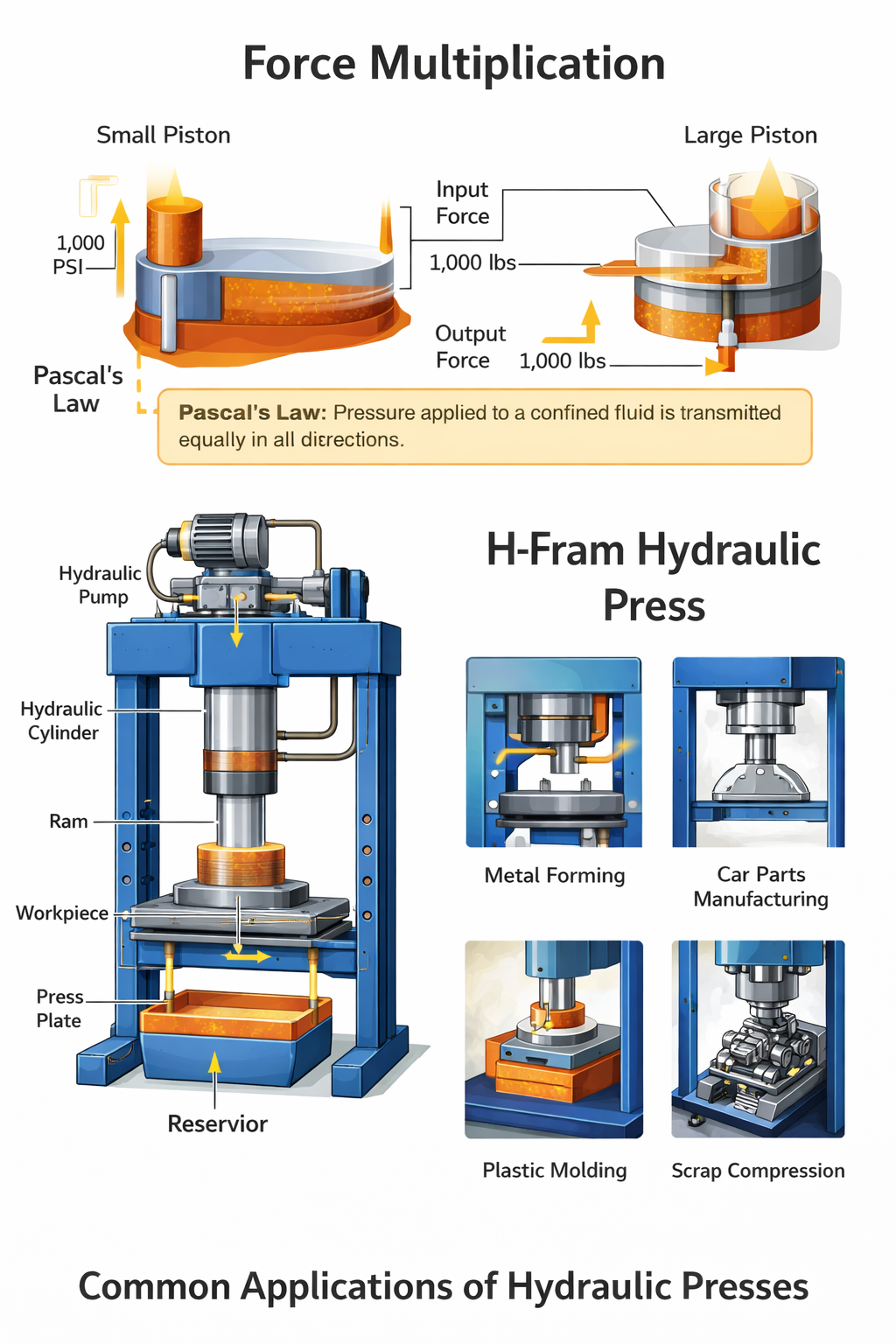
Hydraulic presses operate using a principle developed by Blaise Pascal, which states that pressure applied to a confined fluid is transmitted equally in all directions. This principle allows the machine to multiply force efficiently.
Main Components of a Hydraulic Press Machine
A typical hydraulic press machine includes:
-
Hydraulic pump – Moves hydraulic fluid into the system
-
Hydraulic cylinder – Contains a piston that creates motion
-
Hydraulic fluid (oil) – Transfers pressure
-
Press frame – Supports the structure and withstands force
-
Control valves – Regulate pressure and direction
-
Ram or platen – Applies force to the material
How Do Hydraulic Presses Work? (Step-by-Step)
Step 1: Power Activation
An electric motor powers the hydraulic pump.
Step 2: Fluid Movement
The pump pushes hydraulic oil into the hydraulic cylinder.
Step 3: Pressure Creation
As the oil enters the cylinder, pressure builds because the liquid cannot be compressed.
Step 4: Force Multiplication
The press uses two pistons: a smaller one and a larger one. When pressure is applied to the smaller piston, it creates a much greater force on the larger piston.
Step 5: Material Compression
The ram moves downward, applying controlled pressure to the material placed between the press plates.
This simple yet powerful process allows a heavy duty hydraulic press machine to generate tons of force with precision and control.
Types of Hydraulic Press Machines
In the United States, several types of hydraulic presses are commonly used:
-
H-frame hydraulic press – Ideal for repair shops and small industries
-
C-frame press – Compact design for lighter applications
-
Four-column press – Used for heavy-duty industrial operations
-
Bench press models – Suitable for smaller tasks
Heavy-duty models can produce force ranging from 20 tons to over 1,000 tons, depending on the application.
Applications in U.S. Industries
Hydraulic presses are widely used across various sectors:
-
Automotive industry – Metal stamping and forming car parts
-
Manufacturing plants – Sheet metal bending and molding
-
Aerospace industry – Precision component forming
-
Recycling industry – Compressing scrap materials
-
Construction equipment repair – Bearing and shaft installation
The heavy duty hydraulic press machine is especially popular in large-scale industrial facilities where high force and durability are required.
Advantages of Hydraulic Press Machines
A hydraulic press offers several benefits:
-
High force generation
-
Smooth and controlled operation
-
Adjustable pressure settings
-
Durable and long-lasting performance
-
Lower maintenance compared to mechanical presses
These advantages make hydraulic presses a preferred choice for U.S. industrial operations.
Final Thoughts
So, how do hydraulic presses work? In simple terms, a hydraulic press uses pressurized hydraulic fluid to multiply force and compress materials with precision. Thanks to Pascal’s principle, even a relatively small input force can generate massive output power.
Whether you are operating a small workshop or managing a large industrial facility, understanding how a hydraulic press machine works helps improve safety, efficiency, and productivity. For heavy manufacturing environments, a heavy duty hydraulic press machine delivers the strength and reliability required to handle demanding industrial applications across the United States.
FAQs
Q1: What is a hydraulic press used for?
A hydraulic press is used for shaping, bending, compressing, and molding materials such as metal, plastic, and rubber. It is widely used in automotive manufacturing, metal fabrication, recycling, and industrial repair applications across the United States.
Q2: How does a hydraulic press machine generate force?
A hydraulic press machine generates force using hydraulic pressure. When hydraulic fluid is pushed into a cylinder, it creates pressure that moves a piston. Based on Pascal’s principle, this pressure multiplies force and allows the machine to produce high compressive power.
Q3: What is a heavy duty hydraulic press machine?
A heavy duty hydraulic press machine is designed for high-tonnage applications. These machines can produce forces ranging from 100 tons to over 1,000 tons, making them ideal for industrial manufacturing and large-scale metal forming operations.
Q4: Is a hydraulic press better than a mechanical press?
Hydraulic presses provide smoother operation, adjustable pressure control, and consistent force throughout the stroke. Mechanical presses are faster but may not offer the same level of control and flexibility.
Q5: How much pressure can a hydraulic press produce?
The pressure depends on the design and capacity of the machine. Industrial hydraulic presses can generate anywhere from 20 tons to several thousand tons of force, depending on the application.
Read More Blogs:
Hidden World of Hydraulics | Systems Powered by Fluid Power
Understanding Hydraulic Connectors: Types & Applications

 Arabic
 French
 Spanish
 Portuguese
 Deutsch
 Turkish
 Dutch
Dutch
 Italiano
 Russian
 Romaian
 Portuguese (Brazil)
 Greek
Greek