


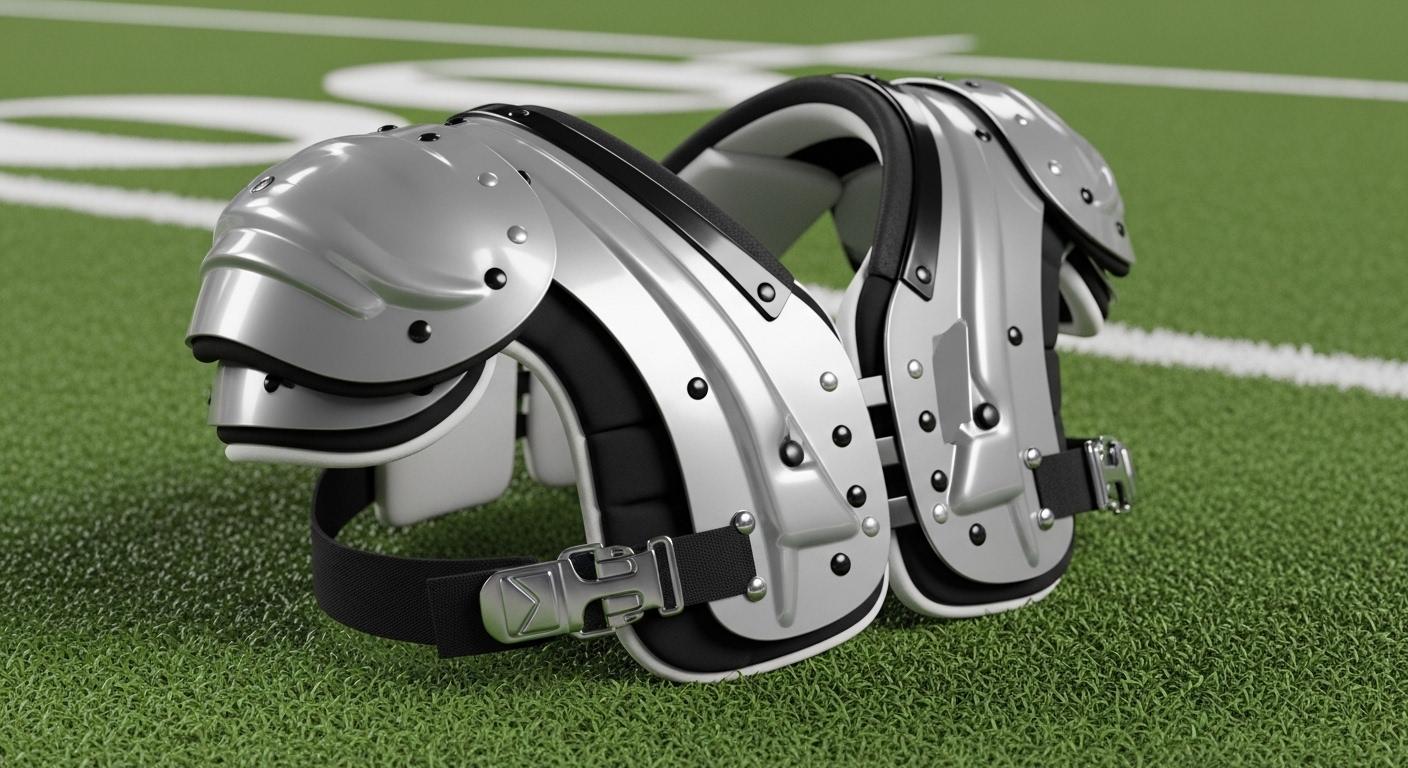
The evolution of football protective equipment has been marked by a continuous tension between safety and performance. Nowhere is this more evident than in shoulder pads designed for skill positions, where the demands of speed, agility, and unrestricted movement must coexist with adequate protection against high-velocity impacts. Modern skill position shoulder pads represent a triumph of materials science and biomechanical engineering, utilizing advanced lightweight materials and precisely engineered flex points to achieve performance levels that were unimaginable just a decade ago.
Understanding how these two elements—material innovation and strategic flexibility—work together reveals the sophisticated engineering that enables today's elite athletes to perform at their highest level while maintaining essential protection. The synergy between lightweight construction and intelligent flex point placement defines the cutting edge of skill position equipment design.
The Materials Revolution in Football Protective Equipment
Traditional football shoulder pads relied heavily on rigid plastics, dense foam padding, and steel hardware—materials chosen primarily for protective capacity with minimal consideration for weight optimization. A conventional shoulder pad from the 1990s might weigh 4-5 pounds, with much of that mass concentrated in bulky shells and thick padding systems.
The materials revolution began with the introduction of advanced polymers and composite materials borrowed from aerospace and automotive industries. Carbon fiber composites, initially developed for aircraft components, offer strength-to-weight ratios approximately five times better than traditional plastics used in sports equipment. A carbon fiber shoulder cap provides equivalent impact resistance to conventional plastic while weighing 60% less.
Tag Sports Gear and leading manufacturers have progressively adopted these advanced materials, driving dramatic weight reductions without compromising protective performance. Modern elite skill position shoulder pads typically weigh 1.5-2.5 pounds—a reduction of 50-65% compared to traditional designs. This weight savings translates directly to measurable performance improvements in acceleration, endurance, and agility.
Kevlar, the material famous for bulletproof vest applications, has found its way into strategic reinforcement zones in premium shoulder pads. Its exceptional tensile strength allows for thin, lightweight reinforcement layers that protect against cutting and abrasion while adding minimal weight. Some advanced designs incorporate Kevlar mesh in high-wear areas, dramatically extending equipment lifespan without increasing bulk.
Polymer Science and Impact-Responsive Materials
Beyond structural components, the padding materials in modern skill position shoulder pads represent significant advances in polymer chemistry. Traditional foam padding used simple polyurethane or polyethylene formulations that provided cushioning through uniform compression. These materials worked adequately but required substantial thickness to absorb high-energy impacts, adding unwanted bulk.
Contemporary padding systems employ dual-response polymers that behave differently under varying force levels. During normal movement and low-force contact, these materials remain soft and flexible, compressing easily to allow unrestricted motion. Under high-velocity impact, the same materials instantly stiffen through a process called shear-thickening, creating a rigid protective barrier that absorbs and disperses impact energy.
This transformation occurs at the molecular level. Shear-thickening polymers contain particle suspensions that flow freely under low stress but jam together under rapid force application, creating temporary solid-like behavior. The effect reverses immediately after impact, returning the material to its flexible state. This dynamic response allows padding to be significantly thinner than traditional foams while providing equivalent or superior protection during actual impacts.
Memory foam technology, adapted from NASA developments for aircraft cushioning, features in premium skill position pads. These viscoelastic materials conform to body contours during wear, creating custom fit that improves comfort and ensures consistent pad positioning. Upon impact, memory foam compresses to absorb energy, then slowly returns to original shape—a property that provides excellent protection against repeated impacts in quick succession.
Strategic Flex Point Engineering
Even with the lightest materials, completely rigid shoulder pads would severely restrict the range of motion that skill position players require. The solution lies in strategically engineered flex points—specific locations where the pad structure is designed to bend preferentially, allowing movement in desired directions while maintaining protective integrity.
Flex point engineering begins with biomechanical analysis of natural shoulder movement. The human shoulder complex moves through three primary planes: flexion/extension (forward and backward), abduction/adduction (out to the side and back in), and internal/external rotation (twisting). Skill position athletes must achieve near-complete range of motion in all planes to perform their athletic functions effectively.
Modern skill position shoulder pads incorporate flex points aligned with these natural movement axes. The juncture between shoulder cap and chest plate, for instance, features engineered flexibility that allows the arm to move forward during reaching and catching motions without fighting against rigid equipment. The material in this zone might be thinner, use a more flexible polymer composition, or incorporate actual hinges that permit controlled bending.
Back plate flex points allow torso rotation essential for running mechanics, throwing motions, and looking over shoulders during play. These are typically placed along the spine at strategic vertebral levels where the torso naturally flexes during rotation. The engineering challenge involves providing enough flexibility for unrestricted movement while maintaining sufficient rigidity to protect the spine during impacts from behind.
Articulated Architecture and Joint Systems
Advanced skill position shoulder pads employ articulated designs where protective elements move semi-independently rather than forming a rigid shell. This architecture mimics the natural articulation of the human skeleton, allowing the equipment to move with the body rather than against it.
Shoulder caps in articulated systems attach to the main pad structure through pivot points or flexible joints. As the athlete raises their arm, the shoulder cap rotates upward, maintaining protective coverage over the AC joint and deltoid while not restricting the arm's upward motion. Without this articulation, the rigid shoulder cap would contact the helmet or restrict overhead reach—a critical limitation for positions that catch passes or defend them.
The chest and back plates in premium designs feature segmented construction where multiple protective panels connect through flexible materials rather than rigid bonds. This segmentation allows the pad to flex along multiple axes, conforming to body movements during complex athletic maneuvers. The protective panels can shift slightly relative to each other, preventing the rigid binding that occurs when continuous shells resist body flexion.
Hardware systems connecting different pad components increasingly use elastic elements that allow controlled movement between parts. Rather than rigid bolts or snaps that lock components in fixed positions, elastic connectors permit several degrees of freedom while maintaining overall structural integrity. This approach provides flexibility without the sloppiness that would occur if components were completely independent.
Material Integration and Multi-Component Construction
The most advanced skill position shoulder pads don't rely on a single material solution but rather integrate multiple specialized materials, each optimized for specific functions within the overall system. This multi-material approach allows engineers to maximize the strengths of different materials while minimizing their limitations.
A typical premium pad might use carbon fiber for the primary arch and load-bearing structures where strength-to-weight ratio is paramount. Kevlar reinforcement appears in areas subject to abrasion and repetitive stress. Advanced polymers form the protective caps and shells where impact resistance is critical. Memory foam and gel systems provide padding in contact zones. Mesh fabrics ensure ventilation. Each material selection serves a specific engineering purpose.
The challenge in multi-material construction involves creating reliable bonds between dissimilar materials. Carbon fiber doesn't bond well to traditional foams using conventional adhesives, for example. Manufacturers employ specialized bonding agents, mechanical interlocking designs, and advanced manufacturing techniques like co-molding (forming different materials simultaneously so they bond during the manufacturing process) to create durable multi-material assemblies.
Thermoplastic elastomers (TPEs) often serve as transition materials between rigid and flexible zones. These materials combine properties of plastics and rubbers, providing good strength while maintaining flexibility. TPE components can bond effectively to both rigid shells and soft padding, creating smooth transitions between hard and soft protection zones that eliminate uncomfortable edges and maintain flexibility across material boundaries.
Ventilation and Thermal Management Through Material Selection
Lightweight materials provide an additional often-overlooked benefit: improved thermal management. Dense traditional materials create insulation that traps body heat, contributing to elevated core temperatures during intense activity. Lighter advanced materials typically have lower thermal mass and conductivity, reducing heat retention.
Many modern skill position shoulder pads incorporate perforated composite panels where the structural material itself contains strategically placed holes. These perforations reduce weight while creating ventilation channels that allow heat and moisture to escape. The engineering involves calculating perforation size and placement to maximize ventilation without compromising structural strength—too large or too many holes and the panel weakens; too small or too few and ventilation benefit disappears.
Mesh integration extends beyond just fabric components to include mesh-reinforced structural elements. Some manufacturers produce composite panels where carbon fiber or fiberglass reinforcement is embedded in mesh rather than solid sheets. This approach maintains strength along fiber paths while leaving open spaces between fibers for airflow. The result is structural components that are simultaneously strong, lightweight, and ventilated.
Moisture-wicking materials in padding layers actively pull sweat away from skin, spreading it across larger surface areas where evaporation can occur more efficiently. Advanced synthetic fabrics designed for this purpose can transport moisture several times faster than traditional materials, dramatically improving comfort during extended wear in hot conditions. For skill position players operating at maximum intensity throughout games, this thermal management directly impacts performance by delaying fatigue onset.
Durability Considerations in Lightweight Construction
One legitimate concern with lightweight materials is whether they maintain protective properties and structural integrity through the punishment of entire seasons. Advanced materials can indeed be more fragile than overbuilt traditional designs, requiring careful engineering to ensure adequate durability.
Carbon fiber, while extremely strong in tension and compression, can be vulnerable to impact damage if not properly reinforced. Manufacturers address this through hybrid constructions that combine carbon fiber with impact-resistant polymers in protective outer layers. The carbon provides structural strength while the polymer layer absorbs localized impacts that might otherwise crack the carbon.
Fatigue resistance—the ability to withstand repeated stress cycles without failure—is critical for equipment that experiences hundreds of impacts over a season. Advanced materials undergo extensive fatigue testing where they're subjected to thousands of impact cycles simulating multiple seasons of use. Materials that show degradation or failure before reaching minimum cycle counts are rejected in favor of more durable alternatives.
Protective coatings extend the lifespan of lightweight materials. UV-resistant coatings prevent degradation from sun exposure during outdoor practices and games. Abrasion-resistant coatings protect surface finishes from the grinding wear that occurs during ground contact and collisions with other equipment. These coatings add minimal weight while substantially extending usable equipment life.
The Future of Materials and Flex Point Innovation
Materials science continues advancing, with promising technologies on the horizon that will further optimize skill position shoulder pads. Graphene, a carbon-based material with exceptional strength-to-weight properties, shows promise for next-generation protective equipment. Early prototypes demonstrate graphene-reinforced panels that are lighter than current carbon fiber solutions while providing superior impact resistance.
Self-healing polymers that automatically repair minor damage represent another frontier. These materials contain microcapsules of repair agents that rupture when the material cracks, filling the damage with bonding compounds that restore structural integrity. For shoulder pads that undergo repeated minor impacts that could eventually lead to material degradation, self-healing technology could substantially extend equipment lifespan.
Smart materials that actively respond to impacts are under development. These systems incorporate sensors that detect incoming impacts and trigger rapid stiffening responses in protective materials, creating enhanced protection precisely when and where needed. While current implementations face challenges with power sources and complexity, the concept holds promise for future equipment generations.
Conclusion
The sophisticated interplay between lightweight materials and engineered flex points defines modern skill position shoulder pads as marvels of sports equipment engineering. Through carbon fiber composites, advanced polymers, impact-responsive foams, and strategic flexibility zones, contemporary designs achieve the seemingly contradictory goals of comprehensive protection and unrestricted mobility.
For athletes competing at high levels where marginal performance advantages determine success, equipment optimized through these advanced materials and engineering approaches provides measurable competitive benefits. As materials science continues evolving and our understanding of biomechanics deepens, skill position shoulder pads will continue advancing, enabling future generations of athletes to perform at levels that push the boundaries of human athletic potential while maintaining the protection necessary for safe participation in football's demanding environment.

 English
 Arabic
 French
 Spanish
 Portuguese
 Deutsch
 Dutch
Dutch
 Italiano
 Russian
 Romaian
 Portuguese (Brazil)
 Greek
Greek